Unit 1, Section B
The material on this page is designed to help you with revision and preparation for your CCEA GCSE English Language exams. It applies to Unit 1, Section B: Reading to access non-fiction and media texts.
- Unit 1 is assessed by a written exam, worth 30% of your final mark
- There are four tasks (numbered 2, 3, 4 and 5) in Section B of the Unit 1 exam, worth 63 of the 150 marks available
- In tasks two and three, you will be given two extracts from a non-fiction text
- In tasks four and five, you will be given a single media text
- For all four tasks, you will be expected to demonstrate your ability to analyse writers’ language choices, interpret their ideas and explain and evaluate how linguistic, grammatical and structural features are used to influence the reader
You can practice for your English Language GCSE exams with a range of CCEA past papers and mark schemes.
INTERIM SPECIFICATION – NOTE FOR YEAR 11 PUPILS
If you are in Year 12 and completing your CCEA English Language GCSE in summer 2027, the above information is correct.
However, if you're in Year 11 and began studying for your CCEA English Language GCSE in September 2026, an interim specification has been introduced.
The external written exam for Unit 1 will now be worth 40% of your final mark.
Key points about non-fiction purpose and audience
- Writers create texts to achieve effects such as informing, persuading, entertaining or explaining
- A single text can have more than one purpose, like both informing and persuading
- Writers think about their intended audience and adjust language, tone and layout to suit them
- You can spot a text’s purpose and intended audience by looking at its content, tone, structure and word choices
- The TAP method - Text type, Audience, Purpose - helps you analyse non-fiction texts effectively
What does the purpose of a text mean?
Think ‘TAP’ when looking at a Writing that is factual rather than invented or imaginary. text:
- Text type
- Audience
- Purpose
A writer has an aim when writing a text – they want to have an How the writer wants the reader to think, feel, imagine and respond. on their reader.
A text can have many purposes. Some examples are to:
- entertain – to amuse the reader or make them enjoy reading the text
- persuade – to influence the viewpoint of the reader - these texts may be Prejudice or favour shown for one person, group, thing or opinion over another.
- advise – to help people decide what to do - these texts may give ideas and options
- analyse – to break down something to help people to understand it better
- argue – to make the case for something - these texts may be one-sided
- describe – to give precise details about a person, place, object or experience
- explain – to make clear ‘how’ and ‘why’ something works or happens in a certain way
- inform – to tell a reader about something they don’t know, or add to their knowledge
- instruct – to tell a reader how to do something, ordered step-by-step
Texts can have more than one purpose, eg a writer could entertain and inform, or they could inform and persuade the reader.
Some types of non-fiction text have a specific purpose. For example, travel writing describes a journey or a place, and can be intended to persuade. This purpose can be When something is obvious or directly stated. – stated directly, eg “You must visit Florida!” – or can be When something is not directly stated. Meanings and ideas could be suggested through writers' methods. – suggested but not said openly, eg “Florida is a wonderful place to visit!”
When you read a non-fiction text, you can tell its purpose by looking at:
- its When something is obvious or directly stated. – who would be interested?
- its When something is obvious or directly stated. – is it serious or light-hearted?
- its The way a text is built and shaped, the order of ideas. This could be a sentence, paragraph or whole text. – what are the order of events? Does the writer use headings, subheadings or pose questions to the reader?
- its language – is the language The standard or conventional way of doing something. Also, 'official' or 'standard' English, as opposed to spoken, colloquial or dialect English. Can also mean 'to do with form'. or A more relaxed and less rigid style. Informal writing is often friendly and can include slang terms.?
Question
What purpose(s) do each of the following texts have?
- a news article
- a self-help book
- a letter asking for a charity donation
- an autobiography
- a book review
- travel writing
- a news article – to inform, but also to persuade if the article is showing a particular opinion towards a topic, eg animal testing
- a self-help book – to advise
- a letter asking for a charity donation – to inform and persuade
- an autobiography – to entertain and to inform
- a book review – to analyse, inform and advise
- travel writing – to inform, persuade and entertain
What does a text's audience mean?

An audience is a person – or group of people – reading a text, listening to a speech, or watching something, eg an advertisement or film.
When writing a text, authors imagine an ideal reader – someone who will respond in a way that achieves the purpose of the writing. For example, someone who visits a place of interest after reading a tourist guide designed to inform and encourage them to visit.
Texts appeal to an intended target audience, eg a piece about ‘selfies’ is intended for teens. Texts can also have more than one specific audience, eg children’s stories are for children but must also appeal to the adults who will buy them. Writers tailor their writing to an audience by adapting:
- language – simple vocabulary and sentences structures are suitable for younger children whereas Words attached to a certain topic eg. a referee is linked to sports and games. are often attached to a specific topic.
- style – a chatty, informal style appeals to young adults, as well as older readers if the text is light-hearted, whereas a formal style suits serious or academic topics.
- layout and organisation – layout will focus the audience’s attention on important parts of the text, gradually guiding them through the ideas. For example, a charity leaflet may begin with a focus on the issues they are tackling and why the reader should donate – then end with information on how to donate.
Analysis
You can tell an intended audience by looking at:
- the content – who is interested? For instance, a detailed and highly technical article about bike maintenance would most interest an audience of regular bike riders.
- the tone – is it chatty or formal? For example, a blogger writing about a skincare routine vs a report about the environment.
- the words – does it use specialist terms, simple words or unusual vocabulary? For example, specialist vocabulary relating to a specific sport shows that the intended audience is people who take part in that sport. Tennis players will understand the specialist terms used to score points, such as love, advantage and deuce.
- the use of language – does it use Standard English, slang or The language of a particular subset of English speakers - often those living in a particular place - having its own unique diction, vocabulary, spelling and even grammar.?
- the use of personal pronouns, such as “we”, “our”, “I” and “you”, includes the reader and invites them to agree with the writer.
- how the layout supports the purpose of the text and focuses the attention of the audience. For example, subheadings signal what each section is about.
Example
Here is an example text from the CBBC website:
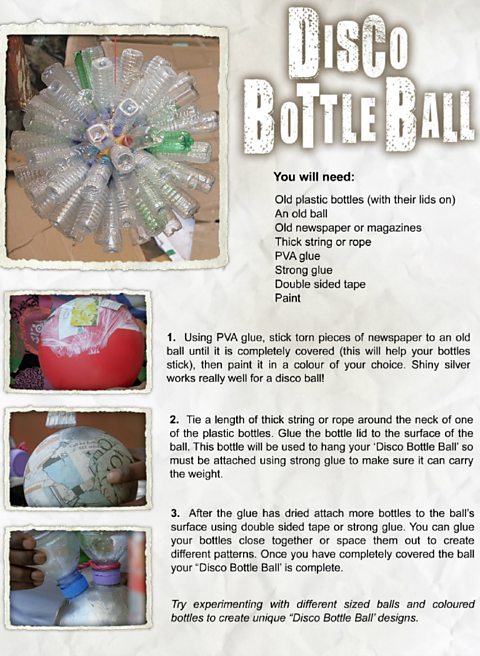
Questions to ask:
- What is the purpose of this text?
- Who is the intended audience?
- What gives you that impression?
Analysis
The purposes of the text are to inform and instruct. The intended audience is children.
- The layout uses a heading and subheading. These clearly tell children what they can make and what they need to make it. The instructions are numbered to organise them into step-by-step instructions. This guides children through something new. Simple and compound sentences deliver the information in a short, punchy way. This avoids confusing the younger readers. Brackets help children’s understanding with extra explanation, eg “(this will help your bottles stick).”
- The language is The language of a particular subset of English speakers - often those living in a particular place - having its own unique diction, vocabulary, spelling and even grammar.: it tells children directly what to do. The words are simple and easy to understand. Children will know what the specialist term ‘PVA glue’ means as they use it at school. The word “completely” reinforces the instruction to cover the ball thoroughly with paper. Without this direction, children might not cover it enough. They will be disappointed if their project goes wrong!
- The tone is informal and chatty: “Shiny silver works really well for a disco ball!” sounds like a friend making a suggestion.The pronouns in English (I, you, he, she, it, we, they, me, him, her, us, and them) showing contrasts of person, gender, number, and case. are direct and invite children to get involved – and to take on the challenge.
Quiz: Non-fiction purpose and audience
More help with your English Language
English Language revision resources. revision-guide
Get ready for your English Language exams with help from Bitesize.

English Language past papers
CCEA past papers and mark schemes, plus top tips to help you prepare for your English Language GCSE.
More on Unit 1: Reading to access non-fiction and media texts
Find out more by working through a topic
- count3 of 4
- count4 of 4

- count1 of 4