How can we warm-up our voices?
Singing involves many different parts of our body.
Just like an athlete, it’s important to warm-up beforehand.
It protects your voice and will also make you sound better.
We use a number of different parts of our body when we sing.
The key body parts we use for singing are:
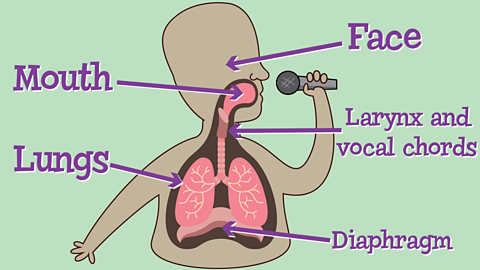
If you run your tongue along the roof of your mouth from front to back, can you feel how it’s softer at the back?
This is called the soft palate. Singing with this lifted helps us to produce a better, clearer sound.
Yawning is a good way to practice the feeling of lifting it. Yawning also stretches out all the muscles in our face.
Controlled breathing

Breathing is very important when singing, especially learning to control how fast the air comes out of our body.
Standing tall, with shoulders back and a long neck, helps support our diaphragm.
The diaphragm is a muscle that supports our lungs as we breathe.

Have a go
Take a deep breath, then breathe out to the sound 'ssss', like air coming out of a balloon.
How long can you make it last?
Can you keep the sound steady with no gaps or bumps?
Singing with correct diction
Diction is how we pronounce the words or say the letters in the lyrics to a song.
This helps our audience hear what we are singing about, so they can understand our performance.
It's especially important in a choir. If people sing at different times, with incorrect diction, it can sound messy.
Listen to this choir performing The Rhythm of Life.
It has lots of words and a fast The rate of speed of a piece of music..
Watch carefully how much these young singers move their mouth and lips, so we can hear the words clearly.
A choir singing the <i>The Rhythm Of Life</i>
[Choir sings] To feel The Rhythm Of Life
To feel the powerful beat
To feel the tingle in your fingers
To feel the tingle in your feet
To feel The Rhythm Of Life
To feel the powerful beat
To feel the tingle in your fingers
To feel the tingle in your feet
To feel the tingle in your feet
To feel The Rhythm Of Life
To feel the powerful beat
To feel the tingle in your fingers
To feel the tingle in your feet
To feel The Rhythm Of Life
To feel the powerful beat
To feel the tingle in your fingers
To feel the tingle in your feet
To feel the tingle in your feet

Did you know?
Tongue twisters are a great warm-up for our face and lips. They can help us improve our diction.
Say them slowly at first and then try to get faster and faster.
Try these:
She sells sea shells, on the seashore.
Red lorry. Yellow lorry.
Shoes and socks.
Singing in tune
When singing, we want the notes to sound as written by the composer. Singers have to learn to listen carefully, to be able to sing in tune.
Singing in tune means singing a note at the correct pitch. It's really important when performing with other musicians.
When you're singing you should also be ready to listen.
A series of notes played one after another starting from the lowest to the highest or highest to the lowest. are when we sing each note step-by-step. It's an exercise that prepares our voice to sing and our ears to listen.
Listen to the scale below. Play it a second time and have a go at singing along.
Create your own tongue twister

Tongue twisters are great fun!
Have a go at creating your own tongue twister. They don't have to be very long, but should have a pattern of sounds that are tricky to say as you get faster and faster.
Start off by saying it slowly and then get quicker and quicker.
Challenge your friends and family to see who can say it the fastest.
Quiz
Play BBC Bitesize educational games! game
Fun, interactive games for children aged 4-11, with maths, English, science, history and many more subjects.

More on Singing
Find out more by working through a topic
- count2 of 3
- count3 of 3