Key points about angles in parallel lines

Lines which never meet and stay the same distance apart. Parallel lines are indicated by a pair of arrows. are two or more straight lines that remain the same distance apart and never intersect.
A A line which crosses a set of parallel lines. is a line which crosses two or more parallel lines. The point where it crosses is called a The location where two or more lines meet.
When a transversal intersects a pair of parallel lines, various types of angles are formed within the parallel lines: Angles on opposite sides of the transversal within the parallel lines. , Angles at the same position within each intersection. and Angles on the same side of the transversal, between the two parallel lines. .
Make sure you are confident with solving linear equations before working with angles written as algebraic expressions.
Video – Angles in parallel lines
Watch this video to explore the relationships seen between angles in parallel lines and learn about the differences between alternate, corresponding and co-interior angles.
The video contains a worked exam-style question.
Katie: What relationships can be seen between the angles in parallel lines?
The arrows indicate that these lines are parallel, meaning they will never meet and are always the same distance apart.
A straight line that crosses two parallel lines is called a transversal, and it creates eight angles with the parallel lines.
If you know the size of just one of these angles, you can work out the rest.
For example, if angle A equals 35 degrees, then angle G also equals 35 degrees.
These two angles are on opposite sides of the transversal, so they are alternate angles, which are equal.
Looking out for a Z shape can help you to spot alternate angles.
The Z can also be back-to-front, and so D and F are also equal alternate angles.
Angles A and E are on the same side of the transversal and are corresponding angles, which are also equal.
The angles correspond, or match, with each other if you slide them along the transversal.
A handy hint for spotting corresponding angles is to look for an F shape, which can also be back-to-front or upside-down.
So D and H, C and G, and B and F are also pairs of corresponding angles.
Finally, co-interior angles add up to 180 degrees.
To spot these, look for a C-shape, as co-interior angles lie on the same side of the transversal inside the parallel lines.
So A and F are co-interior and add up to 180 degrees, as well as D and G.
It's important to use the correct terminology in an exam, so always use the words alternate, corresponding and co-interior in your answers, not Z, F and C-shape.
Let's look at an example question.
Work out the values of 𝑥, 𝑦 and z. 𝑦
Let's start with 𝑥 .
Notice that the 130 degree angle is equal to 𝑥 add 50 degrees, because they are corresponding angles.
Remember, a handy way to spot corresponding angles is to look for an F-shape.
This time, it's rotated.
Then, to solve the equation 𝑥 add 50 equals 130, subtract 50 from both sides, giving 𝑥 equals 80 degrees.
What about 𝑦?
𝑥 add 50 degrees and 𝑦 are co-interior angles, so they add up to 180 degrees.
You can use the rotated C-shape to help identify them as co-interior.
Remember, 𝑥 add 50 equals 130 degrees.
So 130 add 𝑦 equals 180
Then, subtracting 130 from both sides gives 𝑦 equals 50 degrees.
Why not pause the video here and work out the value of z?
𝑦 and 𝑧 are on opposite sides of the transversal, so they are alternate angles, which are equal.
So equals y which equals 50 degrees.
Let's recap.
Alternate angles are equal and you can identify them with a Z-shape.
Corresponding angles are also equal, but they form an F-shape.
And co-interior angles add up to 180 degrees, and they form a C-shape.
Check your understanding
What are alternate angles?
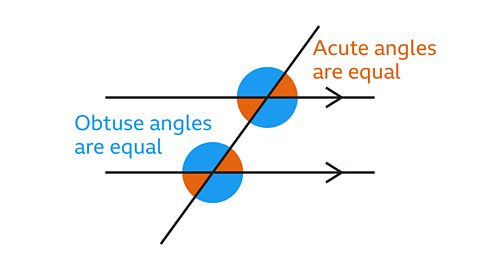
When a transversal intersects a pair of parallel lines, the angles at both points of intersection are related.
Along a specific transversal, all of the An angle less than 90°. are the same size.
All of the An angle between 90° and 180°. are the same size.
Pairs of angles can be given special names.
Alternate angles are on opposite sides of the transversal within the parallel lines.
- Alternate angles are always equal in size.
- When looking for alternate angles, it can useful to look for a Z-shape.
- The Z-shape can be backwards, sideways or upside down.
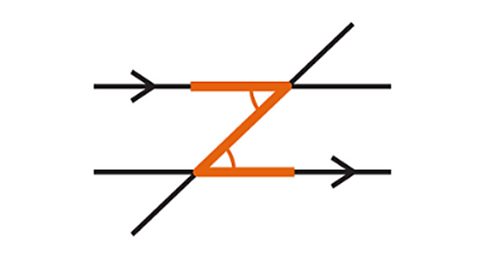
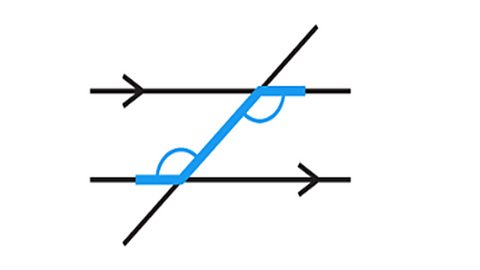
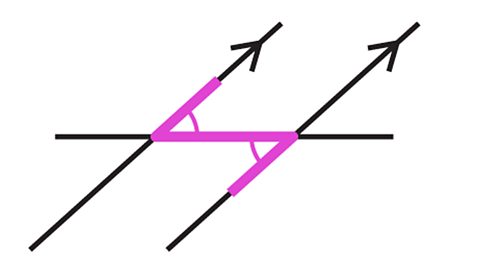
Follow the worked example below
GCSE exam-style questions

- Work out the size of angle 𝑚.
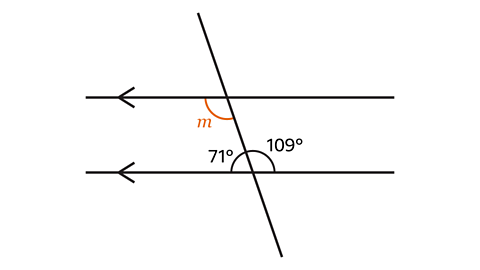
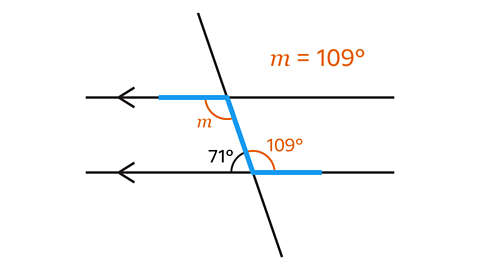
Angle 𝑚 = 109°.
The angle 𝑚 makes an alternate pair with the angle 109°.
- Which pairs of angles are alternate?
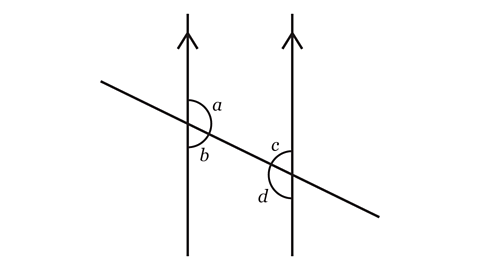
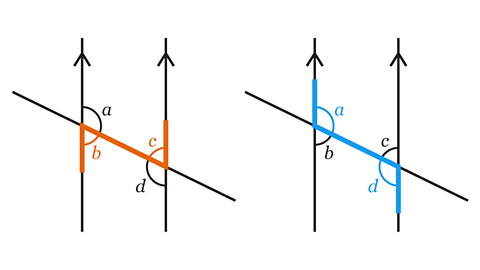
Angles 𝑏 and 𝑐 form one pair of alternate angles.
Angles 𝑎 and 𝑑 form another pair of alternate angles.
- Set up and solve an equation to find 𝑥.
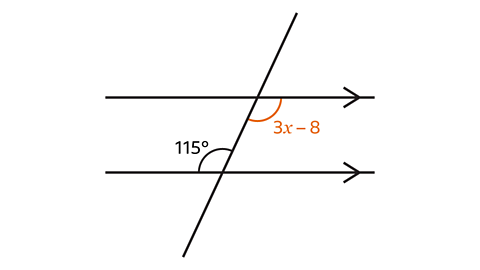
Angle 𝑥 is 41°.
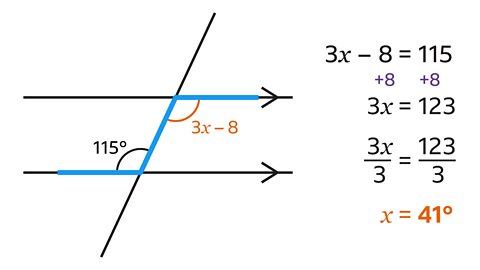
Angles 3𝑥 – 8 and 115° are alternate.
Alternate angles are equal, so 3𝑥 – 8 = 115.
To find the value of 𝑥, first add 8 to both sides. This produces the equation 3𝑥 = 123
Now divide both sides by 3.
3𝑥 ÷ 3 = 𝑥 and 123 ÷ 3 = 41.
The value of 𝑥 = 41°.
What are corresponding angles?
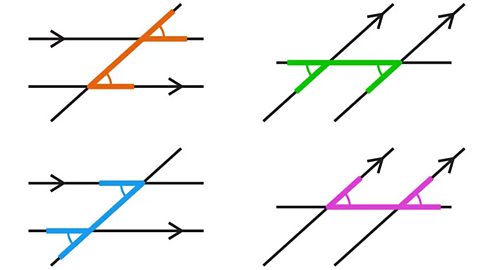
Corresponding angles occur at the same position within each intersection.
Corresponding angles are always equal in size.
When looking for corresponding angles, it can be helpful to look for an F- shape.
The F-shape can be backwards, sideways or upside down.
Follow the worked example below
GCSE exam-style questions
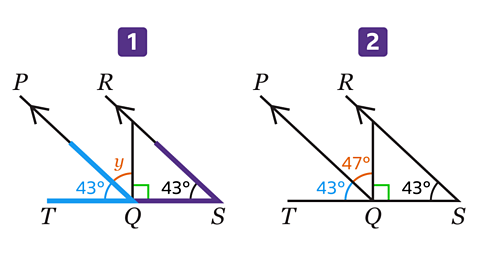
- 𝑃𝑄 is parallel to 𝑅𝑆.
Work out the size of angle 𝑦.
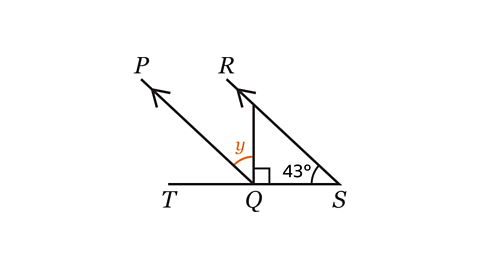
Angle 𝑦 is 47°.
1: The angle adjacent to angle 𝑦 is corresponding to 43°. Corresponding angles are equal so this angle is equal to 43°.
2: Angle 𝑦, 43° and the right-angle are adjacent angles on a straight line. Adjacent angles on a straight line add up to 180°.
𝑦 = 180 – 90 – 43 = 47
- Which pairs of angles are corresponding?
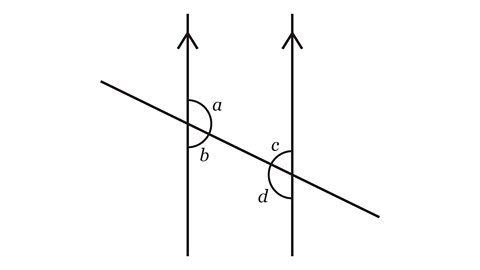
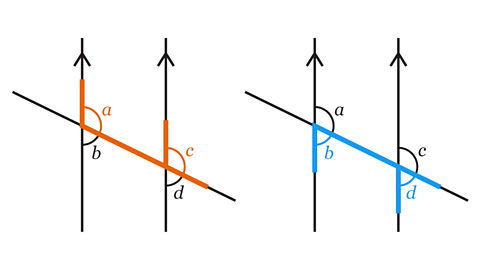
Angles 𝑎 and 𝑐 form one pair of corresponding angles.
Angles 𝑏 and 𝑑 form another pair of corresponding angles.
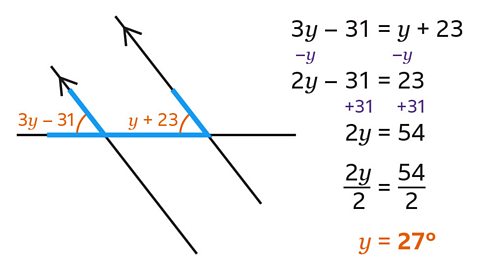
- Set up and solve an equation to find 𝑦.
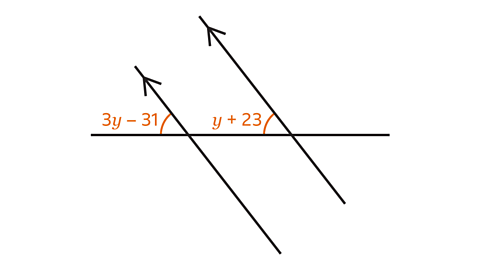
Angle 𝑦 is 27°.
Angles 3𝑦 – 31 and 𝑦 + 23 are corresponding.
Corresponding angles are equal so
3𝑦 – 31 = 𝑦 + 23
- To find the value of 𝑦, first subtract 𝑦 from both sides which gives the equation
2𝑦 – 31 = 23
- Now add 31 to both sides which gives
2𝑦 = 54
- Finally, divide both sides by 2.
2𝑦 ÷ 2 = 𝑦
54 ÷ 2 = 27
What are co-interior angles?
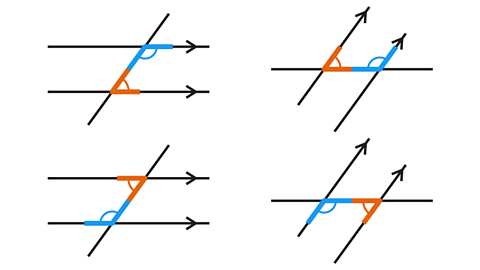
Co-interior angles (or allied angles) occur on the same side of the transversal, between the two parallel lines.
- Co-interior angles add up to 180°.
- When looking for corresponding angles, it can be helpful to look for a C-shape.
- The C-shape can be backwards, sideways or upside down.
Follow the worked example below
GCSE exam-style questions
- Trapezium 𝐴𝐵𝐶𝐸 is made from parallelogram 𝐴𝐵𝐶𝐷 and isosceles triangle 𝐴𝐷𝐸.
𝐴𝐸 = 𝐷𝐸
Work out the size of angle 𝐴𝐸𝐷.
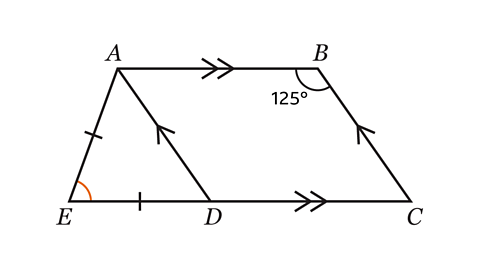
Angle 𝐴𝐸𝐷 = 70°
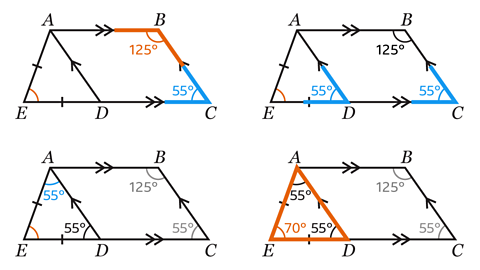
- Angle 𝐴𝐵𝐶 and 𝐵𝐶𝐷 are co-interior angles.
Co-interior angles add up to 180°, so angle 𝐵𝐶𝐷 = 180 – 125 = 55°.
Angle 𝐵𝐶𝐷 and 𝐴𝐷𝐸 are corresponding angles. Corresponding angles are equal so angle 𝐴𝐷𝐸 = 55°.
Since triangle 𝐴𝐷𝐸 is isosceles, angles 𝐴𝐷𝐸 and 𝐷𝐴𝐸 are equal. Angle 𝐷𝐴𝐸 = 55°.
The angles in a triangle add up to 180°. Angle 𝐴𝐸𝐷 = 180 – 55 – 55 = 70.
Angle 𝐴𝐸𝐷 = 70°.
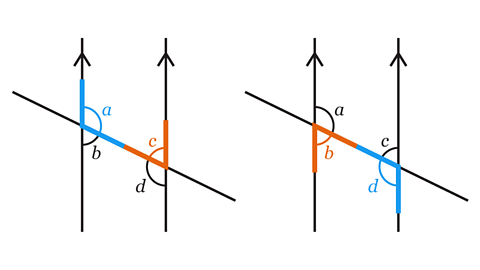
- Which pairs of angles are co-interior?
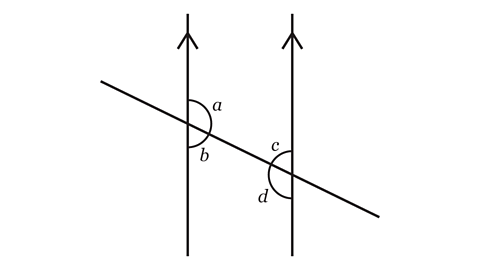
Angles 𝑎 and 𝑐 form one pair of co-interior angles.
Angles 𝑏 and 𝑑 form another pair of co-interior angles.
- Set up and solve an equation to evaluate 𝑧.
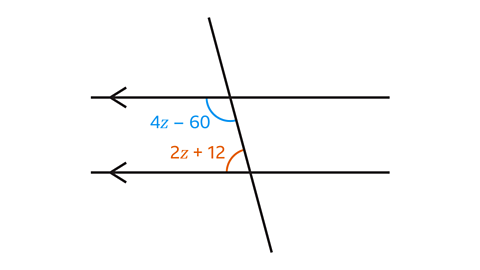
𝑧 = 38°
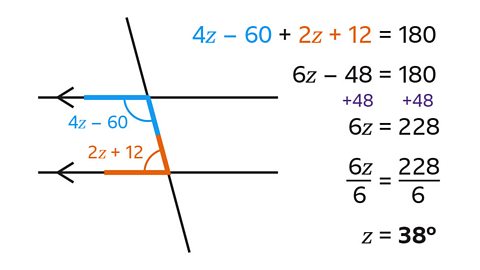
Angles 4𝑧 – 60 and 2𝑧 + 12 are co-interior.
Co-interior angles add up to 180°, so the equation is
4𝑧 – 60 + 2𝑧 + 12 = 180
- Collect like terms, which simplifies to the equation
6𝑧 – 48 = 180
- Now add 48 to both sides. Adding 48 to both sides produces the equation
6𝑧 = 228
- Finally divide both sides by 6.
6𝑧 ÷ 6 = 𝑧 and 228 ÷ 6 = 38.
The value of 𝑧 is 38°.
Quiz - Angles in parallel lines
Practise what you've learned about angles in parallel lines with this quiz.
Now you've revised angles in parallel lines, why not look at bearings?
More on Geometry and measure
Find out more by working through a topic
- count3 of 35

- count4 of 35

- count5 of 35

- count6 of 35