Unit 3, Task 1
The material on this page is designed to help you with revision and preparation for your CCEA GCSE English Language assessments. It applies to Unit 3, Task 1: The study of spoken language.
- Unit 3 is a controlled assessment unit, worth 20% of your final mark
- The controlled assessment is split into two tasks, each worth an equal number of marks, to be completed in class with your teacher
- Task 1: The study of spoken language, requires the completion of a written response to two pieces of spoken language – your teacher will choose the material you will study and respond to
- The themes for this task change each year – ask your teacher for your theme, or check the CCEA website for controlled assessment themes
- In this task, you will be assessed on your ability to:
- Understand variations in spoken language, explaining why language changes in relation to contexts
- Evaluate the impact of spoken language choices in your own and others’ use of language
Useful guidance for English Language controlled assessments can be found on the CCEA support page – select the Student Guidance tab. For further advice on controlled assessments, please consult your teacher.
INTERIM SPECIFICATION – NOTE FOR YEAR 11 PUPILS
If you are in Year 12 and completing your CCEA English Language GCSE in summer 2027, the above information is correct.
However, if you're in Year 11 and began studying for your CCEA English Language GCSE in September 2026, an interim specification has been introduced.
Unit 3: Studying Spoken and Written Language (controlled assessment) has been removed. Unit 3 is now Personal or Creative Writing and Reading Literary and Non-fiction Texts, assessed by a written exam.
Bitesize material is available on these topics, but will remain labelled as Unit 4 until exams under the current specification are complete in November 2027.
Checklist for your spoken language assessment
Here are some questions to ask yourself to check the quality of your response.
- Have I planned and structured my response so it makes sense?
- Have I used a good introduction which introduces the speakers and outlines the setting?
- Have I considered the purpose and audience of the speeches and how these have affected the speeches?
- Have I commented on linguistic and rhetorical devices and their effect?
- Have I compared the speeches (using appropriate ‘connecting’ words)?
- Have I used the key term throughout?
- Is my language formal and depersonalised?
- Have I proofread my work for spelling, punctuation and grammar (including paragraphing)?
If the answer to all these questions is yes, you're well on your way to boosting your marks!
Terms for analysing spoken language
When you are analysing two pieces of spoken language, you are doing more than just spotting features. You are thinking about how speakers use language to shape meaning and influence their audience. Both what is said and how it is delivered matter.
The terms in the glossaries below will help you describe what you hear, but the key skill is explaining their impact. It is not enough to say that a speaker uses fillers, pauses or informal language – you need to think about why they use them and what effect they have.
Think about how the speaker presents themselves, how they connect with their audience and how their choices influence the message. Strong analysis shows that you understand not just the terms, but the difference they make.
Glossary: Rhetorical devices relating to content
Rhetorical devices are powerful because they shape how we think and feel about a message.
The glossary below will help you recognise key techniques, but your goal is to go further than simply naming them. You need to explain their effect. Why does the speaker use repetition? How does a rhetorical question make the audience respond?
Adjective
A word that describes a noun.
Example: The blue car sat in the long driveway.
Alliteration
Words which have the same starting letter or sound.
Example: Peter Piper picked a peck of pickled peppers.
Anecdote
A short personal story to illustrate a point.
Example: When I was ten, I struggled with reading – until I discovered my love for the Harry Potter books.
Comparative Adjective
An adjective used when comparing two things.
Example: This book is better than the last one.
Direct Address
Speaking directly to the audience.
Example: You have the power to make a difference.
Emotive Language
Words that stir emotions in the listener.
Example: Thousands of innocent lives were lost.
Exaggeration
Overstating something to make a point.
Example: There are miles of shops in the new shopping centre!
Expert Opinion
Referencing someone with authority in a particular area.
Example: Dr Smith, a leading psychologist, says this method works.
Facts and Statistics
Using data or factual information to support a point.
Example: 90% of students improved their grades after study camp.
Flattery
Being complimentary to your audience to gain their support.
Example: An intelligent audience like yourselves will understand the problem.
Hyperbole
An extreme form of exaggeration used for dramatic effect.
Example: I have told you this a million times before!
Inclusive Pronoun
Pronouns that include the audience such as we and us.
Example: We all can see what is happening.
Metaphor
Saying something is something else to create imagery.
Example: Time is a thief.
Onomatopoeia
Words that imitate sounds.
Example: The loud tick-tock of the old grandfather clock.
Personification
Giving human traits to non-human things.
Example: The wind whispered in the trees.
Promises/Incentive
Offering a benefit or bonus to persuade the listener.
Example: Sign up today and get a free trial.
Pun
A play on words for effect, often humorous.
Example: I used to be a baker, but I couldn’t make enough dough.
Repetition
Repeating words or phrases for emphasis.
Example: We must act now. We must act together. We must act before it is too late.
Rhetorical Question
A question asked for effect, which does not require an answer.
Example: Who would say no to ending world poverty?
Rule of Three (or Triple)
Ideas or words which are grouped in threes for impact.
Example: This plan is smart, simple and sustainable.
Simile
Comparing two things using like or as.
Example: She was as cold as ice.
Superlative Adjective
An adjective used to describe the extreme of three or more things.
Example: She is the fastest runner in the county.
Glossary: Delivery techniques
When you are analysing delivery techniques, you are focusing on how something is said rather than just the words themselves. The way a speaker uses their voice and body language can completely change how a message is received.
The terms in the glossary below will help you identify these techniques, but your main aim is to explain their effect. It is not enough to say a speaker uses a pause, changes their tone or varies their pace. You need to think about why they do this and how it shapes the audience’s response. Does a pause build tension or give the audience time to think? Does a louder tone show confidence or aggression? Does a slower pace make the message clearer or more dramatic?
Accent
The way someone pronounces words, often influenced by their regional background.
Articulation
A precise and clear pronunciation of words.
Body Language
Non-verbal communication through stance, posture, movement and gestures.
Clarity
Speaking in a way that is easy to understand, with clear pronunciation and clear structure.
Confidence
Speaking with assurance and control.
Delayed Sentence
A technique where the main idea or conclusion is held back to build suspense or emphasis.
Dialect
A form of language specific to a region or group, including vocabulary and grammar differences.
Emphasis
Stressing certain words or phrases to highlight importance or meaning.
Eye Contact
Looking directly at your audience to build connection and show engagement.
Facial Expression
Using your face to show emotion or tone while speaking.
Fluency
Speaking smoothly without unnecessary pauses or hesitation.
Gesture
Movements of the hands or body used to emphasise what is being said.
Intonation
The rise and fall of the voice.
Pausing
Brief breaks in speech used for effect, emphasis or to allow the audience to absorb information.
Pace
The speed at which someone speaks.
Pitch
How high or low a voice is.
Pronunciation
The way words are spoken.
Projection
Speaking loudly and clearly enough to be heard by the audience – without shouting.
Register
Formality or style of language used; this will be influenced by the audience, context and content.
Rhythm
The pattern of spoken words, created by emphasises, pauses and pace.
Slang
Informal or non-standard words and phrases often used within specific groups. Not appropriate for formal or academic work.
Tone
The attitude or emotion conveyed through voice, such as disappointment, excitement or sarcasm.
Volume
How loud or soft a speaker’s voice is.
Exemplar sentences - how language influences the audience
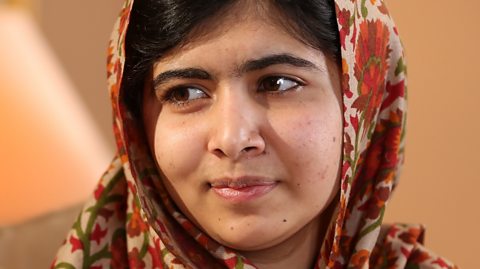
To see how language can influence an audience, we can look at exemplar sentences from famous speeches. These are quotes that clearly show how speakers use language in a powerful way. By studying these examples, you can learn how techniques such as repetition, emotive words and strong imagery help to grab attention, create emotion and make your message more memorable.
Victory speeches are designed to be powerful and persuasive. Speakers know they are addressing a large audience at an important moment, so they carefully choose their words for maximum impact.
Two notable examples of recent times were given by Malala Yousafzai on her acceptance of the Nobel Peace Prize, and Oprah Winfrey on her acceptance of the Cecil B DeMille award at the Golden Globes.
Watch Malala's speech on YouTube
Watch Oprah's speech on YouTube
As well as identifying devices and giving examples of when they occur, it is important that you comment on the effect on the audience. The effect can vary depending on the device and the situation.
Below are some exemplar sentences, based on Malala and Oprah’s speeches, showing how you might describe the use of devices and their effect on the audience.
Exemplar sentences based on Malala's speech
The use of anaphora – "It is for those […] children" – is memorable and ensures the audience hear, and will remember, this.
The use of repetition in Malala's speech – "it becomes the last time" – conveys the insistence of her message to the audience and they respond with the longest applause at any point in her speech.
The use of a triple at the end of Malala's speech creates interest for the audience and is more engaging to listen to.
Exemplar sentences based on Oprah's speech
The use of imagery – “hope for a brighter morning, even during our darkest nights” – creates a vivid and memorable image for the audience.
The factual reference to Rosa Parks lends a historical significance and provides a point of identification for the audience as it is something they will all know.
The use of a list, when Oprah references the different career paths of women, demonstrates to the audience that this abuse can happen in a wide variety of jobs.
When Oprah references her impoverished upbringing – "cheap seats" – it contrasts with the wealth and glitz of her current life. This allows the audience to recognise and admire how much she has achieved in her life.
The use of facts, as in the assault on Recy Taylor, affects the audience as it is drawn from real life and therefore is more powerful.
The use of emotive language, such as "children to feed and bills to pay", affects the audience as it allows them to feel a connection and more empathy towards these women.
When Oprah says "their time is up", both the repetition and tone has an empowering effect on the audience.
Quiz: Rhetorical devices
Quiz: Test yourself on delivery techniques
More help with your English Language
English Language revision resources. revision-guide
Get ready for your English Language exams with help from Bitesize.

English Language past papers
CCEA past papers and mark schemes, plus top tips to help you prepare for your English Language GCSE.