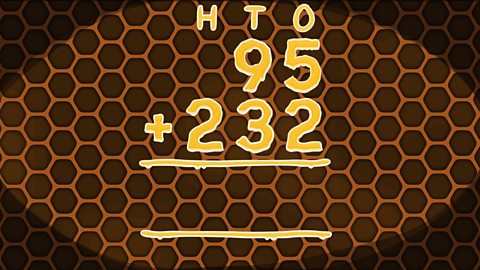
Oh, I didn’t know you kept bees, Jerry? How many have you got? 232.
Oh look, Albert’s found you some more! Ah, there you go! 95 more bees for your hive. So how many have you got in total now?
Ah, don’t worry, we can use number columns. Number columns allow you to take large numbers and add them together easily.
It does this by breaking the sum down into place value headings… and then adding the numbers together in each column separately.
First the ones! In this case, five and two. Adding those numbers together we get seven. Seven is the final number of our total.
Righto. Onto the tens. Adding together nine and three gives us 12. This number is made of two digits: one ten, and two ones. When this happens, you take the ones and put them into our final total… and carry the tens over into the next sum.
We only have one number in the hundreds column, so we simply add the remaining number to that. And then boom! We’ve worked out you’ve got 327 bees in your hive! All with the help of number columns.
See Albert? They’re not so bad!
Ah err, right! No problem just err… RUN!
Description
When writing a column addition, separate the digits of a numbers into the different place values. Then add each on in turn, starting with the ones. Join Jerry and Albert at their beehive to solve a column addition.
Now playing video 3 of 5