What do magnets attract?

Magnets can attract some metals, but not all of them.
Metals such as iron and steel are magnetic, which means they are pulled towards a magnet.
Other metals, like gold, silver and aluminium are not magnetic and are not attracted to magnets.
Magnets can also pull or push other magnets without touching them. This makes them very useful in everyday objects, from fridge doors to electric motors.
Watch: Dr Big Brain and the magnet
Dr Big Brain has another ‘brilliant’ (his word) evil plan and this time it’s more than a little magnetic.
DR BIG BRAIN: Evil plan 79 – magnetic malevolence. Tremble at my new creation, the Electromagnet of Doom.
I said tremble, Agent Goody.
AGENT GOODY: Never, Dr Climbing Frame.
DR BIG BRAIN: It’s Big Brain, and you WILL tremble, for this is an electromagnet, which means it’s only magnetic when it’s turned on using electricity.
And it’s so big, it’ll attract magnetic objects from far away, objects like – oh, I don’t know – every warship in the world.
ELAINE: Ooh, and just think of all the gold and silver it’ll attract.
DR BIG BRAIN: No, Elaine, it’s a magnet, so it doesn’t attract non‑magnetic metals like gold and silver.
ELAINE: Oh, so, no platinum or titanium or tin, lead. They’re all non‑magnetic metals.
DR BIG BRAIN: Thank you for pointing out the limitations of my new favourite machine, Elaine! I’m totally cool with you doing that!
ELAINE: Oh, no! I can explain. Doc, I didn’t mean anything…
DR BIG BRAIN: Take a walk with me, Elaine. Don’t worry. I’m not cross. I just need you to have a big old wave in front of my Death Laser Bot.
ELAINE: OK, then. Hello.
DR BIG BRAIN: So sad. I don’t think I’ll ever get over her death. Now, where were we?
AGENT GOODY: You were about to turn on your giant electromagnet.
DR BIG BRAIN: Actually, I wasn’t, because that would be super‑unsafe, and I’ve learned my lessons from last time.
RICKY: Yeah, that tank came through the wall fast.
DR BIG BRAIN: Indeed. And shush, Ricky. But that incident led to my new metal safety helmets, complete with built‑in ear defenders.
AGENT GOODY: How fetching.
DR BIG BRAIN: Jealous! So, we’re going to evacuate everyone apart from you, Agent Goody, before we turn the magnet on and you will die.
ASSISTANT: What did he say?
RICKY: Turn the magnet on.
ASSISTANT: OK.
DR BIG BRAIN: No, wait! Don’t turn— Argh!
COMPUTER: Magnet on.
DR BIG BRAIN: No, turn it off!
ASSISTANT: I can’t reach!
AGENT GOODY: METAL safety helmets, you said?
DR BIG BRAIN: Oh, no!
RICKY: Agh! The magnet got my helmet!
DR BIG BRAIN: Not wearing a helmet is a clear health and safety breach. Take a walk with me, Ricky.
RICKY: Argh!
DR BIG BRAIN: Curse my protective, magnetic steel underpants!
AGENT GOODY: What?
RICKY: The magnet has activated your laser bot!
DR BIG BRAIN: Thanks for stating the obvious, Ricky. That’s very useful. Oh, you’re kidding me!
AGENT GOODY: Thanks, Doctor Slow Lane. For the first time with magnets, I can see the attraction.
DR BIG BRAIN: Oh!
ASSISTANT: Don’t worry, Doc. I’ve got to the magnet control.
COMPUTER: Magnet power increased.
ASSISTANT: I think I’ve turned the dial the wrong way.
DR BIG BRAIN: You think?
RICKY: Er, Doctor Big Brain, with my helmet gone, I can turn it off.
DR BIG BRAIN: Then why haven’t you? Oh, take yourself for a walk, Ricky. I need someone to test my human box maker. No, wait. What are you doing? Turn the magnet off before you leave!
DR BIG BRAIN: I never liked him.
What is an electromagnet?
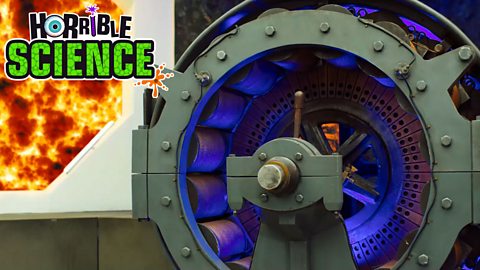
An electromagnet is a special type of magnet that only works when electricity flows through it.
- When the electricity is switched on, the magnet becomes magnetic.
- When it is switched off, the magnet stops working.
Electromagnets are useful because they can be controlled. That’s why they are often used in scrapyards to lift heavy metal objects and in other machines that need magnets that turn on and off, such as MRI machines or some electric motors.
Why do magnets only attract some metals?
Only certain metals are magnetic. Iron is the most common one. Others are nickel and cobalt.
Alloys (mixtures of different metals) that contain any of these metals, for example, steel, are often magnetic too.
Metals such as copper, gold and aluminium are not magnetic.
This is why a magnet might pull in paperclips, but it may not move coins, jewellery or drinks cans if they are not made from a magnetic metal.
Horrible Science fact
Some of the strongest electromagnets in the world are powerful enough to lift entire trains - but only while the electricity is switched on. So it’s important to know where the on and off switch is!
Maglev (magnetic levitation) trains use powerful electromagnets so they don’t touch the tracks at all. By floating above the rails, they reduce friction and can travel at very high speeds, sometimes over 300 miles per hour.
Things would be pretty blurry if you were looking out of the train's window!
Quiz
How to use Horrible Science in the classroom
If you're looking to bring energy, humour and curriculum-aligned content into your science lessons, Horrible Science might just be your new secret weapon.

More on Horrible Science
Find out more by working through a topic
- count28 of 50

- count29 of 50
- count30 of 50

- count31 of 50