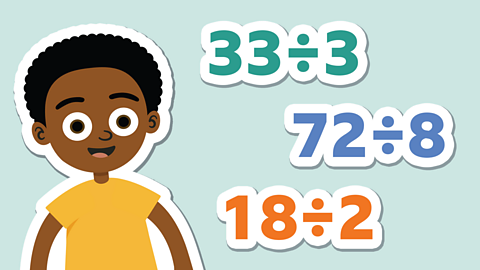
How to use times tables
Times tables are used in all areas of maths.
If you know your times tables, you can work out other multiplication and division problems in your head.
Division is the inverse of multiplication. This means its the opposite.
The good news is you can use your multiplication knowledge to work out division problems.
If you know that:
6 × 3 = 18
Then, you know that:
18 ÷ 3 = 6
What are fact families?
Multiplication is the opposite (inverse) of division.
This means that times tables can help you work out division problems.
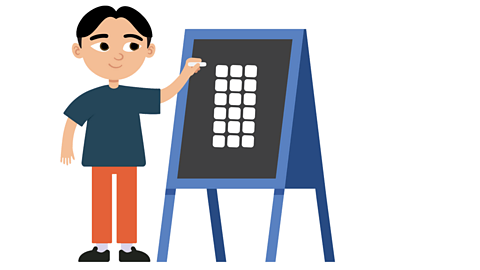
This array has 3 rows of 4 blocks with 12 blocks in total.

This can be written four different ways.
3 × 4 = 12
4 × 3 = 12
12 ÷ 4 = 3
12 ÷ 3 = 4
If you know one fact, you actually know four facts. These are sometimes called fact families.
Notice that the same three numbers are used within each fact. An array can be used to represent a fact family.
Explore: Times tables
Explore how times tables can be represented using an array with this interactive activity.
Example 1
This array has 3 rows of 7 dots with 21 dots in total.
This can be written as 3 × 7 = 21

What are the other three facts that make up the fact family?
✓ Here is the fact family:
3 × 7 = 21
7 × 3 = 21
21 ÷ 3 = 7
21 ÷ 7 = 3
Example 2
This array has 32 dots in total. There are 4 rows each with 8 dots in.
This can be written as 32 ÷ 4 = 8

What are the other three facts that make up the fact family?
✓ Here is the fact family:
32 ÷ 4 = 8
32 ÷ 8 = 4
4 × 8 = 32
8 × 4 = 32
More resources
More on Multiplying and dividing
Find out more by working through a topic
- count7 of 15
- count8 of 15

- count9 of 15
- count10 of 15