When did the Indus civilisation end?
Historians believe things started to fall apart around 1900BC. By 1700BC many Indus cities had been abandoned.
But how did this apparently peaceful, well-organised civilisation collapse in just 200 years?
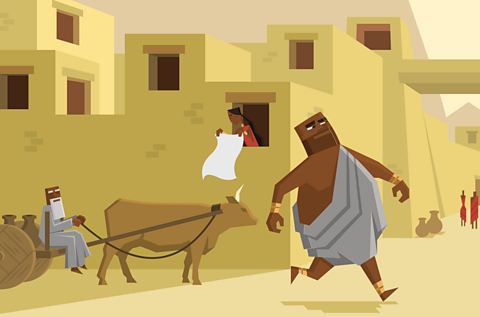
Looking at the ruins we can see many changes. The cities became overcrowded, with houses built on top of houses. Important buildings like the Great Bath at Mohenjo-Daro were built over.
People stopped maintaining the drains and they became blocked. Some traders even hid their valuables under the floors of their homes. What were they scared of? Why did this happen?
Important words for the Indus Civilisation
| Keyword | Definition |
|---|---|
| Abandoned | Left somewhere or something behind. |
| Legacy | The impact that something had or what something is known for. The Indus people’s legacy is that they were great builders who liked to keep clean. |
| Political | To do with government and running a country or a group of people. |
| Sacred | Something that is important for religious reasons. The Indus people thought that cows were sacred. |
Did trade stop?
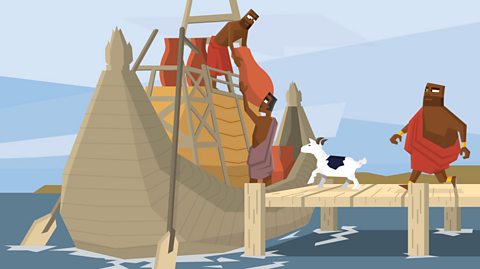
Trade was very important for the Indus civilisation. Their main trade partner was Mesopotamia, which was an advanced civilisation in the Middle East.
Around the time the Indus cities started to fail, Mesopotamia was going through huge political problems.
Mesopotamia's trade networks collapsed and this would have had a big impact on the Indus cities. There would have been less work for traders and for manufacturers, who made the things which the traders sold abroad.
Some historians think this is why the cities collapsed.
We know that only the cities fell into ruins. Farmers in the Indus Valley went on living in their villages and working on their farms, but the civilisation would never return to greatness again.
Was there a war?
Some historians believed the Indus civilisation was destroyed in a large war. Hindu poems called the Rig Veda (from around 1500 BC) describe northern invaders conquering the Indus Valley cities.
In the 1940s, archaeologist Mortimer Wheeler discovered 39 human skeletons at Mohenjo-Daro. He believed that they were people killed by invaders.
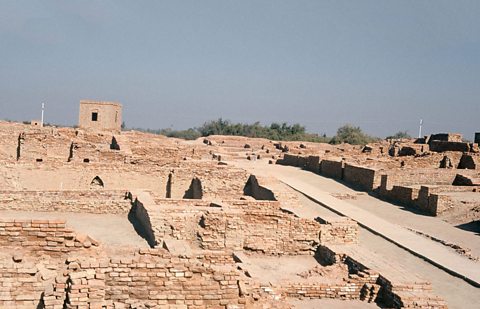
Archaeologists now think this is not true. There is no evidence of war. Indus Valley people seem to have been peaceful. If they had an army, they have left few signs of weapons or battles.
It's more likely that the cities collapsed after natural disasters. Enemies might have moved in afterwards.
Did the river move?
Many historians believe the Indus civilisation collapsed because of changes to the geography and climate of the area.
Movements in the Earth’s crust (the outside layer) might have caused the Indus river to flood and change its direction. The main cities were closely linked to the river, so changes in the river flow would have had a terrible effect on them. Repeated flooding may have led to a build-up of salt in the soil, making it hard to grow crops.
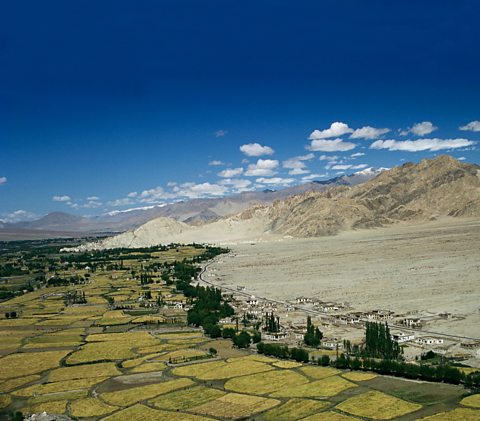
It is believed that at the same time, the Ghagger Hakra River (another river in the area) dried up. People were forced to abandon many of the cities located along its banks, such as Kalibangan and Banawali.
People would have starved and diseases would have spread. Perhaps because of this chaos, the rulers lost control of their cities. Lots of historians think it was a mixture of different reasons. Why do you think the Indus cities collapsed?
How did we discover the Indus Valley?
The Indus Valley lay forgotten and undiscovered for thousands of years.
In 1826, a British traveller in India called Charles Masson came across some mysterious brick mounds. He thought they looked like old castles, but didn't know who built them.
Thirty years later, in 1856, engineers building a railway found more bricks. They carted them off and continued to build the railway. These bricks were the first evidence of the lost Indus city of Harappa.
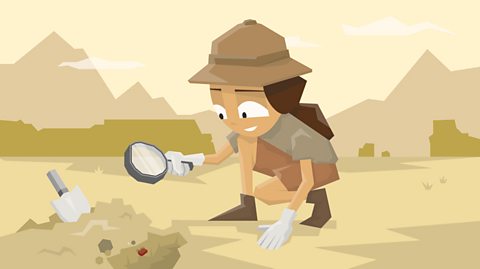
In the 1920s, archaeologists began to excavate the sites of Harappa and Mohenjo-Daro. They had uncovered the remains of two long-forgotten cities and found the Indus Valley civilisation.
The Indus Valley people did not leave great structures, like the Pyramids of Egypt or the Great Wall of China, but they did help shape the modern world.
Watch: Ruins of Mohenjo-Daro
Visit the ruins of Mohenjo-Daro and find out what archaeologists have discovered about this 'planned city'.
Mohenjo-daro.
Narrator: Archaeologists estimated that in 2500BC Mohenjo-Daro was a city full of over 35,000 people.
Presenter: It was a planned city with an Upper and a Lower town, a huge great bath and with an advanced drainage system.Mohenjo-Daro had a really big main street that seems to go all the way to the city. The street is large enough for lots of traffic to go… bullocks and carts, people and traders.
With many small streets running off the main street.
Narrator: All the side streets are exactly the same width.
Presenter The main street is 10 metres wide.
Narrator: Is this evidence to show that someone sat down and thought about planning this city? It looks as though the streets and the drainage systems were laid out first then blocks of houses and buildings were built around them. It works like any modern planned city like Milton Keynes or New York.
Presenter: This is my favourite bit of the city. It’s the Great Bath!
Narrator: The Great Bath is in the city’s Upper Town. The archaeologists think that people used this great deep pool for important religious ceremonies.
It had a water supply coming in. There is a slope to the drainage area which makes it easy to release the water.
It could be possible that the city rulers came here to worship as cleanliness is considered very important to many religions.
Presenter: The Indus people were very civilised. In 2500BC they had toilets. This is a 4,500 year old loo. They also had a drainage system to carry away all the waste.
Think like a historian

Have a look at the thinking points below and think about your answer to each question. You could even write them down on a piece of paper or discuss them with somebody else if you want to.
Why are there different ideas about how and why the Indus civilisation ended?
Why might our understanding of the Indus people change over time?
Why is it important to think about other civilisations who existed at the same time as those in the Indus Valley?
Perhaps you remembered that there hasn’t been any clear evidence found to say why the Indus Valley civilisation ended. Some historians think that it came to an end because of a war, but little evidence has been found linked to weapons. Others think it happened because of climate change and rivers drying up.
Our understanding of the Indus Valley people changes as historians and archaeologists discover more about them. What early Indus Valley historians first thought might be slightly, or even completely, wrong when new evidence is found.
Civilisations living at the same time could be connected. If one civilisation grew, moved or collapsed, it could affect others nearby. For example, historians think the Indus Valley may have traded with Mesopotamia, so when Mesopotamia’s trade networks collapsed, it might have meant less work for Indus traders. Looking at other civilisations helps us spot links and similarities between them.
Activities
Activity 1: Indus Valley culture
Explore the pictures below to find out about the legacy of the Indus Valley culture.
Activity 2: Quiz – What happened to the Indus Valley?
Let's find out what you know about what happened to the Indus Valley civilisation in this quiz.
Grown-ups corner
Are you a parent, carer or teacher?
Take a look at some of the links below on KS2 History which are packed full of knowledge, videos, quizzes and activities.
What happened to the ancient Egyptians?
KS2 History
What happened to the Mayas?
KS2 History
What was the Ancient Sumer civilisation?
KS2 History
Horrible Histories: Raid and Trade game! game
Play Horrible Histories: Raid and Trade KS2 History
More on Indus Valley
Find out more by working through a topic
- count1 of 4