How to say your name in French
If you want to say something about yourself in French, you use the word for ‘I’ – Je.
So if you want to say ‘I am called’, you say Check your connection, refresh the page and try again.:
Check your connection, refresh the page and try again. – I am called Aimée
Check your connection, refresh the page and try again. – I am called Anil
Here appelle means ‘call' so it's like saying ‘I myself call’.
‘What are you called?’ in French

If you want to ask someone else’s name, you use the word tu (you) and the question word comment (how):
Check your connection, refresh the page and try again. – What are you called?
Did you notice that the word for ‘call’ is before the word for ‘you’? Sometimes the order of the words is different in French. So it is like saying ‘how do you call yourself?’.
How to say how old you are
In English, you use the verb ‘to be’ to say how old you are but in French, you use the verb ‘to have’ – avoir:
J’ai _____ ans
Check your connection, refresh the page and try again. – I am eight years old
So it is like saying ‘I have eight years’ rather than ‘I am eight years old’ as we do in English.
Did you notice that the word for ‘I’ has changed from Je to J’? This is because it appears in front of a vowel.
Here are some useful phrases to practise saying how old you are:
| French | English |
|---|---|
| Check your connection, refresh the page and try again. | I am eight years old |
| Check your connection, refresh the page and try again. | I am nine years old |
| Check your connection, refresh the page and try again. | I am ten years old |
| Check your connection, refresh the page and try again. | I am eleven years old |
‘How old are you?’ in French
To ask someone how old they are, you first need a question phrase Check your connection, refresh the page and try again. (what age).
Then use the word for ‘you’ – Check your connection, refresh the page and try again. with ‘have’ – Check your connection, refresh the page and try again..
Check your connection, refresh the page and try again. – How old are you?
So it is like saying ‘What age do you have?’.
How to ask ‘When’s your birthday?’
If you want to ask someone when their birthday is, you say:
Check your connection, refresh the page and try again.
Let’s break the question down into smaller parts:
Check your connection, refresh the page and try again. – What is the date
Check your connection, refresh the page and try again. – of your birthday?
To answer, you use the phrase C’est + le + day + month
Check your connection, refresh the page and try again. – It’s the second of May
Check your connection, refresh the page and try again. – It’s the third of May
Check your connection, refresh the page and try again. – It’s the fourth of May
Unlike in English, you don't say the date as an ordinal number, such as the second, third, fourth, fifth, etc. You just use cardinal numbers, such as two, three, four, five. The only time you use the ordinal number is for the first of the month.
Check your connection, refresh the page and try again. – It’s the first of May
Counting numbers
Numbers one to eleven in French
Numbers are very useful in French when talking about your age or your birthday. Here are numbers one to eleven to get you started:
| French | English | |
|---|---|---|
| 1 | Check your connection, refresh the page and try again. | one |
| 2 | Check your connection, refresh the page and try again. | two |
| 3 | Check your connection, refresh the page and try again. | three |
| 4 | Check your connection, refresh the page and try again. | four |
| 5 | Check your connection, refresh the page and try again. | five |
| 6 | Check your connection, refresh the page and try again. | six |
| 7 | Check your connection, refresh the page and try again. | seven |
| 8 | Check your connection, refresh the page and try again. | eight |
| 9 | Check your connection, refresh the page and try again. | nine |
| 10 | Check your connection, refresh the page and try again. | ten |
| 11 | Check your connection, refresh the page and try again. | eleven |
Numbers twelve to thirty-one in French
Here are more numbers and months of the year so you can work out how to say when your birthday is.
| French | English | |
|---|---|---|
| 12 | Check your connection, refresh the page and try again. | twelve |
| 13 | Check your connection, refresh the page and try again. | thirteen |
| 14 | Check your connection, refresh the page and try again. | fourteen |
| 15 | Check your connection, refresh the page and try again. | fifteen |
| 16 | Check your connection, refresh the page and try again. | sixteen |
| 17 | Check your connection, refresh the page and try again. | seventeen |
| 18 | Check your connection, refresh the page and try again. | eighteen |
| 19 | Check your connection, refresh the page and try again. | nineteen |
| 20 | Check your connection, refresh the page and try again. | twenty |
| 21 | Check your connection, refresh the page and try again. | twenty-one |
| 22 | Check your connection, refresh the page and try again. | twenty-two |
| 23 | Check your connection, refresh the page and try again. | twenty-three |
| 24 | Check your connection, refresh the page and try again. | twenty-four |
| 25 | Check your connection, refresh the page and try again. | twenty-five |
| 26 | Check your connection, refresh the page and try again. | twenty-six |
| 27 | Check your connection, refresh the page and try again. | twenty-seven |
| 28 | Check your connection, refresh the page and try again. | twenty-eight |
| 29 | Check your connection, refresh the page and try again. | twenty-nine |
| 30 | Check your connection, refresh the page and try again. | thirty |
| 31 | Check your connection, refresh the page and try again. | thirty-one |
Months of the year
| French | English |
|---|---|
| Check your connection, refresh the page and try again. | January |
| Check your connection, refresh the page and try again. | February |
| Check your connection, refresh the page and try again. | March |
| Check your connection, refresh the page and try again. | April |
| Check your connection, refresh the page and try again. | May |
| Check your connection, refresh the page and try again. | June |
| Check your connection, refresh the page and try again. | July |
| Check your connection, refresh the page and try again. | August |
| Check your connection, refresh the page and try again. | September |
| Check your connection, refresh the page and try again. | October |
| Check your connection, refresh the page and try again. | November |
| Check your connection, refresh the page and try again. | December |
Say where you live
To tell someone where you live, you use the verb Check your connection, refresh the page and try again. (to live).
As habiter starts with a silent h, when you put je (I) in front of it, it changes to j’ to make it easier to say:
Je + habite = J’habite – I live
Then you add à which means ‘in’ when you are talking about a town or city.
Check your connection, refresh the page and try again.
Try using the phrases below to say where you live or add your own town at the end.
| French | English |
|---|---|
| Check your connection, refresh the page and try again. | I live in London |
| Check your connection, refresh the page and try again. | I live in Edinburgh |
| Check your connection, refresh the page and try again. | I live in Belfast |
| Check your connection, refresh the page and try again. | I live in Cardiff |
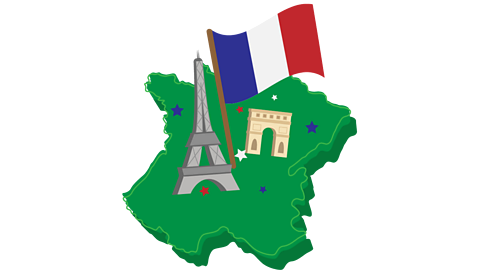
To talk about the country where you live, most of the time, you use the word en for ‘in’ when talking about a country.
Check your connection, refresh the page and try again. – I live in England
Check your connection, refresh the page and try again. – I live in Scotland
Check your connection, refresh the page and try again. – I live in Northern Ireland
Check your connection, refresh the page and try again. – I live in France
Note this exception where you use au instead of en:
Check your connection, refresh the page and try again. – I live in Wales
Say where you come from
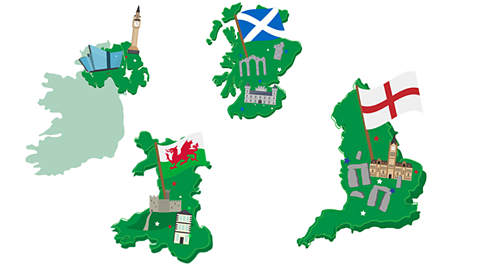
To say where you come from, you use part of the verb venir (to come) followed by de (from).
Check your connection, refresh the page and try again. – I come from
The spelling of de changes depending on which country it comes before. De changes to d’ when the country starts with a vowel:
Check your connection, refresh the page and try again. – I come from England
Check your connection, refresh the page and try again. – I come from Scotland
Check your connection, refresh the page and try again. – I come from Northern Ireland
De changes to du when it appears before a country that is a masculine noun, like le pays de Galles:
Check your connection, refresh the page and try again. – I come from Wales
You can learn more about masculine and feminine nouns in Indefinite and definite articles.
Countries in French
Below are the names of some other countries in French. Try using them to say where you come from.
Notice that in French you use the definite article le, la or l’ (the) in front of the country.
| French | English |
|---|---|
| England | Check your connection, refresh the page and try again. |
| Northern Ireland | Check your connection, refresh the page and try again. |
| Scotland | Check your connection, refresh the page and try again. |
| Wales | Check your connection, refresh the page and try again. |
| Poland | Check your connection, refresh the page and try again. |
| India | Check your connection, refresh the page and try again. |
| Pakistan | Check your connection, refresh the page and try again. |
| Romania | Check your connection, refresh the page and try again. |
| Republic of Ireland | Check your connection, refresh the page and try again. |
| Germany | Check your connection, refresh the page and try again. |
| Italy | Check your connection, refresh the page and try again. |
| South Africa | Check your connection, refresh the page and try again. |
| Bangladesh | Check your connection, refresh the page and try again. |
| China | Check your connection, refresh the page and try again. |
| Spain | Check your connection, refresh the page and try again. |
| France | Check your connection, refresh the page and try again. |
Countries in French. document
Download the PDF for a list of different countries in French.
Key French sounds
Below are some important French sounds that you have heard in this topic. Try practising them yourself out loud.
e
When the letter e is followed by two consonants in French, it makes the sound like e in ‘egg’.
Don't forget that the e at the end of the word is silent.
Check your connection, refresh the page and try again.
eu
This is not an English sound.
Imagine that your have seen something unpleasant, open your mouth a little and sound disgusted!
Check your connection, refresh the page and try again.
j
The letter j always makes the sound like s in the English word ‘television’.
Check your connection, refresh the page and try again.
Quiz
Play Dash and Blink: Forgotten French! game
Construct simple phrases and develop an understanding of vocabulary and grammar with this KS2 French game.

More on French speaking
Find out more by working through a topic
- count2 of 12

- count3 of 12
- count4 of 12
- count5 of 12