What are equations?
Equations are made up of two expressions on either side of an equals sign, such as:
\(x + 1 = 2\)
To solve an equation, you aim to find the value of the missing number.
Example
'I think of a number, add four, and the answer is seven.'
Written algebraically, this statement is \(x + 4 = 7\), where \(x\) represents the number you thought of.
\(x + 4 = 7\) is an example of an algebraic equation where \(x\) represents the unknown number.
The number you first thought of must be three (\(3 + 4 = 7\)).
Therefore, \(x = 3\) is the solution to the equation \(x + 4 = 7\).
Let's turn the problem below into an equation.
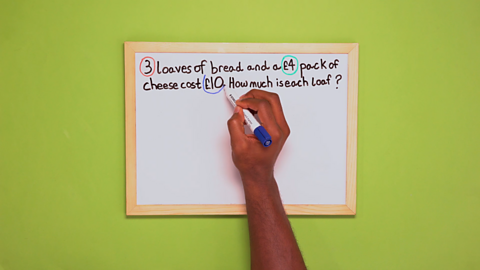
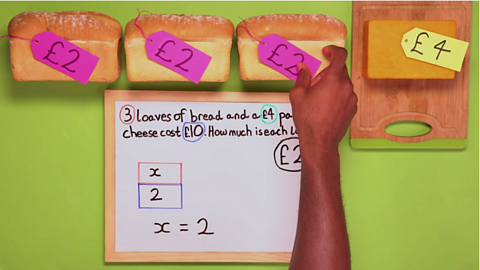
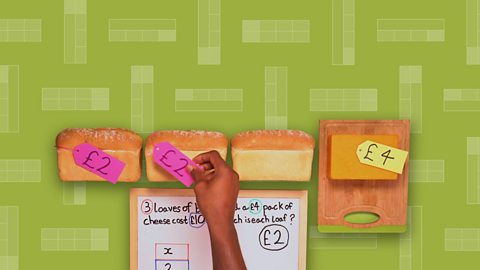
3 loaves of bread and a £4 pack of cheese cost £10. How much is each loaf?
In this equation we want to work out the cost of one loaf of bread.
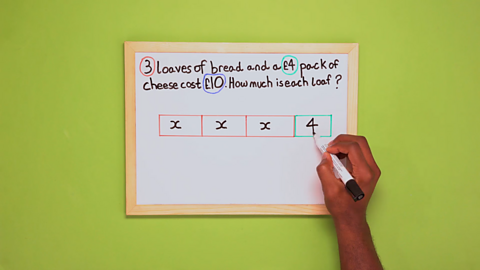
As the cost of bread is the unknown, we will represent this with a x.
We need 3 loaves of bread, so in our equation we will represent this with 3x
We know the cheese costs £4 and the total spend is £10.
So now we can write our equation:
3x + 4 = 10
When solving an equation it is important to find the value of one letter.
Let's solve the equation 3x + 4 = 10
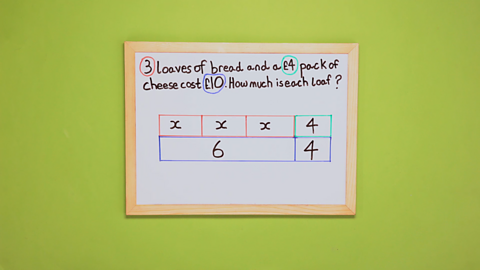
To remove the + 4 we complete the inverse (opposite) operation by subtracting the 4.
3x = 10 – 4
That gives us 3x = 6 (3 loaves cost £6)
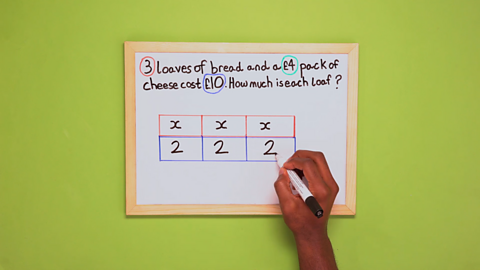
To work out the cost of one loaf we divide both sides of the equation by 3.
x = 6 ÷ 3
So x = 2 (one loaf costs £2)
How to balance an equation
An equation is like a weighing scale - both sides balance because they represent the same amount.
To solve the equation you need to find the value of the missing number by performing the same operation on each side.
Example 1
Suppose you are trying to find out how many sweets are in the bag shown here.
Each of the sweets weighs the same amount.
Let \({x}\) equal the amount of sweets in the bag.
We can ignore the weight of the bag.
By subtracting three sweets from each side, the scales remain balanced.
You can now see that one bag is equivalent to two sweets. Written algebraically, this is:
\(x + 3 = 5\)
Subtract \(3\) from both sides, to give:
\(x = 2\)
There are 2 sweets in the bag.
Example 2
In this case, two bags of sweets are equivalent to six sweets.
Remember - the weight of the bag is zero, so you’ll only need to consider the weight of the sweets inside the bag.
To find the equivalent of one bag, divide both sides by two.
Written algebraically, this is:
\(2x = 6\)
Divide both sides by \(2\) to give:
\(x = 3\)
Question
Solve these equations:
\(a + 4 = 9\)
\(5b = 35\)
You need to subtract \({4}\) from both sides. So, \(a=5\).
You need to divide both sides by \({5}\). So, \(b=7\).
WATCH: Worked examples
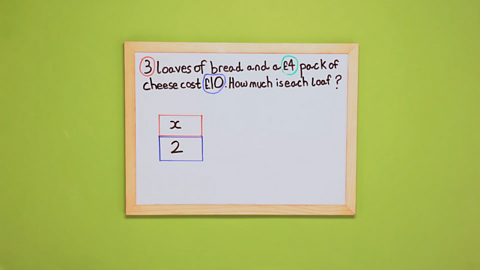
Image caption, Click here to see a step by step slideshow.
1 of 7
Sometimes an equation will have multiples of an unknown, eg \(5y = 20\).
To solve this you need to get the unknown on its own. To do this, divide both sides by \({5}\).
\(5y = 20\)
\(5y \div 5 = 20 \div 5\)
\(y = 4\)
Check your answers
When solving algebraic equations, always check your answers.
For example, if you think that the answer to the equation \(x + 5 = 12\) is \(x = 7\), then check it by replacing \(x\) with \(7\).
\(7 + 5\) does equal \(12\), so your answer is correct.
How to solve more complex equations
Sometimes an equation will have multiples of an unknown and other numbers, eg \(3x + 2 = 8\).
In equations of this type, your aim is to get all the \({x}\)s (or unknowns) on one side and all the numbers on the other.
Example
Let's solve the equation:
\(3x + 2 = 8\).
We can represent this in the diagram opposite, where each bag represents the unknown value \( x \).
Therefore:
\(3x + 2 = 8\)
We want to get the \(x\) on its own.
Start by subtracting \(2\) from both sides.
\(3x + 2 - 2 = 8 - 2\)
\(3x = 6\)
Then divide by \(3\) on both sides:
\(x = 2\)
Question
Solve the equation:
\(4x + 5 = 13\)
\(4x + 5 = 13\)
Subtract \(5\) from both sides to give:
\(4x = 8\)
Divide both sides by \(4\) to give:
\(x = 2\)
How to solve equations with x on both sides
Example
Solve the equation:
\(2x + 2 = x + 4\)
The equation \(2x + 2 = x + 4\) is represented by the diagram opposite.
As before, the bags represent the unknown value (\(x\)) and the sweets represent the numbers in the equation.
Aim to get the unknown value on just one side of the equation, so begin by subtracting \(x\) (taking one bag away) from each side.
Now you have the type of equation that you recognise, so all you need to do is subtract \(2\) from both sides.
Written algebraically, this becomes:
\(2x + 2 = x + 4\)
Subtract \(x\) from both sides to give:
\(x + 2 = 4\)
Subtract \(2\) from both sides to give:
\(x = 2\)
How to solve equations when the term x is negative
Key Point
If the term in \(x\) is negative, tackle the equation in the same way - aim to get all \(x\)s on one side of the equation.
Example 1
Solve the equation:
\(5x - 2 = 12 - 2x\)
Your aim is to get all the unknown \(x\) terms on one side of the equation, so start by adding \(2x\) to both sides:
\(7x - 2 = 12\)
Next add \(2\) to both sides:
\(7x = 14\)
And finally, divide by \(7\) to give:
\(x = 2\)
Again, you can check your answer in the original equation.
So substitute \(x = 2\) back into:
\(5x - 2 = 12 - 2x\)
\((5 \times 2) - 2 = 12 - (2 \times 2)\)
\(10 - 2 = 12 - 4\)
\(8 = 8\)
This makes sense, so the value \(x = 2\) is correct.
Example 2
Solve the equation:
\(4x = 10 - x\)
Add \(x\) to both sides to give:
\(5x = 10\)
To find \(x\), divide both sides by \(5\):
\(x = 2\)
Question
Solve the equation:
\(3x + 1 = 16 - 2x\)
Start by adding \(2x\) to both sides of the equation:
\(5x + 1 = 16\)
Then subtract \({1}\) from each side:
\(5x = 15\)
Divide each side by \(5\) to give:
\(x = 3\)
How to solve equations featuring brackets
Key point
To expand a bracket, multiply everything inside the bracket by the number outside.
Example 1
Expand the bracket:
\(2(3a + 5)\)
Multiply everything inside the bracket by the number outside to give:
\((2\times3a)+(2\times5)\)
Simplify this to:
\(6a + 10\)
Example 2
Solve the equation: \(2(b-2) = -3(2b-4)\)
First expand the brackets: \(2b-4= -6b+12\)
Then add \(6b\) to both sides: \(8b-4=12\)
Add 4 to both sides: \(8b=16\)
Finally divide both sides by \(8\): \(b=2\)
Question
Solve the equation:
\(3(5x - 4) = 2(2x + 5)\)
First expand the brackets:
\(15x - 12 = 4x + 10\)
Then subtract \(4x\) from both sides:
\(11x - 12 = 10\)
Add \(12\) to both sides:
\(11x = 22\)
And divide by \(11\) to give:
\(x = 2\)
How to solve equations written as fractions
To solve equations written as fractions, you must do the same thing to each side of the equation to get the answer.
It is useful to know that \(\frac{1}{2}x\) is the same as \(\frac{x}{2}\), and \(\frac{1}{4}x\) is the same as \(\frac{x}{4}\), etc.
For example look at the equation:
\(\frac{1}{2}x = 3\)
It can be rewritten as:
\(\frac{x}{2} = 3\)
The number at the bottom is \(2\), so multiply both sides by \(2\).
\(x = 6\)
Question
Solve the equation:
\(2x - 3 = \frac {1}{2}\)
The number at the bottom is \(2\), so multiply both sides by \(2\).
Remember that you must multiply every term of both sides by \(2\), to give:
\(4x - 6 = 1\)
Add \(6\) to both sides:
\(4x = 7\)
Then divide both sides by \(4\) to give:
\(x = \frac {7} {4}\), which can be written as \(x = 1 \frac {3} {4}\)
How to solve equations with fractions on both sides
If an equation has fractions on both sides, multiply both sides by the lowest common multiple (LCM) of the denominators…
Example
Solve this equation:
\(\frac {(x - 3)} {2} = \frac {(x - 2)} {3}\)
Solution
One side is divided by \(2\).
The other side is divided by \(3\).
The lowest common multiple of \(2\) and \(3\) is \(6\), so multiply both sides by \(6\).
\(\frac {(x - 3)} {2} \times 6 = \frac {(x - 2)} {3} \times 6\)
\(3(x - 3) = 2(x - 2)\)
Expand the brackets:
\(3x - 9 = 2x - 4\)
Take \(2x\) from both sides:
\(x - 9 = - 4\)
Add \(9\) to both sides:
\(x = 5\)
Test section
Question 1
Solve the equation: \({c}-{7}={1}{2}\)
Answer
\({7}\) should be added to each side.
So \({c}={1}{9}\).
Question 2
Solve the equation: \({5}-{x}={9}\)
Answer
Add \({x}\) and subtract \({9}\) from both sides.
So, the correct answer is: \({x}=-{4}\)
Question 3
What's the value of \({c}\) if \({7}{c}={63}\)?
Answer
Each side must be divided by \({7}\) to get \({c}={9}\)
Question 4
Solve the equation: \({3}{x}+{7}={10}\)
Answer
Subtracting \({7}\) from each side gives \({3}{x}={3}\), we then divide by \({3}\) to get \({x}={1}\)
Question 5
Solve the equation: \({5}{x}+{24} ={9}\)
Answer
Subtract \({24}\) from both sides to get \({5}{x} = {-15}\)
Divide both sides by \({5}\) to get \({x}={-3}\)
Question 6
Solve the equation: \({6}{x}+{5}={19}-{x}\)
Answer
Add \({x}\) to each side to get \({7x}+{5}={19}\).
Then subtract \({5}\) from each side to get \({7x}={14}\).
Dividing by \({7}\) will give you the correct answer \({x}={2}\).
Question 7
Solve the equation: \({4}({2}{y}-{3})={3}({y}+{6})\)
Answer
Expand the brackets: \({8}{y}-{12} = {3}{y}+{18}\)
Subtract \(3y\) from both sides: \({5}{y} - {12} = {18}\)
Add \([12]\) to both sides: \({5}{y} = {30}\)
Divide both sides by \({5}\): \({y}={6}\)
Question 8
Solve the equation: \({4}{x}-{5}=\frac{1}{3}\)
Answer
The first step is to multiply each term by \({3}\) to get \({12x}-{15}={1}\), and then go on from there.
This should lead you to the correct answer which is: \({x}=\frac{4}{3}\)
Question 9
Solve the equation: \(\frac{({y}-{4})}{2}=\frac{({2}-{y})}{3}\)
Answer
The correct answer is: \({y}={3.2}\)
The first step is to multiply each side by \({6}\) (LCM of \({3}\) and \({2}\)).
Then, expand the brackets to get \({3y}-{12}={4}-{2y}\).
Question 10
Solve the equation: \(\frac{({x}+{7})}{6}=\frac{x}{3}\)
Answer
The correct answer is: \({x}={7}\)
The first step is to multiply each side by \({6}\).
Then, expand the brackets and go on from there.
More on Equations with one unknown
Find out more by working through a topic
- count2 of 4
- count3 of 4