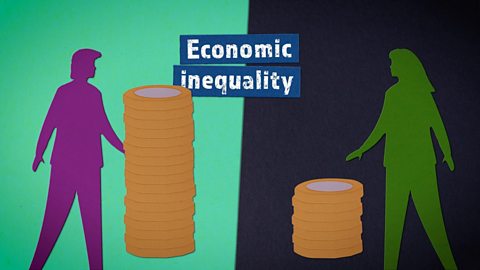
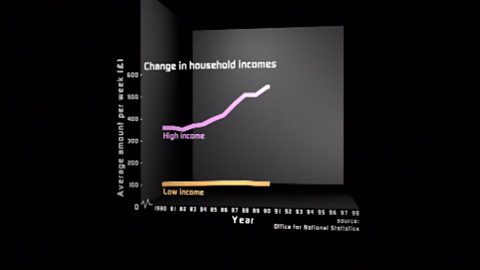
Economic inequality is when financial resources are not shared equally amongst members of society.
Inequality is a major cause of persistent poverty, as people’s income can be affected by education level, access to jobs or social groups.
In the UK, the poverty line is officially defined at around 60% of the median yearly income.
There are many government policies and organisations that aim to reduce poverty. The welfare state has many social provisions to reduce poverty. It is paid for out of tax and national insurance.
So those with higher incomes pay more to support those who have less.
Some provision is general, like the NHS providing free health care for everyone. Some is targeted to help specific groups.
For example, state pensions give older people an income.
Cold weather payments help pensioners and people with disabilities or young children with their fuel costs.
People who are out of work can receive practical support to help them find employment, as well as financial support like Jobseeker’s Allowance.
In return, Jobseeker’s must demonstrate that they are actively looking for a job. Benefits are also used to top up the income of people on low pay.
This is intended to minimise the number of people stuck in a welfare trap where finding a job might result in a lower income because of loss of benefits.
The national minimum wage also aims to help people in low paid jobs.
It is the minimum amount per hour that employers must legally pay their workers.
Everyone over the age of 23 is legally entitled to the National Living Wage, which is a higher amount.
Both are in place to reflect the cost of living.
There are many reasons people are unable to access work that can move them out of poverty, including education levels, care responsibilities and the costs of childcare and travel.
Since 2016, the Scottish Parliament has been responsible for a number of welfare benefits in Scotland, including Disability Payments and Carer’s Allowance.
Best Start Grants for young children and the Bereavement Support Payment. In Scotland there has been free bus travel for over 60s since 2006 and for under 22s from 2022 and the Scottish Government introduced access to free period products in 2021.
Charities and non-profit organisations also provide services to reduce inequality in society.
There are charities that provide food and hygiene banks and help with housing and emergency accommodation.
Health charities can support people with advice and resources.
Some help people with disabilities or health conditions meet the costs of mobility aids and adaptations. or training and assistance to help them find work.
By introducing policies to reduce inequality and support people in need, governments, charities and other organisations hope to create a fairer society for everyone.
Description
Learn about economic inequality in the UK including how factors like education, job access, and social connections can influence income levels, and what are some of the strategies being used to tackle it.
Now playing video 1 of 8
- 3 of 8
- 7 of 8