Unit 4, Section B, Tasks 3-4
The material on this page is designed to help you with revision and preparation for your CCEA GCSE English Language exams. It applies to Unit 4, Section B, Tasks 3-4: Reading non-fiction texts.
- Unit 4 is assessed by a written exam, worth 30% of your final mark
- There are three tasks (numbered 2, 3 and 4) in Section B of the Unit 4 exam, worth 62 of the 150 marks available
- In tasks three and four, you will be given two extracts from a non-fiction text (eg a newspaper article)
- In both these tasks, you will be expected to explain how the writer has achieved something in particular (eg gained and held the interest of the reader, or presented their views on a particular issue)
You can practice for your English Language GCSE exams with a range of CCEA past papers and mark schemes.
INTERIM SPECIFICATION – NOTE FOR YEAR 11 PUPILS
If you are in Year 12 and completing your CCEA English Language GCSE in summer 2027, the above information is correct.
However, if you're in Year 11 and began studying for your CCEA English Language GCSE in September 2026, an interim specification has been introduced.
All Bitesize material currently labelled Unit 4 (referring to the current specification) is now part of Unit 3: Personal or Creative Writing and Reading Literary and Non-fiction Texts, assessed by a written exam, which will be worth 40% of your final mark.
Key points about analysing language and structure
- Writers use techniques such as similes, metaphors, personification and emotive language to make their writing more effective and help readers imagine things clearly
- You should explain how these techniques affect the reader; don’t just spot them, but say how they make people feel, think or picture something
- Structure matters as well: look at how texts are organised, including openings, shifts in focus, pace and endings, to see how they build interest or tension
- Use the SQuID method (Statement, Quote, Infer, Develop) to break down and explain your analysis clearly in your answers
- When annotating, pick out striking words or patterns and think about why the writer chose them: what effect do they have on the reader?
How to analyse use of language
In Martin Luther King's delivered his famous ‘I Have a Dream’ speech in Washington DC. The purpose of King’s The art of persuasive speaking or writing speech was to end racism in America and persuade the audience that everyone should have equal rights.
Included in this speech is the line: “We are not satisfied, and we will not be satisfied until justice rolls down like waters and righteousness like a mighty stream.”
How does he use language to deliver a strong message?
King uses the A comparison using 'like' or 'as' to create a vivid image, eg as big as a whale; float like a butterfly, sting like a bee. “until justice rolls down like waters” and “righteousness like a mighty stream” to make the reader visualise “justice” and “righteousness” as rushing water – implying that they need to be forceful and unstoppable.
Exam questions may ask you to comment on how writers use language to make an impression on the reader.
You should select words and phrases for The interpretation of a piece of text which looks closely at the language, structure and themes used. – to show that you understand how language features affect the reader.
Below are some of the features that writers select deliberately for effect:
Language features
Nouns
Naming words. They may be:
- concrete – naming objects, eg table, car
- abstract – naming ideas and feelings, eg adventure, pride
- proper – naming people, places, days, months etc, eg Marie, Sweden, Monday (always capital letters)
Adjectives
Words that describe nouns, eg green, huge, sparkly.
Verbs
Words that describe actions and states of being:
- action words (do/feel/be), eg run, hide, think
- past tense, eg I played the recorder
- present tense, eg he walks to the shops
- future tense, eg she will go home later
Adverbs
Words that describe verbs and adjectives, eg quickly, patiently.
Pronouns
Someone or something, the subject of the sentence:
- first person, eg I, we, me, my, our, us
- second person, eg you, yours, yourself
- third person, eg he, she, they, them, theirs
Prepositions
Words used to show where something is in place or time, eg at, for, with, after, to, over, from, into.
Literary language features
| Terminology | Definition | Examples |
|---|---|---|
| simile | A comparison using ‘like’ or ‘as’ to create a vivid image. | As big as a whale; float like a butterfly, sting like a bee |
| metaphor | A comparison made without using ‘like’ or ‘as’. | Sea of troubles, drowning in debt |
| personification | A type of imagery in which non-human objects, animals or ideas are given human characteristics. | The jaws of the cave, the leaves danced in the breeze |
| pathetic fallacy | The environment (usually the weather) reflects the mood of the character or scene. | The fog crept evilly through the streets as he stalked his victim |
| onomatopoeia | The sounds of words to express or underline their meaning, sensory imagery. | Crunch, pop, screech |
| alliteration | The repetition of the same sounds usually at the beginning of words. | Reuse, renew, recycle |
| assonance | The repetition of vowel sounds in a series of words. | Harsh bark, moonlit pool |
| rule of three | Repetition in a group of three to strengthen an idea or argument. | Freedom, equality, and justice |
| connotations | Implied meanings suggested by a word rather than its literal meanings. | Red is a colour – but can imply danger, anger and stop |
| hyperbole | Over-the-top exaggeration for effect. | I have ten tonnes of homework to do |
| repetition | Words, phrases or ideas that are repeated for effect. | This is serious, incredibly serious |
| rhetorical questions | A question asked for effect with no answer expected. | Do you think that I’m made of money? |
| emotive language | Words chosen to bring an emotional response. | Defenceless, hard-hearted |
Also consider:
- Is the text in the first person or third person? Is it personal or impersonal?
- Which tense has the writer chosen, eg past or present? What effect does this have?
- How sentences are structured, eg short and simple – to pack a punch – or is listing used to suggest boredom or to pick up the pace?
Avoid ‘feature spotting’ – you need to show that you understand the impact of writers’ language choices on the reader and not just list them.
You should always comment on the possible effects of language use on the reader – how it makes the reader respond eg, think, feel, imagine or visualise something.
Use SQuID to analyse language - My Family and Other Animals
Exam questions ask you to comment on how writers use language to make an impression on the reader. You should use terminology to show that you understand which features the writer is using, as well as how they affect the reader.
One useful language analysis framework is SQuID.
S – Statement – begin with identifying the language feature or type of language being used, eg King uses similes…
Qu – Quote – next quote from the text the word or phrase you are analysing, eg ‘justice rolls down like waters’.
I – Infer – next work out what the words or images imply to you, eg ‘like waters’ implies something is flowing steadily.
D – Develop – finally, develop the analysis with a comment on the reader’s response, eg the reader will imagine justice, like water, being strong and moving forward.
Make your analysis even stronger with a focus on individual words and phrases – analyse closely what they suggest. For example, ‘stony faced’ – ‘stony’ suggests the character is like a statue, hard, unfeeling and immovable.
Example
This extract is from My Family and Other Animals, a memoir by Gerald Durrell, of the five years he and his family lived on Corfu.
How does Durrell use language to describe the character of the ‘Rose-beetle Man’?
For some time the Rose-beetle Man would turn up at the villa fairly regularly with some new addition to my menagerie: a frog, perhaps, or a sparrow with a broken leg. One afternoon Mother and I, in a fit of extravagant sentimentalism, bought up his entire stock of rose-beetles and, when he had left, let them all go in the garden. For days the villa was full of rose-beetles, crawling on the beds, lurking in the bathroom, banging against the lights at night, and falling like emeralds into our laps.
The last time I saw the Rose-beetle Man was one evening when I was sitting on a hill-top overlooking the road. He had obviously been to some fiesta and had been plied with much wine, for he swayed to and fro across the road, piping a melancholy tune on his flute. I shouted a greeting, and he waved extravagantly without looking back. As he rounded the corner he was silhouetted for a moment against the pale lavender evening sky. I could see his battered hat with the fluttering feathers, the bulging pockets of his coat, the bamboo cages full of sleepy pigeons on his back, and above his head, circling drowsily round and round, I could see the dim specks that were the rose-beetles. Then he rounded the curve of the road and there was only the pale sky with a new moon floating in it like a silver feather, and the soft twittering of his flute dying away in the dusk.
My Family and Other Animals, Gerald Durrell (1956)
Analysis
- The choice of name “Rose-beetle Man” implies that the man is very close to nature – like roses and insects. The reader gets the impression he is mysterious – his real name is unknown.
- Durrell uses A 'doing' word; a word expressing action. 'Walk', 'talk', 'come', 'go', 'eat' and 'sleep' are all verbs. and A word that describes a verb (an action or a doing word).“swayed to and fro” and “waved extravagantly” to show the uncontrolled way the man moves. “Extravagantly” suggests the wave was over the top. The reader imagines he is very drunk from “much wine”.
- A sound feature; the repetition of the same sounds (mainly consonants) usually at the beginning of words. “fluttering feathers” also highlights the movements of the man.
- A describing word. “pale lavender evening sky” contrast the lively man to the calm surroundings. The reader can visualise his “battered hat” and “bulging pockets” implying he is scruffy against the beautiful sky.
- The A comparison using 'like' or 'as' to create a vivid image, eg as big as a whale; float like a butterfly, sting like a bee. “the pale sky with a new moon floating in it like a silver feather” creates a gentle atmosphere along with the onomatopoeia “soft twittering” to describe the bird like sound of the man’s flute.
- Durrell uses a A comparison made without using 'like' or 'as', eg 'sea of troubles' and 'drowning in debt'. “his flute dying away in the dusk”, the word “dying” makes the reader feel Durrell’s sadness, as it was “the last time” he ever saw the Rose-beetle Man.
Watch: Analysing language and structure
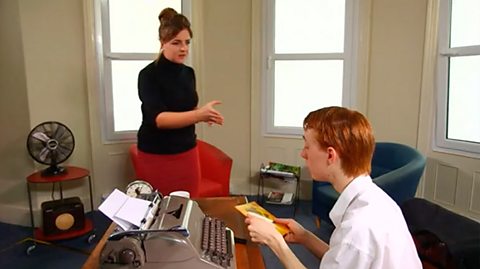
Michelle: Okay, great. Thanks. It's gone like viral. Everyone's on to it. Amazing.
Colleague: These T-shirts are selling like, erm…
Editor: Hotcakes.
Colleague: Eh?
Editor: They're selling fast. I want to know exactly how you put this together so well and what words you chose to persuade people to support our campaign.
Michelle: Natural talent.
Colleague: Big head.
Editor: No, it's technique. It's perfect technique.
Colleague: Yeah, brilliant blog, Michelle.
Michelle: I started with an emotional opening, right? Got the reader involved.
Editor: Yeah, the blog was about bullying, so you started with someone who got bullied. You used emotive language right from the start so readers would know how it feels to be bullied.
Michelle: I found this kid who agreed to tell me his story, and then I used other people's experiences too.
Colleague: I really felt for him.
Editor: Yeah, it made me want to read more and it set the subject.
Colleague: Bullying.
**_Michelle: [LAUGHS] He’s sharp.
Editor: Yeah. And the language you used was persuasive and strong, and like you got into the kids’ heads. And then you went straight to these big and frightening facts. “Almost half of all school kids say they've been bullied at school.” Half: it's terrible.
Michelle: It’s important to get the reader thinking with some shocking facts. Bullying is personal but it's also a big problem.
Colleague: Facts are good, they open people’s eyes. it's good to use them right after a personal story, but too many facts might get dull, right?
Michelle: Right. I edited them down and got the ones that would really get people thinking.
Editor: And went right into online bullying. Good call.
Michelle: Thanks.
Editor: And then you got personal.
Michelle: It pays to get personal. Using your own experience shows you're passionate and keeps them reading.
Colleague: I felt sorry for you.
Michelle: Only for three sentences, and then you knew I got through it.
Editor: And you got angry and got active…
Michelle: …which is what I want the reader to do. Get a T-shirt, stand up for themselves.
Editor: Brilliant.
Colleague: And then you put in interviews with other kids and that made it a bigger story.
Michelle: I wrote it like I was saying it, in the first person. I used simple words like frightening and sad and angry, so it was easy to understand and it was real. I didn't want it to be patronising. I wanted the tone to be honest and powerful.
Colleague: Tone counts.
Editor: And it worked. You're writing to persuade, not just inform. You used the right structure and the right language and it made things happen.
Colleague: [RE-ENTERS ROOM WEARING TINY T-SHIRT] Wrong size.
Understanding how a text is structured - Diary of Samuel Pepys
The structure of a text is how it is organised and how its parts fit together. Writers structure their texts deliberately to have an effect on the reader.
Exam questions ask you to comment on how writers structure their texts to interest the reader. You should use terminology and show that you understand how structural features introduce and prioritise information in a text.
Structural features
| Feature | Purpose | Effect on the reader |
|---|---|---|
| openings | The start of a text must interest the reader. | Comment on how the writer introduces ideas and raises questions. |
| focus | This is what the writer focuses on as the text develops. | Analyse what is implied, eg a gloomy landscape implies an unhappy situation - what is causing that unhappiness? What will happen next? |
| shifts | Changes in ideas and perspectives, eg outside to inside. | Comment on how this change is effective, eg creates contrast. |
| contrast | The differences between two things. | Comment on the effect a drastic difference produces. |
| repetition or patterns | When words, phrases or ideas are repeated for effect. | Repetitive features can highlight key meanings, indicate a development or show a lack of change. |
| pace | The feeling of speed in the writing – are events and ideas revealed to the reader slowly or quickly? | Ask what effect is created by altering the pace, eg a slow pace builds tension or suggests boredom, a quicker pace may suit a piece about things happening at speed. |
| temporal references | References to time. | Comment on how time is used to speed up or slow down the pace of the text. |
| order of events | This could be chronological or writers might choose to start at the end, in the middle, or with flashbacks / flash forwards. | Comment on how the order of events introduces and prioritises key ideas – and how this engages the reader. |
| endings | The conclusion of a text may be neat or leave us with questions. | Think about how the reader feels at the end. Have their feelings changed since the opening? |
| withholding information | Clues and hints are given without revealing everything at once. | Analyse what is implied by hints – how does this build the reader’s expectations? |
| dialogue | Conversations and speech. | How does dialogue move the text forward? |
| headings, subheadings and questions | Divides the content of texts into topics and sub topics, can signal the start of new points. | How do they guide readers through a text? |
| bullets | Bullets can summarise and simplify a range of ideas. | Why does the writer summarise certain points? |
| sentence structures | Varied types of sentences, eg simple, compound and complex. | Comment on how sentence structures affect the fluency of the text, eg a sudden short sentence could reveal shocking information. |
| paragraph lengths | These vary like sentences eg, to highlight significant points or to provide a detailed account. | Comment on how paragraph lengths affect the development of the text, eg a final paragraph might summarise key points in an argument. |
Structure of a non-fiction text
The structure of a non-fiction piece could be:
- chronological – in date or time order
- prioritised – the most important facts first (like a news article)
- separated into blocks by subheadings – eg in a feature article
- question and answer – eg in information leaflets
- problem and solution – eg in agony aunt columns, or self-help guides
- letter structure – a salutation (Dear…) and an appropriate ending (Yours sincerely…)
- starting in the middle of an event, then providing further information to give several possible viewpoints
Using paragraphs to structure a text
Look at the way the key ideas in a piece are ordered. This will help you work out the structure. There is usually one important idea per paragraph, but some texts have more.
Within each paragraph, ideas can be structured in different ways. A common approach is to start with a topic sentence – the big idea – and then develop it with details or examples. Paragraphs often end with a hook to make you consider the ideas included in the paragraph that you have just read, or a link to the next paragraph.
The number and order of paragraphs, the order of the ideas, and how each paragraph is constructed are all features you can comment on. Why has the writer chosen to structure their paragraphs in specific ways?
Additionally, a shortened paragraph that stands out to the reader can sometimes indicate a change in viewpoint or significant point in the text that the writer may offer a counter argument.
Example
This extract describes the events leading up to the 1666 ‘Great Fire of London’.
How does the writer structure the text to interest the reader?
September 2, 1666
It was a small mistake, but with great consequences. On September 2, 1666, Thomas Farrinor, baker to King Charles II of England, failed, in effect, to turn off his oven. He thought the fire was out, but apparently the smouldering embers ignited some nearby firewood and by one o'clock in the morning, three hours after Farrinor went to bed, his house in Pudding Lane was in flames. Farrinor, along with his wife and daughter, and one servant, escaped from the burning building through an upstairs window, but the baker's maid was not so fortunate, becoming the Great Fire's first victim. Did these cakes set fire to London?
The fire then leapt across Fish Street Hill and engulfed the Star Inn. The London of 1666 was a city of half-timbered, pitch-covered medieval buildings and sheds that ignited at the touch of a spark – and a strong wind on that September morning ensured that sparks flew everywhere. From the Inn, the fire spread into Thames Street, where riverfront warehouses were bursting with oil, tallow, and other combustible goods. By now the fire had grown too fierce to combat with the crude firefighting methods of the day, which consisted of little more than bucket brigades armed with wooden pails of water. The usual solution during a fire of such size was to demolish every building in the path of the flames in order to deprive the fire of fuel, but the city's mayor hesitated, fearing the high cost of rebuilding. Meanwhile, the fire spread out of control, doing far more damage than anyone could possibly have managed.
The diary of Samuel Pepys, Samuel Pepys
Analysis
The writer:
- opens with a The differences between two things (in this case, two texts). – “small mistake” and “great consequences”, raising the question of how something small grew so big
- the focus then shifts to Thomas Farrinor, a baker, thinking his “fire was out” – this detail Hint at something that will happen later and will have greater significance the start of the Great Fire, building tension
- a temporal reference – “three hours after Farrinor went to bed” – implies how control was lost in a short space of time as by then his house “was in flames” and there is the “first victim” – implying there will be many more victims
- the question “Did these cakes set fire to London?” suggest that the idea is hard for the reader to believe – and intrigues them to discover how this was possible
- the focus then shifts to how the growing fire “leapt” and “engulfed”, the wooden structure of London and the “strong wind” – together these elements suggest the fire will take over quickly, creating a quicker pace
- contrast is used to show how useless the “bucket brigades armed with wooden pails” are as “the fire spread out of control”
- the extract ends leaving the reader thinking about the vast “damage” the fire caused, and that no-one “could possibly have managed” it
How to annotate for language and structure
Always spend a few minutes considering the question and then quickly annotating the extract to highlight useful evidence – ready to use in your answer.
Annotating language
Don't highlight all the language features you spot – you’ll end up highlighting the whole text. Pick out examples of striking word choices or Any method an author uses to add meaning or interest to a text, such as metaphors, similes or alliteration.. They might be interesting because they’re unusual, or because they’re doing a particularly good job of creating an effect linked to purpose or audience.
Do pick out individual words which you can explore closely – ones with particular An idea or image which is suggested by a word, which is not its dictionary meaning, eg the connotation of 'desk' might be school. for example, or ones which seem especially significant. These are usually adjectives, or phrases that have used particular techniques to conjure up a specific image.
Think about how each word or phrase will support your answer.
Annotating structure
Look at the overall text to begin your annotation. Can you spot patterns in the structure? How has the writer chosen to organise the text? How do they order ideas and information?
Look out for:
- effective openings
- headings and subheadings
- focus and focus shifts
- contrast and pace
- time and place
- repetition and patterns
- paragraph and sentence lengths
- effective conclusions
Highlight or label structural features of a text – it is useful to look at the opening, middle and ending. Briefly note the effect of that feature on the reader – what is the writer prioritising or emphasising through their use of structure?
Quiz: Language and structure
More help with your English Language
English Language revision resources. revision-guide
Get ready for your English Language exams with help from Bitesize.

English Language past papers
CCEA past papers and mark schemes, plus top tips to help you prepare for your English Language GCSE.
More on Unit 4: Reading non-fiction texts
Find out more by working through a topic
- count5 of 5
- count1 of 5
- count2 of 5

- count3 of 5