Housing in the USA
Quick version
- In the USA housing supply is not keeping up with population growth.
- Millions face unaffordable rents and mortgages due to a major shortage of affordable homes.
- Homelessness is rising, reaching record levels in recent years.
- Black and Hispanic Americans are disproportionately affected by poor housing, lower home ownership, and lower incomes.
- Historic redlining created long‑lasting barriers to home ownership and wealth for Black Americans.
- Many low‑income households live in substandard or crowded housing, especially renters.
Learn more
Keep going to learn:
- What problems are there with housing in the US?
- Housing inequality in the USA
- How is the US Government tackling housing inequality?
Then test how much you have learned.
What problems are there with housing in the US?
The USA is described as having a housing crisis. The rate at which new homes are built is lower at the rate at which the population is growing.
As demand for housing has increased, the cost of buying or renting a home has also risen. An increasing number of Americans struggle to pay rent or mortgage payments.
According to the National Low Income Housing Coalition, there is a growing shortage of affordable rental properties, rising from a shortage of 6.8 million homes in 2019 to 7.3 million in 2022. Black and Hispanic Americans are more likely to rent their home, and to be on a lower income, so this shortage is likely to affect these groups more than white or Asian Americans.
Rising housing costs and a lack of properties have contributed to an increasing rate of homelessness, reaching a record high of 653,100 people in 2023.
Rundown inner city areas
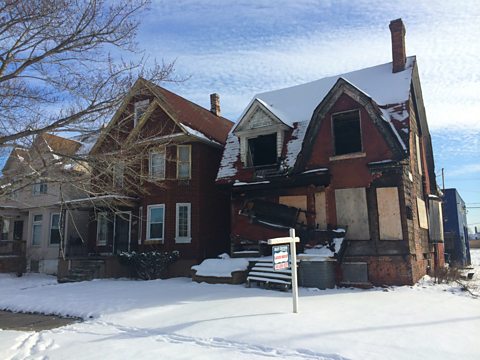
A significant minority of Americans live in run-down inner-city areas. As black and Hispanic Americans are, on average, poorer than white and Asian Americans, proportionally, many more people who are black and Hispanic Americans can be found there.
These areas are characterised by:
- poor housing
- less home ownership
- unemployment
- poverty
- crime
- drug-related issues
American suburbs
Wealthier people, who are more like to be white or Asian Americans as these groups tend to have better education and better incomes, are more likely to live in the suburbs, located on the outskirts of cities.
The characteristics of suburbs include:
- less poverty
- greater home ownership
- less crime
- better-funded schools
- clean streets
(Source: National Library of Medicine)
Lasting impact of redlining
In the 1930s, the federal government set up the Homes Owner's Loan Corporation (HOLC) to help Americans buy their own homes, including by providing mortgages. However, HOLC used the racial mix of areas to decide how much properties were worth, and how safe an investment they were.
Neighbourhoods with large black populations were 'redlined' - classed as "hazardous" investments and residents of these areas were often refused a mortgage or other loan.
In theory, the Fair Housing Act of 1968 brought redlining to an end, but it has left a lasting legacy for black Americans:
- They are less likely to be home owners.
- Younger generations are less likely to inherit property.
- Housing in predominantly black areas has lower value.
- Differences in housing cost make it difficult for black home owners to trade up and move to other areas.
Housing inequality in the USA
Inequality in home ownership
Nearly three quarters of white American live in a household that owns their own home. This is significantly higher than the rate for Hispanic Americans and black Americans: fewer than half of households in these groups owned their own home in 2019.
Home ownership (%) by racial group (2019)
| Racial Group | White | Hispanic | Black | Asian |
|---|---|---|---|---|
| Percentage (%) | 71.7 | 46.8 | 41.7 | 59.4 |
(Source: JCHS analysis of US Census Bureau, 2019 American Community Survey)
Inequality in access to housing finance
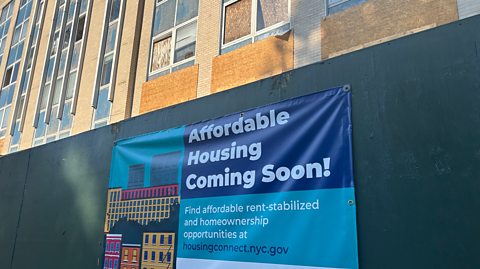 Image source, UCG / Getty Images
Research by The Financial Times based on mortgage applications between 2018 and 2023 found significant differences in how likely different racial groups were to have a mortgage application turned down.
After adjusting for factors such as income, black American applicants were 2.1 times more likely to be refused a mortgage than white Americans. Hispanic Americans were 1.5, and Asian Americans were 1.2 times more likely to be refused than white Americans.
Different racial groups were also found to have different access to different mortgages:
- Prime mortgages are seen by banks as the safest investment and have the lowest interest rates.
- Near prime loans are seen as riskier and come with higher interest payments.
- Subprime are high risk and come with higher interest.
Hispanic and particularly Black Americans are less likely to be offered a prime mortgage with lower interest than Asian or white Americans. This means that buying a home effectively costs them more and takes up more of their income.
| prime | near prime | subprime | |
|---|---|---|---|
| Black | 20% | 13% | 40% |
| Hispanic | 29% | 17% | 29% |
| Asian | 62% | 12% | 11% |
| White | 61% | 13% | 20% |
(Source: Chandan Economics, 2025)
Image source, UCG / Getty ImagesInequality in housing conditions
There are huge differences in the quality of housing across the USA, with many Americans living in inadequate or substandard housing.
in 2021, 6.7 million households, (5.2 %) of all US households, lived in substandard homes. The means homes with multiple structural issues or a lack of electricity, plumbing, or heat.
This issue affects those on lower incomes more, and those who rent are more likely to be live in substandard conditions compared to homeowners. These factors may partly explain why this issue affects black and Hispanic Americans more than other racial groups.
| Share of households in substandard housing (2021) | Homeowner | Renting |
|---|---|---|
| White | 2.9% | 7.0% |
| Hispanic | 4.9% | 9.7% |
| Black | 5.7% | 10.2% |
| Asian | 1.9% | 5.9% |
(Source: Joint Center For Housing Studies, Harvard University)
There are also differences in levels of household crowding for different racial groups. For rented accommodation, 30.9% of Hispanic Americans share a bedroom with at least one other person. The rate is 20.6% for Asian Americans, 12.9% for black Americans and 7% for white Americans.
(Source: Chandan Economics analysis of 2023 American Community Survey data)
Inequality in homelessness
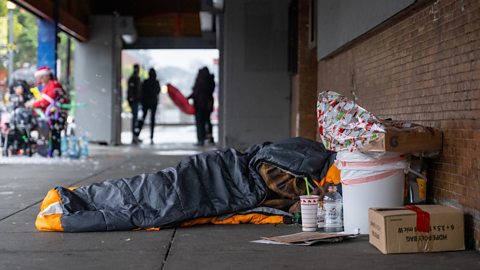 Image source, VCG / Getty Images
 Black Americans have the highest rate of homelessness, although the rate dropped by 7% between 2020 and 2024. The rate of homelessness in the Hispanic American population has risen by 7% over the same period. This may partly be due to higher rates of poverty and unemployment, as well as lower levels of home ownership.
White Americans, and particularly Asian Americans are much less likely to experience homelessness. This may partly be due to higher incomes and higher levels of home ownership.
| People experiencing homelessness by racial group | % of population | % of homeless population 2020 | % of homeless population 2024 |
|---|---|---|---|
| White | 75% | 48% | 38% |
| Hispanic | 20% | 23% | 30% |
| Black | 12% | 39% | 32% |
| Asian | 7% | 1.3% | 1.5% |
(source: Annual Homeless Assessment Report (HUD) 2020, 2024)
Image source, VCG / Getty Images How is the US Government tackling housing inequality?
The Department of Housing and Urban Development (HUD) has introduced various initiatives to tackle housing inequalities.
For example:
- rental assistance programmes
- providing direct housing and services to millions of families across the USA
Funding has also been provided to help:
- people with disabilities who are on low-income pay their rent
- homeless veterans
Housing Supply Action Plan
In 2022, the Housing Supply Action Plan was released by President Biden. The plan aimed to ensure that more and better quality housing would be available, as well as reducing housing costs and enabling more Americans to be able to afford to buy the own homes.
In January 2026, President Trump said he will move to ban big corporate investors from buying single-family homes, in a bid to make housing more affordable for Americans.
Quiz
Recap what you have learned
- The USA is experiencing a housing crisis with population growth, driving up demand, increasing both rents and house prices.
- Millions of Americans struggle to afford housing, with a growing shortage of affordable rental properties rising from 6.8 million (2019) to 7.3 million (2022).
- Rising housing costs and limited availability have contributed to record homelessness, reaching 653,100 people in 2023.
- Black and Hispanic Americans are more likely to rent, have lower incomes, live in run down inner city areas, and experience poorer housing conditions.
- The legacy of redlining, affects Black Americans through lower home ownership rates, reduced inherited wealth, and lower valued housing.
- Access to housing finance is unequal, with Black, Hispanic, and Asian applicants more likely to be denied mortgages and less likely to secure low interest “prime” loans.
- Housing conditions vary widely, with millions living in substandard homes; low income households and renters are more affected.
More on World power: USA
Find out more by working through a topic
- count10 of 10