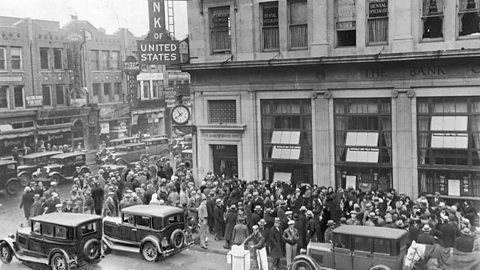
The Wall Street Crash and its immediate effects
A number of financial experts warned that the American economy was slowing down and in September 1929 some investors started selling Financial stakes in a company or business. in large numbers. Many people started feeling nervous and investors went into panic and rushed to sell their shares.
On 24 October 1929, now referred to as 24 October 1929 - the start of the Wall Street Crash, a 'black' day economically., 12.8 million shares were sold. Thousands of people saw their fortune, or any money they had in the bank, disappear. On 29 October 1929, 16 million shares were sold at very low prices. A centre where shares are bought and sold. in New York had collapsed.
A period during the 1920s when people enjoyed cultural and economic developments. came to a sudden end. Investors lost their money in the Crash and could not pay their debts. Many banks closed, ordinary people lost their savings and people lost all hope for the future.
People could no longer buy consumer goods like cars and clothes. As a result, workers were made redundant, other workers' wages were cut and unemployment rose to very high levels. By the end of 1929, 2.5 million Americans were out of work.
This was the start of the A prolonged economic downturn, beginning after the Wall Street Crash, that affected the whole world. of the 1930s.