
What are your plans for 12 August 2026? If some social posts are to be believed, you might need to cling on to something heavy to stop your day being ruined.
A conspiracy theory has been building online that the Earth’s gravity will 'stop working’ for seven seconds on that day, due to activity related to black holes. It’s allegedly linked to a programme by the US space agency NASA called Project Anchor, with claims on some posts that - as part of the project - almost 90 billion dollars had been spent on trying to prevent the massive problems a brief loss of gravity would cause.
What would happen if the Earth lost gravity?
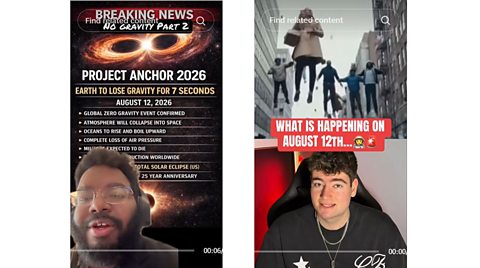
According to the website How Stuff Works, if there was no gravity - even for a brief period - Earth would start to break up as there would be nothing to keep people, buildings, and even air and water, anchored to the ground. The injuries and damage caused, especially from everything falling back to any ground that was left as gravity returned, would take a long time to put right.
Is the Earth going to lose gravity for seven seconds?
There is absolutely no evidence to suggest that the Earth is going to lose gravity on 12 August, nor is there any public record that NASA is working on something called Project Anchor. This is an example of disinformation that has been spread on socials, in an attempt to put fake news out there. It may be that someone wanted to discredit NASA by publishing incorrect stories about them. Posts by those who believed the stories and shared it themselves are an example of misinformation - spreading fake news by mistake.
BBC Bitesize Other Side of the Story contacted Jodrell Bank, the Cheshire observatory famous for its huge radio telescope, to find out more about the Earth’s relationship with gravity. Education officer Lexie Southern explained: “Objects have a pull of gravity because they have mass – the larger an object’s mass, the larger its gravitational pull.
"The Sun’s gravitational pull dominates the solar system, keeping the planets in orbit because it is the body in the solar system with the greatest mass. The strength of gravity experienced is also affected by proximity – the closer you are, the stronger the pull you experience, so the Moon is kept in orbit around Earth by gravitational pull between Earth and the Moon, and the Moon’s gravitational pull affects our tides.
"In order to 'turn off' gravity, you would need to stop the Earth, and everything on it, from having mass, which is impossible.”
What is really happening on 12 August 2026?
There is an astronomical event happening on this date, but it has nothing to do with gravity. A total solar eclipse is expected to be seen from the Arctic Ocean, Greenland, Iceland, Atlantic Ocean, Portugal, and northern Spain on that day.
There is no connection between this and the supposed gravity loss, as NASA explained: “A total solar eclipse has no unusual impact on Earth's gravity. The gravitational attraction of the Sun and Moon on the Earth, which doesn't impact Earth's total gravity, but does impact tidal forces, is well understood and is predictable decades in advance.”
This article was published in March 2026

Not sure if the news you’re seeing on social media is true or false? Can you always tell if the things you see online are real or fake?
Learn how to get the other side of the story with our quizzes, videos and explainers about media skills and viral trends including popular food myths.


Other Side of the Story
Back to our homepage for more quizzes and explainers about fake news, viral trends and media skills.