Sign up to the BBC Bitesize newsletter! External Link
For home education news and stories plus updates on the latest Bitesize content, register for our newsletter today.

Grandparents and home education
If grandparents are a part of your child’s life, the benefits they're able to bring to a child’s wellbeing can also extend to a child’s home education.
Whether that’s through reading together with your child, offering them one-on-one time and attention, or passing on their own skills and interests, grandparents can be a positive and plentiful source of development.
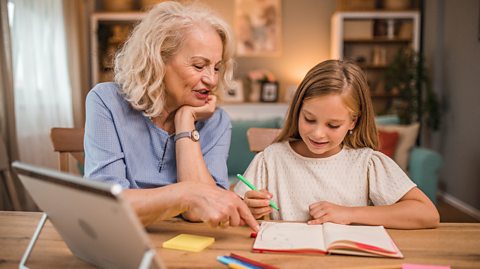
What benefits do grandparents bring to children?
According to the Association of Child Psychotherapists (ACP), children can feel “another level of support and care” through their relationship with their grandparents, contributing to their overall wellbeing.
Grandparents offer attention, support, different viewpoints and interests. They can also offer a bridge between life at home and the “outside world”, according to the ACP, helping children feel safe and secure enough to venture out into the world.
Teenagers often need a relationship with a close adult who’s not part of the immediate home and family environment, a part that can be filled by a grandparent.
What role can grandparents play in a child’s home education?
“One of the greatest gifts grandparents can offer is being able to show children that learning lives in everyday life.” – Dr Alistair Bryce-Clegg, early years expert
Dr Alistair Bryce-Clegg MBE is an early years consultant, author and recent grandfather: “Grandparents are brilliantly placed to support children’s learning because often they can bring time, patience and a different rhythm to the day."
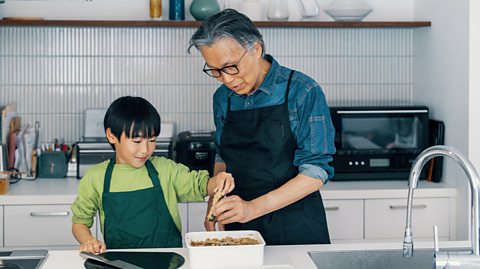
"When learning happens through shared experiences - playing cards or board games, cooking, gardening, reading together or talking - children are developing language, early maths, problem solving and social skills without it ever needing to feel like ‘work’."
"Grandparents can… show children that learning lives in everyday life, not just in workbooks, or on screens.”
Video - learning from grandparents
NICOLA: My dad, so the girls' grandad, he is really involved with the kids.
He's musical. So he brings violins, he brings instruments for them.
He is able to teach them a lot of things that I can't teach them.
And they absolutely love him being here.
For Nicola and her family, home education has been a tough but transformative journey after worries about her daughters' mental health in school and additional needs.
Nicola's dad, the girls' grandfather, plays an active part in their home education activities. Watch Nicola's full story.
What can grandparents who are helping to home educate do?
Jenny is home educating her 15-year-old grandson. As well as helping him prepare for his GCSEs she says she takes him out, “for a broader education experience”, including history days out, opera and open air Shakespeare.
They’re also “studying logic and philosophy”, cooking and financial literacy.
Jenny tries to teach her grandson critical thinking, discussing politics with him, “and the role the media takes in shaping public opinion.”
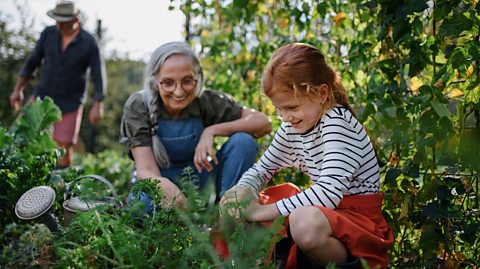
Dr Alistair Bryce-Clegg says: “For grandparents who are supporting home education, the most important shift is to stop worrying about having to ‘teach’ and capitalise on the value of sharing time and just being alongside."
"Children learn best when they’re doing things that matter to them, with an adult who’s interested, responsive and curious. Playing, exploring, telling stories, fixing things, going for walks and wondering out loud all create rich learning opportunities."
"You do not need to recreate ‘school’ at home. Everyday moments are more than enough to support deep and meaningful learning.”
What are some examples of how grandparents help with home education?
“My sons regularly spend a day with my father, where they work alongside him… things like carpentry, gardening and general property maintenance.” – home-educating parent, Emma
Emma Beal home educates her three children. Her eldest son is thirteen. She says grandparents “play a really active role” in her children’s lives and learning: “While they’re not involved in formal ‘lessons’, they contribute hugely through shared time, skills and experiences. My sons regularly spend a day with my father, where they work alongside him on practical projects. It’s very hands-on and focused on real-life skills, problem-solving and learning by doing.”
Her daughter sometimes bakes with her husband’s mother and goes on theatre trips with Emma’s parents. Her son’s grandparents recently took him to explore London and the Natural History Museum.
It helps that all the grandparents live nearby, making their involvement “easy and natural”. Emma feels grandparents, “can enrich home education through skill-sharing, cultural experiences, and simply through their presence."
Home-educating grandparent Jenny tries, “to make sure family holidays incorporate some education opportunities too. In Turkey we visited Ephesus… and he’s had a weekend in Rome.”
Jenny adds: “My main tip is to think holistically, to try to think of all the areas you wish you’d been taught at school but weren't. To remember that home ed doesn’t have to be books and worksheets (as in school, although we do use these) but a wider range of things.”
What other things can grandparents do for home education?
As well as the activities already mentioned, grandparents can have an impact on speech, reading and literacy. Ellena (not her real name) is a carer with special guardianship of her two grandchildren, aged five and two. She received books through care charity Kinship and reading charity Booktrust.
Her five-year-old granddaughter has learning difficulties. Ellena's noticed how the books grabbed her granddaughter's attention: “Identifying emotions, that’s something she’s recently done,” she says. “I know for a fact she picked up from the faces in the book, The Perfect Fit, how those people were feeling.”
Where can I find more activities for grandparents?
Check out these fun things to do with your grandchildren:
- Nine indoor craft activities to do with kids on rainy days
- Five fun, free things to do outside the house when you're home educating
- Five fun ideas for a sleepover with your grandchildren
Explore loads more ideas on the CBeebies grandparents page, including advice on how to build your confidence.
Where can I find more support for home education and parenting?
The BBC Bitesize home education collection is designed to support you and your child’s learning at home with free downloadable resources, advice articles and videos for children aged two-to-five years old, five-to-11 years old and 11-to-16+ years old.
Bitesize Parenting is the go-to place for the whole parenting community to find stories, expert advice and fun activities.
If your child has special educational needs or disabilities, be sure to check out the Parenting SEND collection. Bitesize has a collection of Sensory Stories, an immersive video series of unique sensory adventures for children with additional needs.
For more information about home education, this BBC News article covers the rise in families deciding to educate their children at home.
