What happened to the Maya?
The ancient Maya were a complex civilisation that built many cities, temples and pyramids in Mesoamerica. They developed sophisticated writing and had many achievements.
Over seven million Maya people live today and have maintained some of their ancient traditions.
Important words for the Maya civilisation
| Keyword | Definition |
|---|---|
| Archaeologist | A person who digs up and uncovers artefacts to help understand the past. |
| Artillery | A large weapon, such as a cannon, that can fire over long distances. |
| Disease | An illness that can make people feel unwell. |
| Excavate | Digging into the ground to find clues to understand the past. |
| Fresco | A special way of painting onto walls. They are usually pictures painted onto wet walls. |
| Remote village | A village far away from where most people live, such as towns or cities. |
| Tradition | A special belief or activity that a group of people or family follows. |
Watch: How did Maya civilisation change?
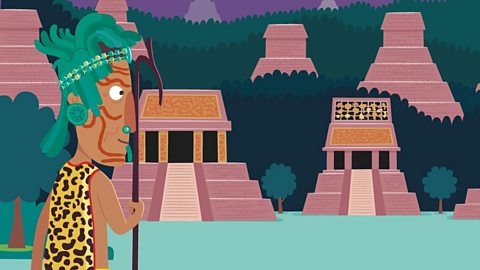
Jade Skirt in AD732: Look at our beautiful city of Yax Mutul. I imagine our people will live here for hundreds of years. But who knows what the future holds?
Jade Skirt in 1150: We now live further North than my ancestors, in new cities like Chichén Itzá. I’m not exactly sure why we had to move. Some say it was a change in weather.
Or that we farmed the land too much. Terrible diseases. Or because our cities fought so much!
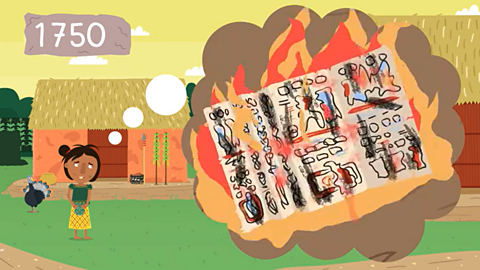
Jade Skirt in 1750: So much has changed. The Spanish arrived and destroyed our cities and built their churches – sometimes on top of our pyramids!
They made us work on huge farms and even burnt our books.
But we still try hard to keep our traditions alive.
Present Jade Skirt: And that’s the story of my people. Over the years people moved from villages to modern cities, making it difficult to continue some of our traditions. Which is why I’m telling you our story.
Hopefully you will now tell it too.
What happened to the ancient Maya?
From around 1517 - 1697 Spanish invaders (conquistadores) started to destroy the Maya cities and people.
The Spanish were armed with artillery, steel swords and muskets (guns) the Maya had only spears, bows and arrows.
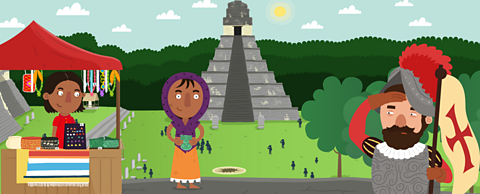
The invaders brought diseases which were new to the Maya. They also tried hard to remove all traces of Maya culture over the following centuries.
Did Maya culture and society survive?
The Spanish conquest resulted in centuries of cruelty towards the Maya people, causing their population to get smaller. In spite of this, many Maya people kept some of their traditions.
The remote villages continued the Maya beliefs and language. In the late 19th and early 20th century, people began to study the Maya culture. So Maya people tried to keep their way of life.
Watch: Maya remains
Jade Skirt: Many hundreds of years from now, I hope people will still be able to admire the things we Maya create.
(SHOUTS) Like our incredible temples.
Oh look… the scribe is writing a book.
The books are sacred and reading them brings the spirits of our ancestors to life.
Our books are made from tree bark, with the covers made from the skin of a powerful animal.
Scribe: Shhh!
Jade Skirt: These books may not last forever, so we also carve our writing into stone.
We also have other types of art too…our pottery, our jewellery, our amazing mosaic masks.
Surely though, our roads will survive the longest.
They run through the forests - connecting our cities.
Our warriors use these roads… Arrggghhh! But we also use them to send important messages and trade our goods.
Jade’s Brother: [GROWLS]
Jade Skirt: Ooo, that’s my brother. I should be at home.
Deer: [SPLAT]
[FLY BUZZING]
Buildings
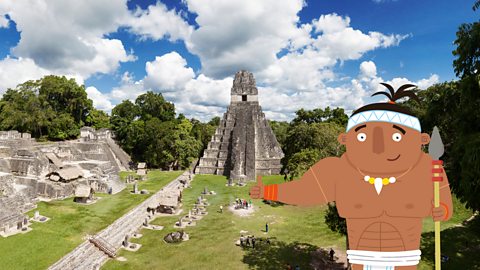
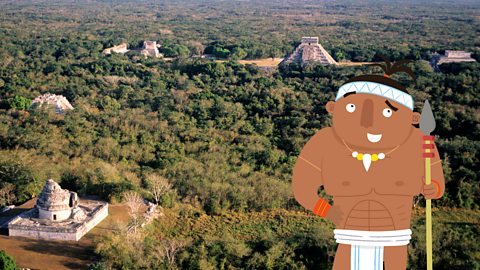
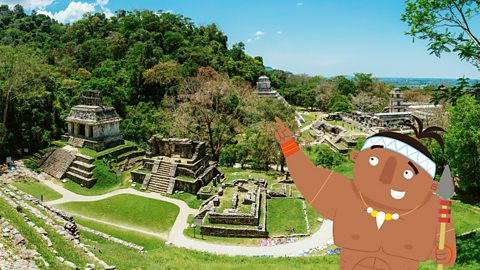
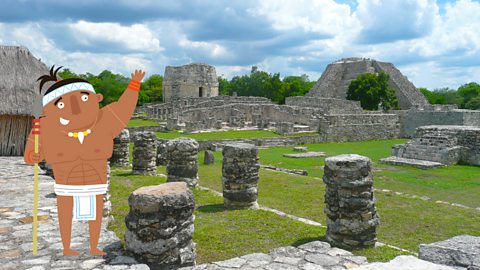
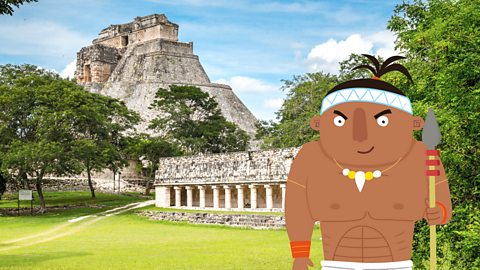
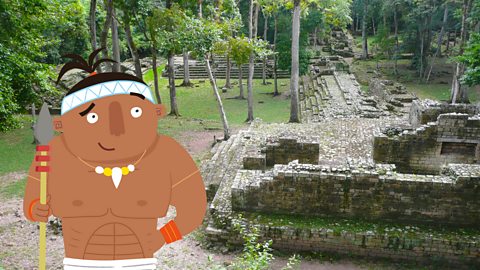
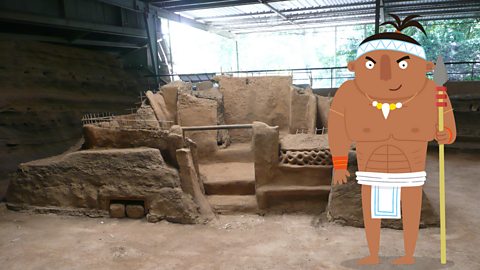
The Maya people built many cities, temples, pyramids, palaces and gateways in stone which have been uncovered and excavated.
Each region and city had different building materials, limestone or volcanic materials. There were complex networks of defensive walls and ditches, brightly coloured with paint.
What do they look like now?
Image caption, Take a look at some of the fascinating ancient ruins from around the Maya world.
1 of 8
Weapons
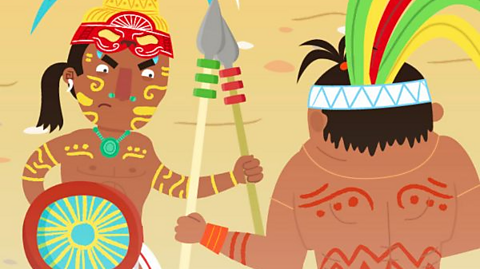
Archaeologists have found stone blade points, which they believe were used as part of weapons such as spears.
They have also found images on frescoes and pottery which show show kings and warriors in protective clothing carrying weapons and shields. These images help historians understand what Maya warriors wore and what they used to fight in battle.
Writing
Maya writing was the most sophisticated system in Mesoamerica, dating back to 300 BC.
Maya script survived on stone inscriptions (‘stelae’), frescoes, ceramic vessels, wooden lintels and cave walls.
The Spanish conquistadors tried hard to destroy all evidence of Maya writing in the 16th century and only three books survive, a tiny fraction of all their writing.
What about the Maya today?
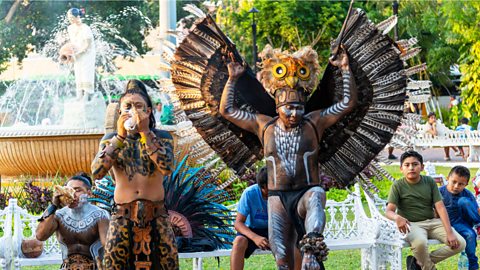
Today there are over seven million Maya people, most of whom live in Central America and southern Mexico.
There are 250 museums around the world with Maya items in their collections.
Image caption, Explore modern Maya life by clicking through the images.
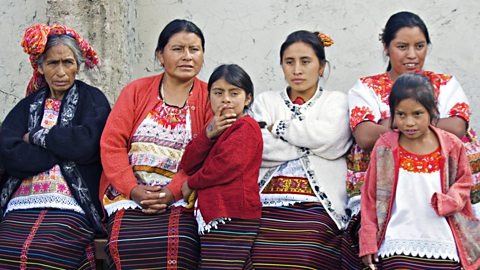
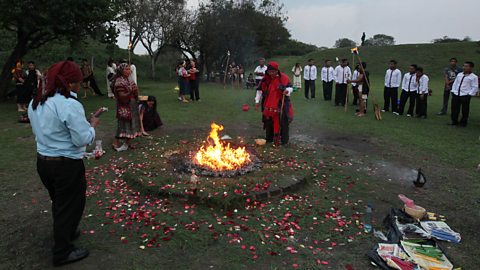
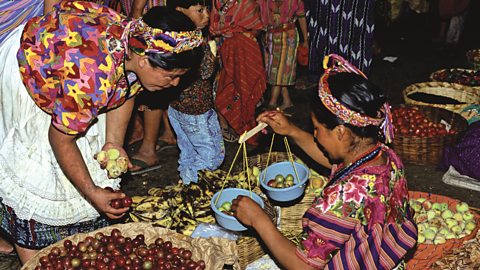
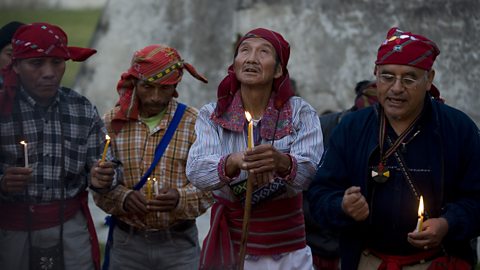
1 of 5
There are currently 31 different Mayan languages being spoken today.
However, these languages are becoming endangered because of discrimination. Sometimes people won’t even be offered jobs if they speak a Mayan language!
To keep these languages alive, some people write literature in Mayan languages as well as Spanish, so that their culture will not die out forever.
Think like a historian
Have a look at the thinking points below and think about your answer to each question. You could even write them down on a piece of paper or discuss them with somebody else if you want to.
- What do you think was the most significant change that happened to the Maya people?
- Why do you think the Spanish invaders were so successful against the Maya?
- Why do you think it is so difficult for archaeologists and historians to agree on exactly what happened to the Maya?
Did you think about the Maya leaving their cities in the south and moving to the north? This may have happened because the land was over‑farmed, the weather changed, or because cities fought each other so often. These changes would have been very difficult for many Maya people. You may also have thought about the arrival of the Spanish invaders. They destroyed many Maya cities and temples and brought new diseases. This would have had a big impact on Maya people’s lives.
Maybe you thought about the weapons the Spanish had and how they would have helped them to fight. They had artillery, steel swords and guns while the Maya only had spears, bows and arrows. This would allow the Spanish to overpower the Maya. Did you also think about the different diseases the Spanish brought with them? The Maya people would not have been exposed to them before which meant many would become very ill and possibly die.
Did you remember that historians have to use different pieces of evidence, like ruins, artefacts and pictures, to decide what might have happened. They may explain this evidence in different ways. Perhaps you thought about how the Spanish burnt many of the Maya’s books, which means important evidence was lost. Perhaps you thought that because historians do not have all the evidence, it is difficult for them to agree on one clear explanation.
Quiz – Remains of the Maya
Let's find out what you know about what happened to the Maya in this quiz.
Grown-ups corner
Are you a parent, carer or teacher?
Take a look at some of the links below on KS2 History which are packed full of knowledge, videos, quizzes and activities.
History Explorer: Secrets through time. game
History Explorer: Secrets through time: KS2 History
What happened to the ancient Egyptians?
KS2 History
Horrible Histories: Raid and Trade game! game
Play Horrible Histories: Raid and Trade KS2 History
More on Maya Civilisation
Find out more by working through a topic
- count5 of 9
- count6 of 9
- count7 of 9
- count8 of 9