Why do we still talk about the ancient Greeks?
Many parts of modern life, from the Olympic Games to the way we choose our leaders, began thousands of years ago in Greece. The ancient Greeks:
- made discoveries in science and maths
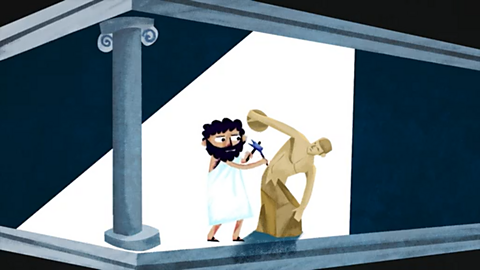
- created beautiful art and buildings
- wrote stories and kept historical records
- used a language and alphabet that influenced English
- developed ideas about government
Important words for the ancient Greeks
| Keyword | Definition |
|---|---|
| Architecture | The art and science of designing and constructing buildings. |
| Mathematics | The study of numbers, shapes and patterns to solve problems and explain the world. |
| Philosophy | The study of ideas about knowledge, truth and how people should live their lives. |
| Statue | A figure of a person, god or animal made from a hard material like stone or metal. |
| Temple | A building used for worship to honour a god or goddess. |
How did Greek ideas spread so far?
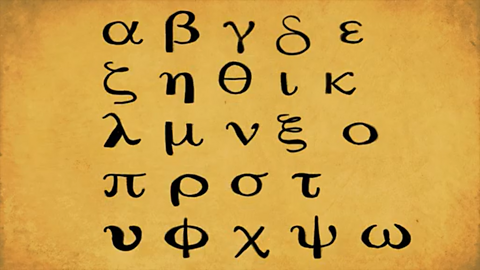
Even after 3,000 years, we're still using ancient Greek ideas in maths, science and art. Our alphabet is based on the Greek one. Hundreds of words we use come from the Greek language.
This happened because of a young king called Alexander. He led his army to take over Greece, Persia, Egypt and even part of India. He ruled so much of the world people called him ‘Alexander the Great’.
Wherever he went, he took Greek ideas. After he died, the Romans took over. They liked the Greeks' way of life and carried Greek ideas to even more countries - including ours!
Watch: What did the ancient Greeks do for us?
Find out about some of the ways the ancient Greeks changed the world.
Many of the things that make the UK a really cool place to live were actually invented by the Greeks – we just copied them.
OK, we didn’t copy everything. But let’s give them a bit of credit anyway. First off the Greeks gave the world democracy – which we still use in Britain today to choose who runs the country.
In ancient Athens, citizens met regularly to vote on the laws that changed their daily lives using a simple show of hands by all.
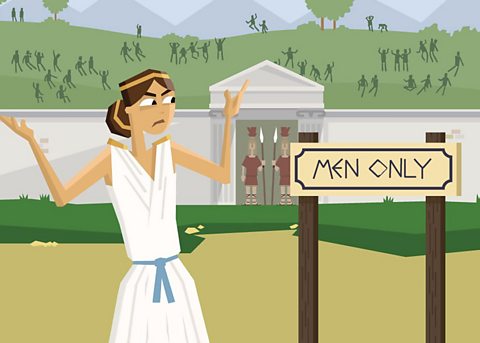
I say all… women, slaves and foreigners were banned from voting. So NOT so democratic really!
The Greeks also gave us the Olympic Games. The very first Olympics took place in 776BC.
The only event was a 200m foot race and the winner was a humble baker named Coroebus.
As time went on the Greeks added more events making it more like the Olympics we know today.
The big difference being that the Greeks did it all in the nude!
The Greeks pretty much invented modern mathematics, sculpture, philosophy, science and even medicine.
And they used some of their new knowledge to make inventions like the water wheel, the alarm clock, the catapult and even, the vending machine!
Finally, our language has roots in ancient Greece, from the individual letters through to complete words like dinosaur and helicopter!
So, whether we are talking about language, science, maths, law, building, sport, art or annoyingly early wake up calls – the Greeks got there first.
Did the Greeks invent government?
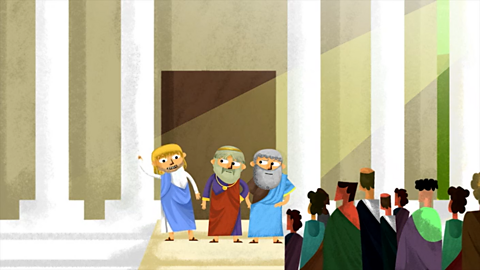
In ancient Athens, citizens would gather together on a dusty hill called the Pnyx.
There they would decide the city’s laws and who should be on its ruling council. This was democracy or ‘rule by the people’.
All 30,000 citizens were men. Women and enslaved people didn't get a say.
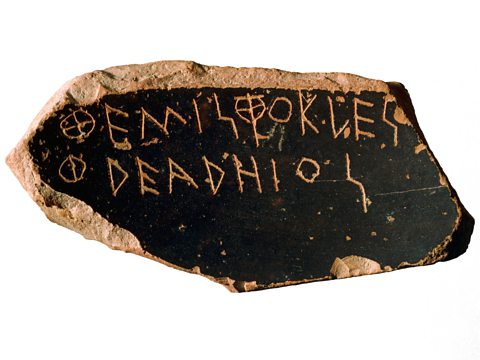
A citizen could speak for the time it took water to run from one jar into another. When this water clock ran out, it was someone else’s turn.
Men could write a name on a broken bit of pottery called an ostracon. Anyone named at least 6,000 times got kicked out of the city.
Today, we also live in a democracy. Unlike in ancient Greece, women get to vote, too. Juries decide if someone is guilty of a crime - we don’t use ostracons anymore!
How did the Greeks change sport?
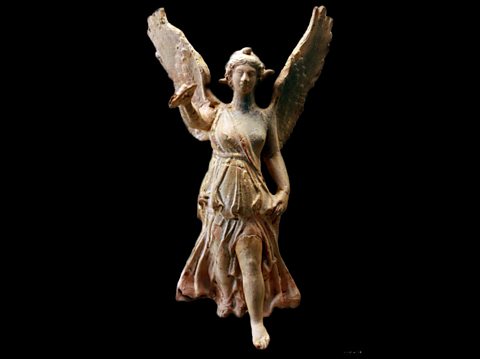
The Greeks loved sport as much as we do. They enjoyed the discus, javelin, long jump, boxing and horse racing.
Greek men and boys trained in a gymnasium. We also go to the gym, although today women and girls are welcome too.
Athletes prayed to Nike, the goddess of victory - she’s still a big name in sport today!
The Greeks loved to watch races in a big, open-air ‘stadion’, very like a modern sports stadium.
An ancient Greek legend tells of Pheidippides, who fought at the battle of Marathon. When the Greeks won, he ran 26 miles (42 km) to Athens with the news – and then fell down dead. Modern marathon races cover the same distance as his epic run.
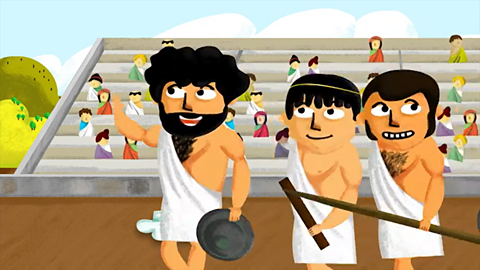
Every four years the Greeks held a special sporting festival at Olympia - the Olympic Games.
These inspired the modern Olympics which began in 1896. Some of the events were very similar.
Like the Greeks, we also hold the Olympics every four years.
How did the Greeks influence art and architecture?
Greek art showed people and gods in lifelike poses, inspiring artists for thousands of years.
The ancient Greeks also built beautiful temples and statues to honour their gods.
They used columns in three main styles to decorate buildings.
- Doric was the simplest style with sturdy plain tops and no base.
- Ionic styles were more decorative with slimmer columns and scroll-shaped designs at the top.
- Corinthian style columns were the most ornate with elaborate designs with carved leaves.
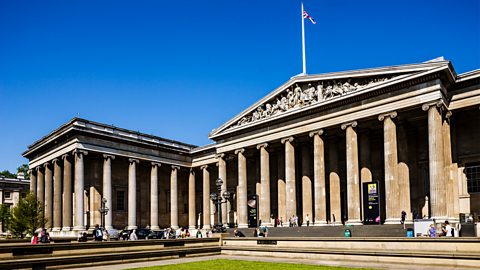
Many modern buildings, like museums and government offices, are based on Greek designs.
Famous Greek scientists, philosophers and writers
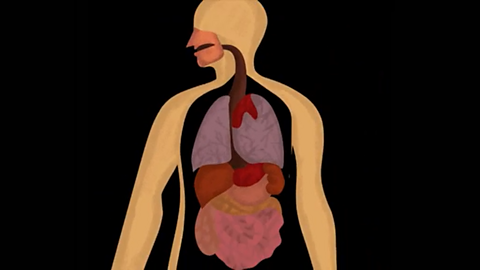
The ancient Greeks valued education and believed learning helped become better citizens.
Ancient Greek thinkers made big discoveries. Hippocrates was famous for his ideas about medicine. Ancient Greek ideas about medicine spread to other countries and were used for a long time.
Doctors still take a Hippocratic Oath, promising they will help people and not cause anyone to be hurt.
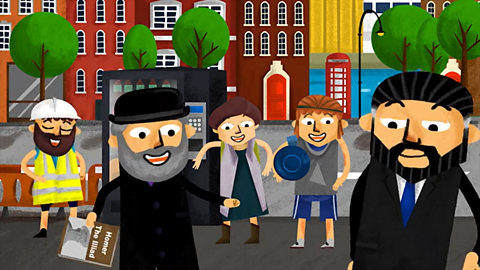
Sappho was a famous Greek poet. What we have left of her poetry is still read today.
Herodotus wrote a history of the Greeks. He used eyewitness reports to write it, something today’s historians also try to do.
Philosophers like Socrates, Plato and Aristotle studied philosophy and science to understand the world. They asked questions such as “What is a good life?” and “How do we think?”, which people are still trying to answer today.
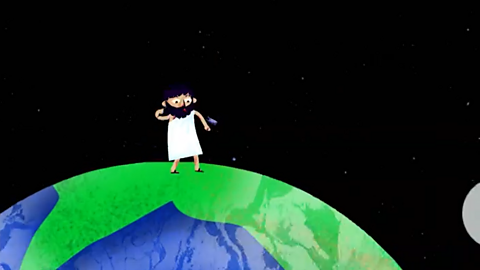
Aristotle studied plants, animals and rocks. He carried out experiments to find out about the world we live in. Modern scientists do the same kind of thing.
Greek mathematicians such as Euclid and Pythagoras made discoveries still used in schools today. Their ideas shaped how people study and learn across the world, from universities to modern science.
Watch: Dick and Dom discover Archimedes
Dick and Dom discover the work of Archimedes, one of the greatest Greek thinkers.
Dick: Ah, you join me in the bath where we go inside one of the greatest scientific minds this world has ever seen.He was famous for coming up with the genius idea whilst in the bath. Not only was he a fantastic mathematician and engineer but his genius machines are still being used today.
Dom: He did all of this over 2000 years ago.
Dick: Why are you in my bath?
Dom: I, I, I don’t know.
Dick: Ladies and gentlemen we give you, Archimedes.
Archimedes: Why are you in his bath, Dom?
Dick: Archimedes was a Greek guy with a great beard. Born a ridiculously long time ago around the year 287BC.
Dom: Archimedes was a genius when it came to maths, physics and engineering. He was so clever, he was hired to solve tricky problems by the King of Syracuse.
Dick: He came up with the brilliant theories about why objects float and he built amazing machines to help defend the king’s city against attack.
You might know the story of Archimedes being in a bath and coming up with a fantastic idea that helped him solve a problem that had been puzzling him for ages.
Dom: He was so excited about solving this problem that he jumped out of the bath, nudey, shouting ‘Eureka, eureka!’
Dick: In Greek, that means ‘I’ve got it, I’ve got it!’
Dom: But what exactly had he got?
Dick: If only Fran, our genius scientist was here to tell us more.
Fran: So Archimedes was working on a problem that had been set by the king because the king didn’t know whether his crown was made of pure gold or not.
Dom: So it was at that moment in the bath that Archimedes solved the problem.
Fran: Yeah.
Dick: But why did he get so excited about that?
Fran: Well, the thing is, his solution didn’t just allow him to work out whether crowns were made out of pure gold or not, it allowed him to figure out why things float and why things sink and that is much more useful. Come with me.
Dom: I mean, we’re not complaining or anything Fran but what’s all this got to do with Archimedes?
Fran: He knew that different materials could weigh the same but you get different amounts of material for that same weight.
Dom: So what you’re saying is, basically you get some light and fluffy marshmellows , you get loads of them for 100g.
Fran: Yeah.
Dick: Ah, but only a few aniseed balls.
Fran: Exactly, and Archimedes figured out that the more of a material you get for that certain weight, the more likely it is to float.If you don’t believe me, let’s try it.
Dick: Ah, sinkage.
Dom: Sinkage. So… There you are. Floating!
Dick: Ah, eureka!
Dom: Eureka!
Archimedes: I’ll say!
Dick: Until Archimedes came along more than 2000 years ago, building ship that would float well was always a trial and error operation.
Dom: I mean there’s no doubt Archimedes was a really clever bloke.
Dick: Look there’s something else here. ‘He set to catch the full rays of the sun at noon.’ He’s saying here that he set fire to boats.2000 years ago Archimedes made a special heat ray to defend his city walls against attack from Roman ships.
By cleverly positioning mirrors, Archimedes caught the sun’s rays and concentrated them to make one amazingly hot heat ray.
Fran: I’ve actually got a specially shaped mirror here for you.
Dom: What can we set on fire?
Fran: I don’t know.
Dick: Ah, just like Archimedes did.
Dom: What?
Dick: Let’s set fire to a boat.
Dom: Where are you going to find a big red boat –
Dick: There, there.
Dom: Oh.
Fran: Right in you come. Pop your safety specs on because what we’ve got here is a heat lamp. And we’re going to use this along with this other mirror as our artificial sun.
Dom: So that’s kind of like your sun and this is the reflector which is gonna be generating the heat etc yes?
Fran: Yeah.
Dom: Well we can’t exactly set fire to a boat in here though can we?
Fran: Well no. That’s why I’ve got two other things to show you. Firstly this stuff, fuse wire and that we can ignite in here but then that’ll take the flame outside where we can light the boat at a safe distance. I’ve also got this stuff.
Dick: What? Cotton wool?
Dom: No, no, no. This is flash wool. You know. You remember me using this stuff as a magician. It just bursts into flames and then disappears.
Fran: Yeah like this.
Dom: Ready…
Dick: That’s my BBC pass.
Dom: Oh right. Now, don’t copy this at home. We’re doing this as a controlled experiment but setting fire to stuff in your back garden is a no-no.
Dick: In three, two, one, go.
BANG
Dick: Ah!
Dom: Woah! It’s alight! There she goes, slowly and steadily to the boat down there but what’s in the boat?
Dick: I’ll tell you what’s in the boat. A nice combustible bag of tricks.
Dom: This is finally it… or is it? That boat’s absolutely fine. A failed experiment. No bangs, flashes, whooshes.
Dick: F,f,f, FIRE!
Dom: Eureka! We’ve done it.
Dick: Archimedes, you are an absolute genius.
Think like a historian
Have a look at the thinking points below and think about your answers to each question. You could even write them down on a piece of paper or discuss them with somebody else if you want to.
How have Greek ideas about learning and questioning shaped the way we study today?
Can you think of any modern buildings that remind you of Greek temples?
Did you remember that Greek thinkers like Socrates and Aristotle encouraged people to ask questions and think for themselves? This idea of exploring through discussions and evidence is still how we learn in schools, universities and workplaces today.
Perhaps there's a building you've been to that reminds you of those found in ancient Greece. Buildings like museums, government offices and banks often have tall columns and triangular roofs, just like Greek temples. These designs make them look grand and important.
Activities
Activity 1: Famous ancient Greeks
Click on the figures below to hear more about their lives.
Activity 2: Quiz – Greek discoveries
Let's find out what you know about how the ancient Greeks changed the world in this quiz.
Grown-ups corner
Are you a parent, carer or teacher?
Take a look at some of the links below on KS2 History which are packed full of knowledge, videos, quizzes and activities.
Ancient Greece: Theories, thoughts, language and law
BBC Bitesize for Teachers
Horrible Histories: Raid and Trade game! game
Play Horrible Histories: Raid and Trade KS2 History
More on Ancient Greece
Find out more by working through a topic
- count8 of 15
- count9 of 15
- count10 of 15
- count11 of 15