The Bayeux Tapestry, one of the most important artworks of the Middle Ages, has returned to England for the first time in nearly 1,000 years.
Through pictures, the tapestry tells the story leading up to the Norman invasion of Britain and the Battle of Hastings. But the tapestry is only one source, and parts of it suggest bias in how it tells the story.
BBC Bitesize Other Side of the Story investigates how bias has appeared in different media throughout history, and how this can shape not just the way we understand the past, but how we understand the present.

How is the Bayeux Tapestry biased?
In 1066 different men claimed their right to the English throne. The tapestry shows Harold Godwinson, the Earl of Wessex, swearing a sacred oath to recognise William, Duke of Normandy, as the next king - only to take the crown for himself, provoking the Norman invasion.
Harold may have felt forced to make the oath because he was in William’s court at the time, concerned for the safety of his men and anxious to return to England. This version of events is not put forward in the tapestry. Why?
A clue may lie in how it represents Odo, Bishop of Bayeux and half-brother of William. Odo appears in various scenes, giving him a big role in events - some historians think this may be because Odo paid for the tapestry to be made. This might also explain why the version of the story in the tapestry supports William's claim to the throne.

The Bayeux tapestry is a vital source for understanding the last time Britain was conquered. It shows us glimpses of life and culture at the time.
But the signs of bias are a reminder that, even when a source was made soon after the event, it's important to check as many other sources as possible to get a full understanding.
Was King Richard III really a villain?
In the 1590s, William Shakespeare wrote about another royal power struggle in his play Richard III.
In this telling, Richard is a ruthless villain, and the character of Richmond is a hero for defeating him. Richmond was also known as Henry Tudor, who in real life became King Henry VII after defeating Richard. His granddaughter, Elizabeth I, was queen when the play was written… so it’s not surprising that it shows Richard negatively and the Tudors positively!
Shakespeare’s writing for the Tudor audience helped solidify the image of Richard III as a villain, including exaggerating and stereotyping Richard’s disability. This impression has continued in performances of the play for centuries and in film adaptations.
But as time has gone on, by examining other sources and following the discovery of his remains in 2012, historians’ understanding of the real Richard has become more complex.

What was wartime propaganda?
In the First World War, the British government effectively created and used bias as a tool to influence public opinion and boost the country’s war effort.
This included distributing posters encouraging men to join the army, suggesting that not going to fight was a cause of shame. The government also put out false stories to newspapers about German soldiers to incite greater anger against them. In Germany, similar propaganda was released against British troops.

“Who controls the past controls the future. Who controls the present controls the past.” George Orwell
Decades later in Germany, the Nazi regime took complete control of all media. As well as spreading Hostility or prejudice against Jews and Jewish community institutions. propaganda about Jewish people, Hitler and his allies imposed their own image of German culture and a one-sided impression of its history, seeking to make the public nostalgic for a past that had never truly existed.
By controlling the media and banning various historic books, films and pieces of art, the Nazis tried to make it impossible to question their version of Germany. Understanding the past properly can help us to understand our place in the present.

How can I look out for bias today?
Whether it’s a tapestry, a play or a viral post on social media, information will often be fed to us with a certain spin.
Social posts with a biased perspective and misinformation can spread easily online. This can be made worse by social media algorithms showing us more of what they estimate we want to see: posts which may have lots of engagement but not necessarily with a balanced viewpoint. This can lead us to form biases of our own and believe that everybody thinks the same way.
Like historians, it’s important to look at a range of sources to piece together the full picture. Do some detective work and ask yourself why someone might present a subject a certain way, and why they might want you to feel the way you do. Then you can make up your own mind.
This article was published in September 2026.

Not sure if the news you’re seeing on social media is true or false? Can you always tell if the things you see online are real or fake?
Learn how to get the other side of the story with our quizzes, videos and explainers about media skills and viral trends including popular food myths.
The history of fake news
Fake news is everywhere, but what is it and how can you spot it? Watch our video and read useful tips on how you can spot fake news quickly!
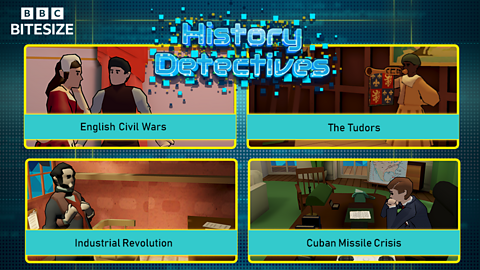
Play History Detectives - BBC Bitesize KS3 History game. game
Travel back in time and explore President Kennedy’s Oval Office, a factory in the industrial revolution and even a Tudor cargo ship.
Other Side of the Story
Back to our homepage for more quizzes and explainers about fake news, viral trends and media skills.