
BBC Writers' Voices - My Experience
Jo Gatford was part of the Voices 2026 development group. She describes how she gained a place in Voices and what it involved.

Every year around 70 writers from across the UK and Republic of Ireland are invited to join our Voices development programme. We've recently announced the 69 writers who were part of this year's group and asked Jo Gatford (who was one of the 13 writers from the south of England hub) to share a bit more about the experience. Hear from Jo below.
I’ve taken a slightly circuitous route back to screenwriting after writing all sorts of other things — novels, short fiction, poetry, plays — and teaching creative writing for many years. But I have always been obsessed with film and TV, and actually started out writing scripts, so returning to this form of storytelling feels like I’m bringing all the different strands of my creative work together.
Sometimes a story idea feels so visual that a screenplay is the only possible way to express it. For example, a few years ago, I became obsessed with a particular period of local history after coming across the gravestone of an 18th century smuggler in my hometown of Brighton. I tinkered with it as a novel idea, but it quickly became much bigger than that. And, after a lot of research, I wrote a historical drama pilot called Free Traders and submitted it to the 2025 BBC Writers Open Call.
I’d submitted scripts in previous years without getting anywhere and wasn’t holding my breath, so it was an utter shock to receive the email saying my script had made the top 1.8% out of nearly 6000 submissions. This meant I was eligible for the BBC Voices scheme: a six-month development programme to give screenwriters a solid foundation in writing for TV. It felt a bit like finding a golden ticket — I was at a real crossroads with my writing, and while I have experience in other forms of publishing, the development and production side of scriptwriting felt overwhelming and unknown. Plus, after spending years supporting other writers as an editor and mentor, I was desperate for some guidance of my own!
It was hard not to feel daunted when I was invited to an interview with Simon and Philip from the BBC Writers team but they were so kind and welcoming. We talked about my writing, what to expect from the Voices programme, and what shows I’d been watching lately (and somehow segued onto a discussion about Shakespeare and Victorian sewer architecture?!). Shortly after, I was accepted as part of the South East/South West Voices hub along with 12 other writers, one of six hubs across the UK comprising 69 writers in total this year.
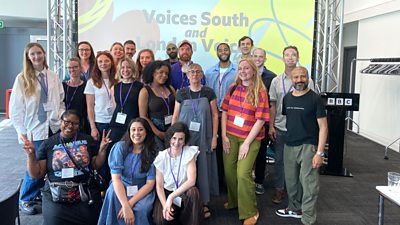
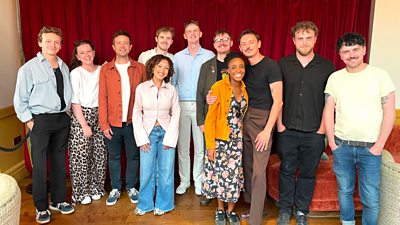
Our first in-person meet was at Broadcasting House in London, which felt a bit like a school trip as development coordinator Paddy herded our gaggle of nervous writers through the building, but we soon got to know each other and formed a fantastically supportive little group. Each one of us has completely different experiences, writing journeys, and approaches, and it was really inspiring to be surrounded by so many talented writers — especially when we got to learn about everyone’s story ideas (all of which I’m desperate to see on screen one day!).
From the very start, the BBC Writers team was unwaveringly enthusiastic with a genuine passion for great storytelling, and encouraged us to write stories we truly believe in. Obviously, the TV industry is a business, and there’s a lot more to the process than that, but one piece of advice that came up again and again over the six months was: “You need to enjoy what you’re writing — development and production can take years, so you’ve got to have faith in your story.” For writers in the trenches, it can be very easy to feel jaded about chasing success, so it was refreshing to be reminded that our best writing will always be something we really care about. And that passion is one of the vital ingredients in persuading other people to care about it (and hopefully develop/fund/commission it!).
With that in mind, our first task was to pitch three completely new story ideas with the aim of developing one of them into a pilot/series outline over the six months. Idea generation is a part of the process I love, especially with the added challenge of figuring out if the spark of a concept was strong enough to stretch across a whole series, and the hardest part was honing my choices down from six to three: a comedy drama, a historical biopic, and a dark thriller. Simon and Philip gave feedback on each of them, and after some group pitching sessions, the unanimous decision was Trash Witch, a story about a chaotic, self-taught witch begrudgingly trying to save the town that banished her.
Over the next six months, we had weekly webinars on all aspects of the scriptwriting process with script editors, development executives, agents, commissioners and other industry experts like John Yorke. I particularly enjoyed the workshops on structure and characterisation with script editor Kate Leys, as well as sessions that gave insights into aspects I wouldn’t have necessarily considered, like audience analytics, shooting location logistics, and incorporating the BBC’s Climate Content Pledge into our work.
For me, the most useful workshops were all about what happens after you’ve written your script, eg: “From Pitch to Production” with BBC Commissioning Editor Nick Lambon, and the development process with Adam James (script editor at Wall to Wall), whose advice was: write a lot, forge relationships with indies, and analyse shows you love and hate so you can articulate exactly why you think they work (or don’t).
We also had sessions with working scriptwriters (some of whom had previously been on BBC Writers development schemes), and it was so interesting to see how different their journeys were and what they’ve learned along the way. The Q&A with Miriam Battye was an utter joy — such an inspiring, prolific, rule-breaking (and hilarious) writer — as was the spec script session with Gemma Bedeau, who encouraged us to: “Write the weird thing and make it your calling card!”
In our final in-person session, we even had the chance to do a little awkward mingling around the buffet with a bunch of (very friendly) development execs from different companies, who reinforced that same message that’d been drilled into us over the six months: “Write what you’re passionate about — not because it’s a guarantee of success, but because if you are going to succeed with a project, you need to keep up that same level of commitment and motivation all the way through.”
Alongside these weekly sessions we were also busy working on our pilot outlines, pitches, and series overviews — a comprehensive document that went through several rounds of feedback and drafting with input from the BBC Writers team and our fellow writers. My story, Trash Witch, went through so many iterations and changes over the six months (and continues to do so as I write the pilot!), and while there may have been a few exasperated late night writing sessions, it’s been the best kind of creative puzzle pulling together all the different story threads and connecting all the dots.
The phrase: “TV eats up plot” has really stuck with me throughout Voices. Essentially: the action in a script moves fast, and a plot point that looks meaty in your outline might actually be over in just a few beats, so you have to make sure your story has the depth and complexity to sustain a whole series (or even just one episode). This, along with so many other things I learned on the programme, has totally changed the way I approach an idea, and I think my writing is better for it.
I honestly didn’t want the six months to end but was lucky enough to be selected for a collaboration with the National Film & Television School to continue my development until the end of the year, as a handful of Voices writers are paired with graduating script editor students to develop our pilot scripts. A month in, I’ve already had some valuable advice from my editor and I’m especially grateful for the regular accountability check-ins to keep me on track. Our little Voices hub group chat is still going strong, too, with plenty of advice, support and sharing of opportunities and resources as we all take the next steps in our scriptwriting careers…
For me, that means writing a killer pilot script for my Voices project, developing all the other pitch ideas pinging around my head, and finding an agent or producer (or both) who believes in my work. After working in the arts for a long time, I’m well aware of how challenging it can be, but Voices has reignited my belief that it is possible to “make up stories” for a living, and now I’m even more determined to make it happen.
Thanks again to everyone at BBC Writers. It’s been a delight from start to finish.
Related Links
- Meet all the 2026 BBC Writers VoicesOn the BBC Writers blog
- BBC Writers Open CallFind out full details and dates
Latest blog posts
More blog postsSearch by Tag:
- Tagged with VoicesVoices
- Tagged with Voices SouthVoices South
- Tagged with BlogBlog
- Tagged with 20262026
