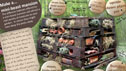
Debbie and Ellie get up early one morning in the search of hares. Plus, surveillance footage of the wildlife that was attracted to the Ilford garden after the Wild About Your Garden team worked their magic.
In order to see this content you need to have both Javascript enabled and Flash installed. Visit BBC Webwise for full instructions
In the last programme in this series the 'Wild About Your Garden' team face a truly daunting mission as they take on a small garden surrounded by housing in the shadow of one of London's busiest roads, the North Circular. What wildlife could they possible attract here?
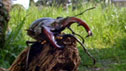
It's a tough challenge for wildlife buff Ellie Harrison who comes up with some truly bizarre suggestions to save some truly bizarre creatures. Take Britain's largest insect, the stag beetle -this giant lives underground as a larvae eating rotting wood for seven years, only to emerge and enjoy four weeks of life before dropping dead. The kids, Keira age 6 and Shay age 3 are easy to win over but can the team sell the idea to mum and dad too?
"I don't really have a favourite part of a garden, it's a bit like if you ask a chef what's his favourite ingredient, there isn't one..."
Chris Beardshaw
Garden designer extraordinaire, Chris Beardshaw, goes all primeval and creates an incredible bog garden including trees which go in roots up! But when he makes the mistake of leaving his masterpiece for a few hours to judge at a flower show, Nick Knowles takes it upon himself to acquire the biggest shed you've ever seen and install it in the garden. When the master returns he's not best pleased.
Panoramic 360° Image
Explore the finished Ilford garden in all its glory by dragging your way around the panoramic image below. You can also view it full screen.
The garden planTake a look at Chris Beardshaw's hand drawn plan for the Ilford garden. Click the image to view full screen.
Stag Beetles:
The large larvae of this endangered species crave the haven of decomposing hardwood, so to attract and cater for this extraordinary species create log piles of old timber in sheltered and moist areas of the garden under hedges and mature trees.
Ladybirds and Lacewings:
These carnivore species are valuable in the garden for their aphid eating ability, often harvesting fifty aphids a day per adult. To provide good over wintering locations for adults plant herbaceous perennials such as Echinacea, Solidago and Aster, the hollow stems of which will provide a restful home during winter storms. To allow the insects to make most use of the plants leave stems untrimmed till the first shoots of spring emerge, by which time the insects will have resumed their hunt for aphids.
Bees:
Enthusiastic for nectar and pollen from early spring to late autumn bees thrive where green roof plantations include long flowering plants such as Sedum, Saxifrage and Thrift. The shallow root and tussocky habit of these plants makes them ideal for clothing the roof of sheds, outbuildings and garages.
Trees: Amelanchier lamarckii, Arbutus unedo, Cercis siliquastrum, Corylus maxima 'Purpurea', Gingko biloba, Magnolia loebneri 'Merrill', Metasequioa glyptostroboides, Prunus serrula.
Shrubs: Buxus sempervirens
Herbaceous plants and Grasses: Achillea 'Coronation Gold', Actaea simplex 'Brunette', Ajuga reptans 'Braunherz', Alchemilla mollis, Allium christophii, Alpinia zerumbet, Anemone x hybrida 'Honorine Jobert', Angelica archangelica, Aquilegia var. stellata 'Blue Barlow', Aruncus dioicus, Astilbe x arendsii 'Fanal', Aster x frikartii Monch, Astrantia major, Brunnera macrophylla, Caltha palustris, Carex elata 'Aurea', Carex oshimensis 'Evergold', Carex pendula, Centaurea montana, Cephalaria gigantea, Dicentra spectabilis, Digitalis ferruginea 'Gigantea', Dryopteris filix-mas, Echinops ritro 'Veitch's Blue', Epimedium x versicolor 'Sulphureum', Euphorbia amygdaloides 'Purpurea', Euphorbia mellifera, Filipendula purpurea 'Elegans', Geranium 'Johnson's Blue', Geranium x magnificum, Geranium macrorrhizum 'Spessart', Geranium phaeum, Geranium phaeum, Geranium renardii, Geranium sanguineum, Geum 'Mrs J. Bradshaw', Gunnera manicata, Helleborus argutifolius, Hemerocallis 'Burning Daylight', Heuchera 'Stormy Seas', Hosta 'Frances Williams' (sieboldiana), Hosta (Tardiana Group) 'Halcyon', Hosta 'Patriot', Kniphofia caulescens, Lamium maculatum 'White Nancy', Ligularia 'The Rocket', Luzula nivea, Lychnis coronaria, Lysimachia ciliata 'Firecracker', Melianthus major, Musa basjoo, Nepeta racemosa 'Little Titch', Penstemon 'Garnet', Persicaria bistorta 'Superba', Polystichum proliferum, Polemonium yezoense var. hidakanum 'Purple Rain', Primula veris, Pulmonaria 'Blue Ensign', Rheum palmatum var. tanguticum, Rodgersia pinnata 'Elegans', Salvia x sylvestris 'Mainacht', Sedum spectabile 'Brilliant', Stipa gigantea, Thalictrum delavayi 'Hewitts Double', Verbascum chaixii 'Gainsborough'.
Carnivorous plants: Sarracenia var, Drosera var, Nepenthes var.
For more on plants go to BBC Gardening's Plant Finder Database.