Getting ready for labour isn't just about packing a hospital bag. Learning about your body, practising breathing techniques and understanding your pelvic floor can help you feel more confident as birth approaches.
Watch our video below for advice from midwife, Pip Davies.
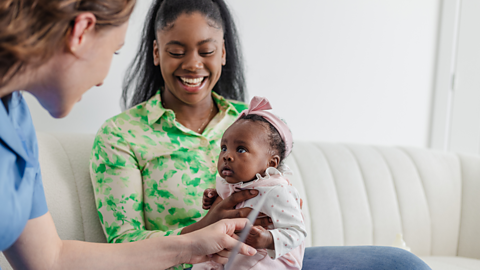
Midwife demonstrating the pelvic floor.
Today we're going to be talking about your pelvic floor and breath and how they work together during labour and birth.
So what it actually is, is like this hammock of muscles and it extends from the pubic bone at the front to the back passage at the back.
And then also from side to side, it's like a hammock or a bowl in your pelvis.
Now the special thing about women during pregnancy with their pelvic floor is that it's carrying extra weight from your baby andalso it needs to relax and let go of any tension for your baby to be born.
So, with that in mind if you take a nice big inhale breath and then as you exhale think about letting everything go.
So really relax through your jaw, your shoulders, your abdomen and your pelvic floor.
This works really well during labour and birth because we want that pelvic floor to be nice and relaxed so that baby can descend through the birth canal easier.
So, it's really important during labour and birth we know if we're tense then our muscles can kind of work against each other and actually that can make labour less efficient.
So, then as you take that nice inhale breath, then think about just relaxing and letting everything go.
You can almost feel that relaxation right through your whole body.
Is everyone feeling ready to go home and give that a little bit more practice?
We spoke to midwife and lactation consultant Jyoti Gandecha for some additional advice…
What is the pelvic floor?
Your pelvic floor is a group of muscles that supports your bladder, bowel and uterus. During pregnancy, it works harder as your baby grows.
Jyoti explains: "Your pelvic floor sits just below your baby, so it's carrying a lot of weight throughout pregnancy."
"Understanding and looking after your pelvic floor can help you feel more prepared for labour and recovery after birth."
Why is your pelvic floor important during pregnancy and birth?
During pregnancy, your pelvic floor supports your growing baby. While strengthening these muscles is important, learning to relax them is just as important for labour.
Jyoti says: "Women often ask whether they should be doing pelvic floor exercises during pregnancy, and the answer is yes. But learning how to relax your pelvic floor is just as important for labour."
"Gentle exercise and techniques such as perineal massage can help prepare your body for birth and boost confidence."
How can breathing and relaxation help during labour?
"Breathing can help you stay calm and work with your body during labour. Relaxing your pelvic floor, especially as you breathe out, may help your body make the changes necessary for birth."
Jyoti says:
"When your body is relaxed, it's able to make the changes needed during labour. Breathing helps you stay calm and work with your body."
"Gentle activities such as walking, swimming, pregnancy yoga and practising breathing exercises can help you feel more prepared. Creating a calm environment and focusing on things you enjoy can also help you relax in early labour."
How can you look after your pelvic floor after birth?
"After your baby is born, it's important to give your body time to recover. Pelvic floor exercises can help, but there's no need to rush."
Jyoti says: "The sooner the better if you're comfortable, but there's no pressure."
Jyoti's final tip is: "When you breathe out and relax your face, your pelvic floor naturally relaxes too."
"Remember, every birth and recovery is different. Trust your body, be kind to yourself, and seek support from your midwife, health visitor or GP if you have any concerns."
For more expert advice on pelvic floor health, exercise and sex after having a baby, listen to this Helpline podcast with Clare Bourne.