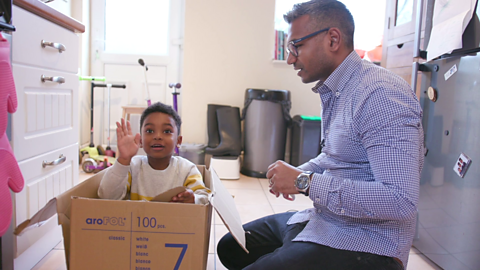
Connecting with nature has benefits for children, including boosting their wellbeing and helping them to become more aware of their environment.
In Hamza Loves Animals, wildlife expert Hamza meets a whole host of exotic creatures in Africa, including lions, elephants and monkeys.
Watch our exclusive film with Hamza to get inspired with fun activities to try…
Watch Hamza's wildlife inspiration for parents
HAMZA:
Welcome to Kenya, where we're out and about enjoying all that nature has to offer.
Being outside and connecting with nature has many benefits for children - it boosts their wellbeing while helping them become more aware of their environment.
Observing animals in nature, also builds empathy and kindness for others.
Let me and my animal friends show you how you can teach your child to build these skills by watching Hamza Loves Animals together.
Children love watching animals and seeing them in nature.
(parent's voice) "Did you see where the birdy was?"(child's voice) "Over there!"
HAMZA:
Like animals, children also learn when they play and explore outside.
Use moments from the series to encourage your child to discover new things outdoors. Like when I visited the baby elephants and we saw them exploring different textures and smells.
'Wow, this is where some of the elephants have been rubbing their body up against it.'
You and your child could make a picture scavenger hunt together, inspired by animals in the series.
And search for things that animals would look for, or discover in the wild.
(child's voice) "A rhino might like to eat this loooong grass."
HAMZA:
There are so many fun things you could do outside, inspired by the series.
Why not get your child to move like Maisha, the Rhino?
(child's voice) "I'm Rhino"
HAMZA:
And stomp, stretch, tiptoe and then freeze.
(child's voice) "Stomp, stomp, stomp."
HAMZA:
Encourage your child to look around or simply suggest going on an adventure like my curious friend Bean the Warthog.
(child's voiceover) "Where are we going, Bean?"
(child's voiceover) "We're going to the wild."
HAMZA:
And see what your child can tell you about what they discover along the way.
Something as small as a puddle, a tree or a bird can lead to amazing discoveries.
So let my adventures in the African wild, inspire you and your child's next trip outdoors. And remember, have fun!
(children's voices) "Yay!"
Watching CBeebies shows together
Watching CBeebies shows together like Hamza Loves Animals is a great way to start conversations and games with your child.
Just like in the film above, you could pause the show and chat about the different animals you've seen together and what your favourites were.
You can use moments from the series to encourage your child to be curious and to discover new things outdoors.
Three ideas to encourage your child to learn about nature
1. Copy an animal's movements
You and your child could pretend to be an animal in the wild, like the elephant seen in Hamza Loves Animals.
As an elephant, you could both swing your arms like a trunk.
Or you could pretend to move like a rhino who might both stomp, stretch, tip-toe and freeze.
As a giraffe, you could both stretch your arms above your head, as if it's a giraffe's long neck.
Repeating actions like this can help your child's coordination and motor skills.
2. Go on an outdoor adventure together
Children learn when they explore. Encourage your child to look around them and to be curious.
Help your child to name what they see while they’re out with you – for example, something as small as a puddle, a tree, or a bird could start a conversation about nature.
You could search for things that animals might look for in the wild, like a giraffe might look for leaves, or an elephant might look for a tree trunk to rub against.
You don't have to venture far from home to discover new and exciting sights, sounds and talking opportunities.
Here's a video of an adventure challenge to give you some more ideas.
3. Go on a picture scavenger hunt
You and your child could do a ‘picture scavenger hunt’, inspired by the Hamza Loves Animals series.
This could involve you putting together a list of things your child could find outdoors and taking simple photos of objects (e.g. a crunchy leaf, a bug, a snail, a branch), You could then encourage descriptive chatting based on the pictures you have.
Your child could use the photos (or drawings if you're feeling creative) to help your child find the objects.
A picture scavenger hunt can help to encourage speaking skills, as your child tries to name what they can see.
As well as pictures, you could also try a sound treasure hunt.
For more ideas for what you could do outside, here are 10 fun park activities to help with your child's communication skills.

In case you missed it
Why is imaginative play so great for children?
An article explaining the benefits of imaginative play for children's understanding of the world.