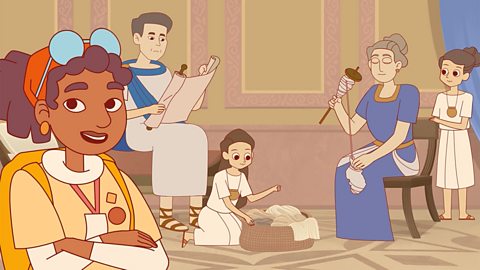
Exploring the Roman invasion and settlement of Britain, including resistance by Boudica and the Iceni tribe.
JULIA: I’m at Richborough Roman Fort on the south coast of England. It marks the spot where the Romans landed when they invaded Britain in 43 CE.
The people they fought and conquered here were one of many Celtic tribes that lived in Britain at the time. They wore jewellery, like this torc, which would have been the height of fashion. It’s made of silver and gold, which were just two of the many natural resources from Britain the Romans wanted to trade.
Before the invasion, the Celts were already selling metals like lead, copper, tin and iron and crops like wheat to people in Europe, including other Celts in Gaul, which is now France, and to the Romans themselves. The Romans had conquered lands across Europe, North Africa and the Middle East, and had grown rich by making the people who lived there pay taxes to Rome. It’s not surprising then, that Britain was on their ‘invasion wish list'.
At the time, Britain was split up into lots of similar tribal kingdoms. They sometimes fought each other, and until 43 CE, they had always managed to fight off the Romans. But the Romans had learned from their failed attempts and brought an army of 40,000 men. Some tribes knew they couldn’t take on the might of the Roman army and quickly surrendered. But others fought back, and it took several years and many battles for the Romans to take over most of Britain.
Most Celtic chieftains agreed to live peacefully alongside their Romans masters. And, over time, the tribes started being more Roman…by living in Roman houses called villas…by joining and fighting for the Roman army…and by paying taxes to Rome.
But things didn’t always go to plan. When Prasutagus, King of the Iceni tribe in the East of England died, half his land was meant to be given to the Romans and half kept by his wife. But the Romans took it all and treated his wife and daughters very badly. Which was a mistake, because the wife of Prasutagus was none other than BOUDICA!
Rock guitar sound
Like many Celtic women, she had been trained to fight and she could drive a chariot. She united Celtic tribes that were fed up with being ruled by the Romans and built up an army which was said to be over 100,000 strong. They destroyed Colchester and wiped out the Roman 9th Legion. They burned London - or ‘Londinium’, as it was called then - to the ground. But even though they outnumbered the Romans by more than 10 to 1, Boudica’s army was finally defeated at the Battle of Watling Street.
However, nearly two thousand years later, she is still celebrated in books, films and stories, and there’s even a statue of her and her daughters near the Houses of Parliament.
The Roman conquest of Britain continued for many years, but the Picts, who lived in what is now Scotland, were never defeated. To protect the North from the Picts, Emperor Hadrian built a wall. And what a wall! 'Hadrian’s Wall', as it became known, was nearly 120 kilometres long, three metres thick, and over four metres high and it stretched right across the north of England. It had over 80 towers spaced out at regular intervals and sixteen forts with soldiers that patrolled the wall night and day.
JULIA (to Roman soldier): Morning!
The Romans stayed in Britain for four hundred years after its conquest, but in the 5th Century tribes across Central Europe were fighting back and Rome withdrew its soldiers from Britain to fight elsewhere in the empire.
The Romans may have left Britain all those years ago, but you can still see their legacy today.
4. The Romans in Britain
Julia is at Richborough Roman Fort in Kent on the south coast of England. It marks the spot where the Romans invaded Britain in 43 CE. The Romans had made previous attempts to conquer Britain almost a hundred years before under the leadership of Julius Caesar, but the Britons had successfully resisted and the Romans had chosen to abandon the project.
In 43 CE they returned with a much stronger force and many of the Celtic tribes in Britain were quickly overwhelmed. Many Celtic chieftains chose to live alongside their Roman overlords, paying taxes to Rome in return for peace. Over time many of the Celtic tribes became Romanised, adopting Roman customs and habits.
The main resistance to Roman rule in Britain came from Boudica's revolt in c 60 - 61 CE. Boudica was the wife of Prasutagus, king of the Iceni tribe in what is now East Anglia. There was an agreement that when Prasutagus died half of his land would be given to Rome and half retained by Boudica. However, the Romans reneged on the agreement, instead taking all the land and abusing Boudica and her daughters.
Boudica raised an army and destroyed the Roman settlements at Camulodunum (Colchester), Londinium (London) and Verulamium (St Albans). Boudica was defeated at the Battle of Watling Street and is thought to have died shortly after.
The Romans remained in Britain for nearly 400 years, but in 410 CE they abandoned Britain to focus on defending the empire in mainland Europe.
Duration: 3' 49"
Final words: '…still see their legacy today.'
Video questions
- Why did the Romans wish to conquer Britain? (It was rich in natural resources, including silver, gold, lead, iron, tin, wheat, etc)
- How was Britain ruled at the time of the Roman invasion? (It was split up into several tribal kingdoms)
- In which year did the Romans successfully invade Britain? (43 CE - or AD43)
- Who was Prasutagus? (King of the Iceni)
- Who was the wife of Prasutagus? (Boudica)
- What did Boudica do? (She led a revolt against the Roman occupation)
- How big was Boudica's army? (Said to be over 120,000 strong)
- Where is there a famous statue of Boudica? (Near the Houses of Parliament in London)
- What area of Britain was never conquered by the Romans? (Scotland)
- What was the purpose of Hadrian's Wall? (To protect the Roman occupied land to the south from the Picts to the north)
- How long is Hadrian's Wall? (120 kilometres)
- How tall were the walls? (4 metres)
- Why did the Romans leave Britain? (To defend the empire against warring tribes in Europe)
This film is relevant for teaching History within the National Curriculum at KS2 in England and Northern Ireland and equivalent levels in Scotland and Wales.
Further resources
Teacher Notes. document
Download / print the Teacher Notes prepared in partnership with Classroom Secrets (pdf)
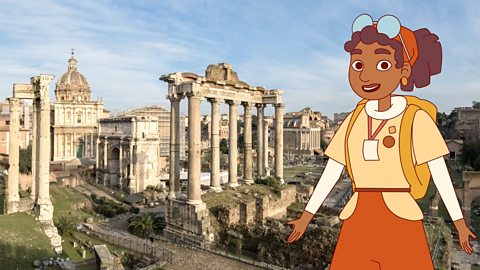
Transcript
Click to download / print the episode transcript

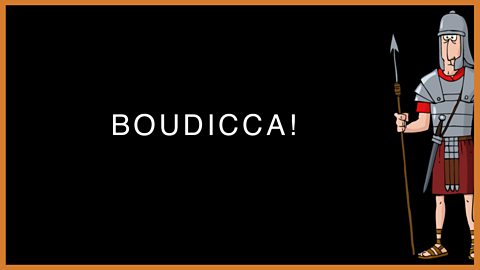
Song: 'Boudicca!' video
Learn a song about Boudica's revolt from our musical 'Rocking Romans!'
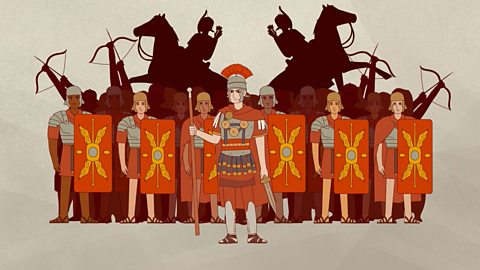
3. The Roman army. video
Exploring the formidable Roman army - its organisation, tactics, weapons and influence.
5. The legacy of Ancient Rome. video
Exploring the enduring influence of Ancient Rome on modern Britain and countries around the world.
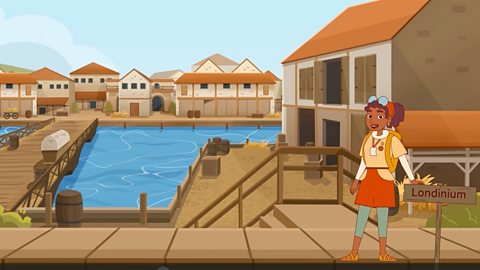
6. Growing up in Ancient Rome. video
Julia introduces a narrative episode about Augusta and Felix - two children growing up in Ancient Rome.