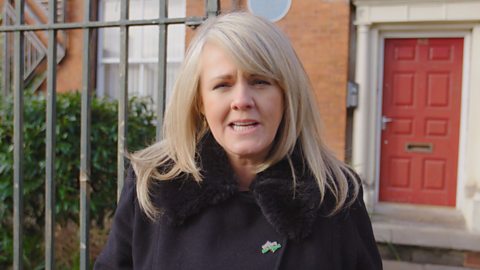
Sally Lindsay:
Named the woman of the 20th century, Emily Pankhurst is a famous face the world over. Born in 1858, in industrial Manchester, she formed and led the suffragettes, a women only militant group who fought and died to secure their voting rights. But what made Mrs Pankhurst want to be part of the Votes for Women campaign? I'm finding out from her great-nephew, Michael Goulden: .
Michael Goulden:
She was born Emmeline Goulden, the eldest girl in a family of 11.
Sally Lindsay:
Wow.
Michael Goulden:
And her parents we know were both politically active in a lot of the big causes that were taking place in Manchester at that time.
Sally Lindsay:
Emmeline's father, Robert Goulding, and his wife, Sophia, were part of a thriving activist scene in Manchester, campaigning against slavery and for women's rights to vote, also known as Suffrage.
Michael Goulden:
This is Sophia Jane, she was going to Suffragy meetings, she was subscribing the Women's Suffrage Journal, and taking Emmeline to the meetings.
Emmeline Pankhurt (Reconstruction):
Returning from school one day I met my mother just setting out for the meeting, and I begged her to let me go along. I left the meeting a conscious and confirmed suffragist.
Sally Lindsay:
It was at a suffrage meeting that she would meet her strongest political ally, Dr. Richard Pankhurst, a radical lawyer campaigning on women's rights, and her future husband.
Sally Lindsay:
Married within months, the couple went on to have five children, not only were they a love match made in heaven, but a political one too. While Richard stood for election as an MP, Emmeline became active in committees and causes.
Emmeline Pankhurt (Reconstruction):
Dr. Pankhurst did not desire that I should turn myself into a household machine, so, while my children were still in their cradles I was serving on the Women's Suffrage Society.
Sally Lindsay:
But a tragedy was on the horizon.
Emmeline Pankhurt (Reconstruction):
In 1898, I suffered an irreparable loss in the death of my husband.
Sally Lindsay:
Emmaline was on a trip abroad when things took a dramatic turn.
Sally Lindsay:
Despite a telegram asking her to rush home, as his health was failing, Richard dies as Emmeline is on her way home.
Sally Lindsay:
Forced to leave their big house in a posh suburb of Manchester, the family had to find rented accommodation and, for the first time, Emmeline took a job.
Sally Lindsay:
And she came here to this house in Nelson Street. Which is now the Pankhurst Centre.
Sally Lindsay:
She lived here with four of her children and ran a registry office for births, marriages and deaths from the front room.
Sally Lindsay:
Now, what would life have been like for her?
Elaine de Fries:
Well, she had to downsize to come here after her husband's sudden and unexpected death, and they were completely grief stricken. This is her place of business, and she was a registrar here.
Sally Lindsay:
Ah, right, okay. So, through that job, did she realize what was going on in Manchester? Did she realize–
Elaine de Fries:
Yeah, she saw the horrible working conditions of women, and also, the very heartbreaking stories, and it was upsetting for her. But it, you know, it led to her belief that women had to help women.
Sally Lindsay:
Five years later, on the tenth of October, 1903, the house would become the home of her famous political movement. I'm meeting her great granddaughter, Helen Pankhurst, to find out more.
Helen Pankhurst:
It was called the WSPU, the Women's Social and Political Union, mother and daughters primarily, who just decided enough was enough, a new way of campaigning on women's issues was needed. You've got these strong girls that you were bringing up, one wants to become a barrister, the other wants to become an artist, and you see their opportunities thwarted.
Sally Lindsay:
The militant tactics began in October 1905 when Emmeline's eldest daughter, Christabel, and her friend, Annie Kenny, attended a political meeting at Manchester's Free Trade Hall, determined to ask a panel of politicians when they would give women the vote. They were thrown out of the meeting, arrested and sent to prison.
Sally Lindsay:
Seeing the national sensation it caused, Emmeline was persuaded that militant measures were the way forward. Their new tactics, more violent than the suffragists, earned them the derogatory nickname, in The Daily Mail, of the Suffragettes. But they adopted this with pride.
Sally Lindsay:
Years of militant action, petitions and marches on parliament followed. Emmeline herself was sent to prison several times between 1908 and 1913, and, like many suffragettes, she went on hunger strike to protest against her conditions, and was brutally force fed by the guards. Ultimately, the vote for women was won, first, for women over 30 with property in 1918, and then, with equal voting rights to men in 1928 for all women over 21.
Sally Lindsay:
Sadly, Emmeline never lived to see this final victory in her life's battle, she died on the 14th June 1928, at the age of 69, weeks before the final bill in parliament was passed.
Sally Lindsay:
But her legacy lives on, because, thanks to the sacrifice of Emmeline and hundreds like her, men and women are now equal at the ballot box.
Video summary
Sally Lindsay examines the life of the leader of the Suffragettes, Emmeline Pankhurst, and traces the people, places, and events that turned her into the leader of the ‘votes for women’ campaign group.
Formally known as the Women’s Social and Political Union, the Suffragettes were a national organisation that fought for female voting rights when only men had the vote.
In interviews with Emmeline's descendants and expert historians, Sally learns about Emmeline’s early years in industrial Manchester and discovers more about the people and the political and social events that made her believe votes for women could only be won by military means.
Teacher Notes
Students could examine a number of different images of Emmeline Pankhurst and be asked to think about what each picture tells them about Emmeline Pankhurst.
When watching the video students could answer the following questions: What was Emmeline’s childhood like and what impact did this have on her politically?
How did her work as a registrar affect her? What was the WSPU and what was her role in it?
Why do you think Emmeline Pankhurst was named the woman of the 20th century? Why is she a significant individual in History?
Students could then produce a front cover for TIME magazine or write a short interview with Emmeline Pankhurst.
At the end of the lesson students could be asked to consider what three key things have they learnt about her today and what surprised them the most about her life?
Suitable for teaching History at KS3 in England, Wales and Northern Ireland and 3rd Level in Scotland.
How the Votes for Women campaign began. video
How the votes for women campaign began, and the women who led the fight for suffrage.
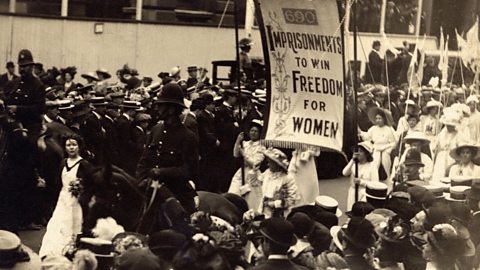
Historical sources and interpretations of Emmeline Pankhurst. video
How historical sources can tell us more about the Suffragettes leader Emmeline Pankhurst.
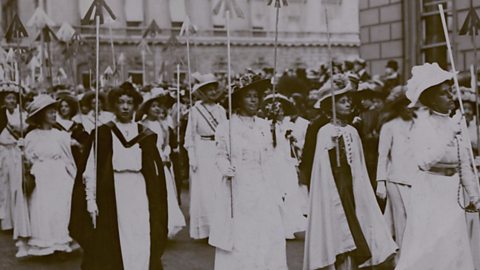
How Manchester shaped Emmeline Pankhurst. video
Sally Lindsay finds out how Manchester shaped the Suffragettes leader Emmeline Pankhurst.