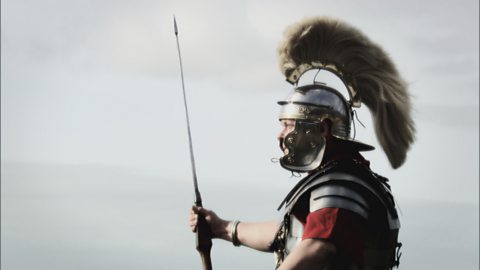
BETTANY HUGHES: Over 2,000 years ago, the Romans first arrived in Britain. Although that was way back in the past, many clues still survive which tell us what life was like during Roman times. From the remains of ancient forts, to the jewellery, letters, and household items still being dug up by archaeologists today, we can find out brilliant details of what they ate, what their homes looked like, and even what they did for fun. And thanks to a book written all those years ago by the famous Roman commander Julius Caesar, we also know one reason why the Romans wanted to come to Britain in the first place. They wanted to make use of the amazing natural resources to be found here. Caesar wrote, 'The Britons have a huge number of cattle. They use gold coins or iron bars as their money and produce tin and iron.' That description helps to explain why Caesar and his army decided to pile over here to Britain to try to invade. Rome wanted to get its hands on all those British resources to make itself even richer.
BETTANY: Back then, before the Romans invaded, we didn't have one king or queen ruling over the nation. Britain was made up of different groups or tribes known as the Celts or native Britons. We get an idea of what the native Britons looked like, thanks to a description of them in here. But do remember, of course, they were Caesar's enemy, so his opinion might be a little bit one-sided.
CAESAR: All Britons use woad to dye their bodies a blue colour, which makes them terrifying when they're fighting in battle.
BETTANY: The Celts also put lime in their hair to make it stiff and thick, which made them look even more ferocious.
CAESAR: They used their chariots in battle, steering them in all directions while hurling their weapons, generally causing the enemy to separate and part. Then, one of the warriors leaps from the chariot and fights on foot.
It was all just too much for Caesar. He invaded the country twice, but he never actually managed to take over. That would have to wait until 100 years later, when the Emperor Claudius tried again. This time, he succeeded. And that is how we became part of the Roman Empire.
But what exactly was the Roman Empire? The Romans actually started out in life as just a small tribe in Italy. They fought battles with local people and took over their land. But then they wanted more, so they could become super rich. Eventually, the Roman tribe grew to be in charge of vast areas across Asia, Africa, and Europe, including Britain. And all the land they controlled came to be known as the Roman Empire.
This is the great city of Rome in Italy. It was once the capital of the Roman Empire and this is what it looks like today. Some remains of the ancient city, built thousands of years ago, are still there for us to see, giving us great clues as to how the Romans lived their lives. At the centre of ancient Rome was the Forum, a big open area where markets took place and people heard the latest news. A bit like a modern-day shopping centre. People living and working in Rome worshipped at temples or visited the amphitheatres to watch animals and gladiators fight to the death. The Romans believed in this way of life so totally that they brought it right across the Empire and all the way to Britain.
Archaeologists have discovered precious objects decorated with gladiators.
BARBARA: This is a great example of gladiatorial combat and the importance it had in ancient life. And you can see on the piece of glass here that it shows all the different types of gladiators.
BETTANY: That's so beautifully done. So is it painted or is it set in glass?
BARBARA: It is painted onto the glass.
BETTANY: Wow. So these gladiators would have been like the kind of superstar sportsmen of today?
BARBARA: Yes, yes. They would have their legends told and they would have talked about them. They were also highly paid, especially if you were good at going into the arena. They were very, very popular and the games in general were hugely popular all over the Empire.
BETTANY: The Romans didn't just bring their way of life to Britain, they also brought their Roman-style buildings too, creating whole new towns, almost like mini versions of Rome. Many of the cities we live in today were once Roman towns with Roman names. The town of Corinium Dobunnorum is now modern-day Cirencester. This is what Cirencester looks like today. The people living in these new Roman towns had to obey Roman laws and pay money to the Roman Empire, known as taxes. But it wasn't all bad. Wealthy people and those with important jobs lived in posh Roman houses known as villas with new types of decoration and sophisticated technology.
It's still possible to see some of the clever technology they had in Roman houses. In this museum in Cirencester, there is an example of Roman underfloor heating. It's called a hypocaust and it's a brilliant idea because we all know how chilly it can get here in Britain. Now, this is how it worked. The floor was built on top of these piles of tiles and then down that little hole there, a fire would be lit. The fire would push out hot air and smoke under the ground and up through these kind of clay tubes that went through the hollow walls. There would be slaves down there keeping the fire going the whole time so the house stayed warm. But they also constantly had to keep a watch-out that the fire didn't go out of control and burn the whole house down.
And in some villas, if you could afford it, you would have had one of these beautiful things called a mosaic on your floor. Now, mosaics are made up of lots of tiny little bits of coloured stone, or sometimes glass. And they usually tell a story. The story that's being told here is about a man called Orpheus. That's Orpheus in the middle there. He's playing an instrument called the lyre and, as he does so, he's charming all these animals around him. This one was actually found 200 years ago very close to Cirencester. And isn't it fantastic to think that somewhere near you, there might still be a Roman mosaic under the ground just waiting to be discovered?
Video summary
Bettany Hughes explains why the Romans were keen to invade Britain and, by referring to a book written by Julius Caesar, introduces the Celts and how they looked and lived.
It shows how the Celts were fierce warriors and used chariots in their battles and why it took another 100 years before Claudius finally gained control.**
It describes how the empire expanded and the countries that it controlled. Bettany visits Rome to show where it all started and visits the forum and an amphitheatre and discusses how the gladiators were so popular that they were also brought over to Britain.
Bettany looks at how the Romans introduced under-floor heating which was called a hypocaust and the towns they built, like Cirencester, that still exist today.
This clip is from the series Roman Voices.
Teacher Notes
Children could write a diary as though they were Julius Caesar talking about the Celts, describing what they looked like, what he thought of them and what he thought of Britain.
Then they could write a diary as though they were a Celt explaining their feelings about the Roman invasion, what they thought of the Romans and the differences between them.
This clip is relevant to teaching History at KS2 in England, Wales and Northern Ireland and Second level in Scotland.
Women in Roman Britain. video
Bettany Hughes explores the lives of Roman women and looks at genuine artefacts to piece together a picture of what their life was like.
Children in Roman Britain. video
Bettany Hughes looks at the life of children in Roman Britain, discovering how tough life was for them - but also that it could be fun.
Soldiers in Roman Britain. video
Bettany Hughes explains the significance of Hadrian’s Wall and uncovers what life was like for Roman soliders in Britain.