Who were the Tudors and what events led them to ruling in England?
NARRATOR: Ah, the Tudors, their awe inspiring name once feared and revered the world over, now the subject of many a primary school history lesson. The Tudor dynasty produced some of the most famous kings and queens England has ever seen. The legendary Henry the VIII, perhaps most famous for the treatment of his many wives, divorced, beheaded, died, di… Well, you know how the song goes.
HENRY VIII: Those were different times!
NARRATOR: And Elizabeth I. Perhaps most famous for her defeat of the Spanish Armada.
ELIZABETH I: Good show. Yes, indeed. You should do a whole episode about me.
NARRATOR: So why are we here in a seemingly random car park in the city of Leicester? Well, believe it or not, in 2012 a body was discovered here. The body of King Richard III. See, the Tudors weren't always the rulers of England. Before them came another dynasty: the Plantagenets. King Richard III, the last Plantagenet king was buried here over five hundred years ago after he lost a battle to Henry Tudor. It wasn't a car park at the time of course. The battle took place at Bosworth Field. Not too far away from ourcar park, and is now known as the Battle of Bosworth. The battle was fought at the end of a turbulent period in English history filled with civil revolts bloody battles and many, many dead kings, princes, knights and nobles.
HENRY VIII: Ah! just like me.
NARRATOR: Oh yes, Henry, but let's take it back to King Richard III shall we?
HENRY VIII: Ah fine, but I'm way more fun.
NARRATOR: So, after thirty long and brutal years of battles and power changes, Richard III claimed the throne. But, and it's a very big but, Richard wasn't very popular with his people. He seized power from his young nephews and had them imprisoned in theTower of London.
RICHARD III: It was for their own good.
NARRATOR: It was supposedly for their own good. But then his nephew's mysteriously disappeared. The sudden disappearance ofRichard's nephew sparked outrage because people assumed that King Richard must have been responsible. Enter our soon to beTudor King, Henry. His claim to the throne was fairly weak, but the people's dislike of King Richard made his cause easier.Intending to take the throne, Henry marched his army to Bosworth. After an intense battle, Henry's forces won, Richard was killed, and his body was moved to a friary where it was hastily buried in a shallow grave. In time, the friary was demolished and eventually replaced by our car park and Richard's grave was lost to history, until that momentous day in 2012. Now, you might be wondering, with Richard dead and buried, what became of the victorious Henry Tudor? Well, Henry Tudor became King Henry VII.
HENRY VII: Haha! Long live me. Or I? Long, liveth your King, Henry VII.
NARRATOR: Indeed. King Henry wasted no time founding the Tudor dynasty, that would last a whopping 118 years. He married Elizabeth of York, a close relative of Richard III, and united the two great families that had for so long been at war over who should rule the country.
HENRY VII: Oh, what a kind and loving wife she was, my Elizabeth. We had two sons. Our eldest well he, he…
NARRATOR: Well yes, their eldest son, Prince Arthur sadly died. We'll get to that. After Henry married Elizabeth he ruled his kingdom in a much wiser fashion than his predecessor. Henry's eldest son, Arthur, was in line to become king. But as we now know he died before he could inherit the crown. After 24 years on the throne, Henry VII also died and his next surviving sonpeacefully inherited the crown. Henry VIII.
HENRY VIII: Yes! Finally! I mean, sad about Dad and Arthur of course, but now it's my turn!
NARRATOR: And that…
HENRY VII: Oh, oh.
NARRATOR: Was how…
HENRY VII: Hang on!
NARRATOR: Henry VII…
HENRY VII: You're not going to include me?
NARRATOR: …established the legendary Tudor dynasty.
1. How the Tudors rose
This series of content on the Tudors begins with the reign of King Richard III (1452 - 1485). When Richard's elder brother - Edward IV - died the crown passed to his son, Edward V. Edward, however, was never actually crowned because Richard had his two nephews imprisoned in the Tower of London and took the crown for himself. The fate of the 'princes in the Tower' cast a shadow over Richard's short reign and accounts in part for both his unpopularity and his downfall.
Henry Tudor (1457 - 1509) had a distant claim to the throne via the House of Lancaster and had been living in exile in Brittany since 1471. In 1485 Henry invaded and marched his army towards London. He clashed with Richard's army at the Battle of Bosworth in August 1485. Richard III was killed and Henry Tudor became Henry VII.
Henry married Elizabeth of York (1466 - 1503) - thereby uniting the warring dynasties of Lancaster and York. Their eldest child - Arthur, Prince of Wales (1486 - 1502) - died before inheriting the throne. So Arthur's younger brother, Henry, became the heir - the future Henry VIII (1491 - 1547).
Video questions
- Where and when was Richard III's body discovered? (In a car park in Leicester in 2012)
- Which dynasty ruled England before the Tudors? (The Plantagenets)
- How did Richard take power? (He imprisoned his nephews and made himself king)
- What do you think happened to Richard's nephews? Why? (It is likely, but not proven, that the princes were killed in the Tower on Richard's orders)
- How did Richard's burial place become forgotten about? (It was a hasty burial; the friary was demolished; a car park was built)
- How did Henry Tudor become king? (By conquest; his army killed Richard III at the battle of Bosworth in 1485)
- Who did Henry marry and what did it help to bring? (Elizabeth of York - brought peace by uniting Houses of Lancaster and York)
Further resources
Teacher Notes
Download / print the Teacher Notes for this episode.

Downloadable Transcript. document
Download / print the transcript for this episode.
This film is relevant for teaching History within the National Curriculum at KS2 in England and Northern Ireland and equivalent levels in Scotland and Wales.
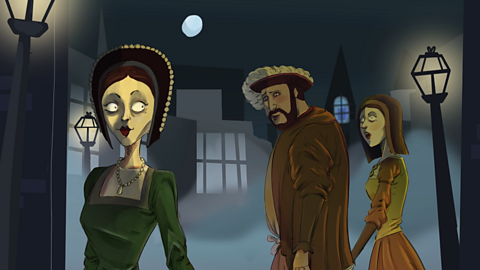
2. Henry VIII. video
Exploring the circumstances that led Henry VIII to marry six times.
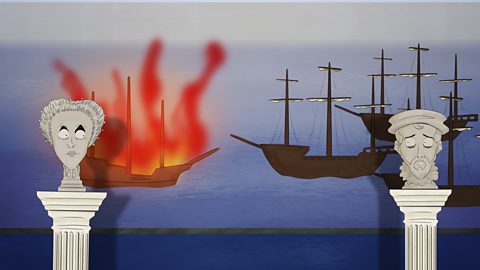
3. Elizabeth I. video
Exploring the key events of Elizabeth's long reign, including the Armada.
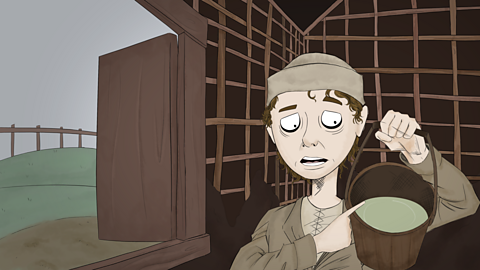
4. Crime and punishment. video
In Tudor times even minor crimes could lead to grisly punishments.
See also...
Music - Songs about life in Tudor times - a collection of songs about life in Tudor times
Dance - The reign of King Henry VIII - exploring the time of Henry VIII through movement and dance
The Tudors - Audio - comic sketches and powerful dramas exploring life during the Tudor dynasty
