Learn how to make sentences easier to understand by using commas or hyphens.
RADZI CHINYANGANYA: This is Barton Arcade a shopping centre in the heart of Manchester. Now any shop would want to attract a customer's attention and one way they do that are through A-boards which have information and deals to encourage customers into their shop. A-boards are a simple way for shops to advertise their latest offers. Shops want to attract customers straightaway so it's important that the information is in short punchy sentences and not confusing to read. And the best way of doing that is by punctuating correctly.
Take a look at this sentence. At first glance this sentence could be interpreted in two ways. And there'd be nothing wrong with either interpretation. But see what happens when the sentence is punctuated with a hyphen. Suddenly the meaning of the sentence becomes clear.
So this next challenge is for you Maisie. Each A-board will have on it a confusing sentence and to help make it more clear you need to either add a comma or a hyphen. Are you up for it?
Let's go this way.
Yes.
Take a look at these four A-boards each with a confusing sentence. Which punctuation would you use here? A comma or a hyphen? And where would you place it? Have a go at doing this yourself.
Let's take a look and see how Maisie does in this challenge.
ALL: Come on Maisie! Come on!
SHE READS SIGN
HE SPLUTTERS
SHE READS SIGN
CHEERING
SHE READS SIGN
CHEERING
SHE READS SIGN
CHEERING
Maisie let's see how you did. You might see this ad outside a restaurant. By using a comma after the word 'eat' to create a brief pause in the sentence it no longer means eating Dad but going to eat with Dad. Using the comma after the word 'paste' helps to make the sentence clearer. There will be no cutting and pasting kids!
Phew Maisie!
Here's a sentence you might see in a travel agent's. Maisie used the hyphen between the words 'all' and 'inclusive' to show the meaning is linked in some way and she was right. This final sentence is a little bit trickier because the comma can be used in more than one place to help separate the items in the list. Maisie used it correctly after the word 'paper'. But a comma wasn't needed after the word 'hats' because the last item on the list was jewels. But if Maisie use the comma here or here and here that would also work.
I hope that clears that one up.
CHEERING
Maisie you were absolutely awesome and now it is time for another challenge. Are you up for it?
ALL: Yeah!
Video summary
Radzi and some children visit a shopping arcade, where they look at a series of boards with confusing messages and insert commas or hyphens to make them easier to understand.
They visit a shopping arcade where there are a series of boards with messages written on.
There is a mini-tutorial explaining the use of a hyphen in 'man eating shark' or 'man-eating shark'.
One of the children is tasked with inserting comma(s) or hyphen(s) to clarify the meaning.
After the task, Radzi reviews each board and explains if the child is correct or not.
There is a detailed explanation of using commas in a list and also an explanation of how the word ‘and’ is used in a list sentence.
This short film is from the BBC series, Punctuation Rules.
Teacher Notes
Using commas in ambiguous list sentences is a tricky area of grammar to teach.
Pupils will benefit from the explanation about the comma before ‘and’.
Pupils could create their own boards on black paper to demonstrate their understanding of this.
This short film is relevant for teaching English language and literacy at KS2 and KS3 in England, Wales and Northern and 2nd Level in Scotland.
Using punctuation in advertising - brackets, commas and dashes. video
Radzi and a group of children visit an advertising agency to learn about the importance of punctuation in advertisements.

Verbs, adverbs and fronted adverbials in sports journalism. video
Radzi and a group of children visit Manchester City Football Club to learn why grammar and punctuation are so important in sports journalism.

Why is punctuation important in news? video
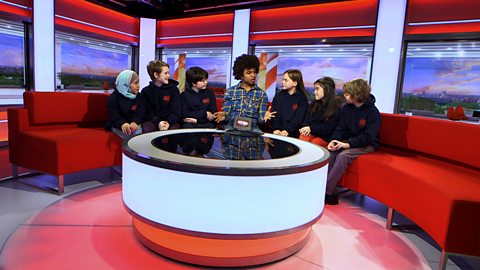
Radzi and a group of children set out to discover why punctuation is important for clarity in the BBC newsroom.
Punctuation in story-writing - inverted commas, full stops and question marks. video
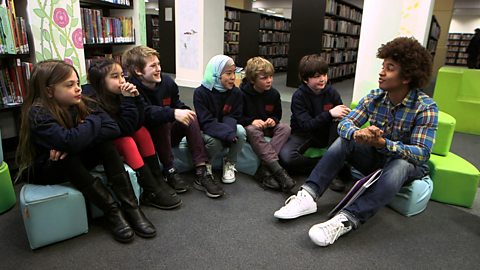
Radzi and a group of children visit Manchester Central Library to learn how to identify correct punctuation in a paragraph of a story.
Using punctuation in presentations - colons, semi-colons and bullet points. video
Radzi and a group of children visit a law firm to learn about using punctuation in presentations, finding out about colons, semi-colons and bullet points.