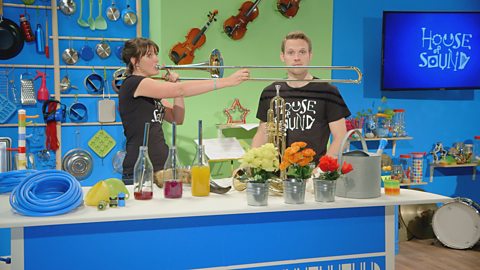
GREG FOOT: Hello I'm Greg Foot.
FRAN SCOTT: And I'm Fran Scott. And this is the House Of Sound.
BOTH: Yeah!
FRAN: We're going to investigatethe sounds of music. And find out how all differentsorts of sounds are made. Sounds like these - this music. It's called Connect It and it was written by a moderncomposer called Anna Meredith. "So as you can see" we could all make musical sounds just by using our bodies. Yeah!
FRAN: Yep and we can clap obviously.
Yes we can. Or we can s-i-i-ng!"
"No you can't!
Or we can play musical instruments like a clarinet."
"But first things first what is sound?"
And how do we hear it?
FRAN: Well pin back your ears as you're about to find out with this little film I made. So Greg is over there having a little bit of a snooze. But I think there's something I can do about that.
GONG CRASHES
GREG: Ah!
FRAN: Ha-ha-ha. Yeah ha-ha very funny. OK look let's slow things down a bit and see exactly what was happening there.
Sound is a type of energymade by vibrations and vibration is the word we use to describe something that's shaking backwardsand forwards really quickly. When any object vibrates it causes the air around it to move. You can't see this happening because it's tiny things called molecules that are doing the vibrating. The molecules bump into each other passing the vibrations through the air.
This is called a sound wave. If your ears are close to the vibrations then you hear them clearly. The further a sound wave travels the weaker it gets. So because I was very close to Fran's gong the vibrations were really strong and so the sound it made was loud.
We can't actually see sound waves but we can imagine what they look like. If I drop this pebble intothis paddling pool of water… …then you can seelittle rings of waves moving outwards over and over again getting smaller untilthey run out of energy. And something else about sound wavesis that big things vibrate slower than small things. Slow vibrations makea low musical note…
LOW-PITCHED NOTE
…whereas small things like this triangle vibrate more quickly and make a higher note.
HIGH-PITCHED NOTE
We call this pitch. Slow vibration means low pitch… fast vibration means high pitch. Lovely! I've seen enough ofthat gong. Can you take it away? The thing is sound waves can travelthrough anything that can vibrate like air or metal or water. Sound travels faster through water than air and even faster through metals like steel. What the sound travels throughis called a medium. In fact sound needs a medium to travel through otherwise there's no sound.
Fran did you know that because sound travels so well through water whales can sing to each other across a distance of up to 800km?
FRAN: That is so far. Whoa! It';s the distance between Scotland and Iceland or the entire length of Italy. But look here look at this demo that I've got that will prove that sound needs a medium to travel through. OK. This is an experiment that was first carried out hundreds of years ago made famous by this scientist Robert Boyle.
GREG: Hmm nice hair. It's good isn't it? Believe it or not in this big jar there is an electric bell ringing but we can't hear it because we've taken out almostall of the air out of the jar using this machine here called a vacuum pump. It's called a vacuum pump because it pumps out the air to make a vacuum and a vacuum is what we call a space where there is no air. And because there is no air for the sound waves to travel through we can't hear the bell until I remove this pipe and let the air back in.
So…
AIR WHISTLES
That sound now that's the aircoming back in. But wait…
BELL RINGS
And there.
GREG: Yeah.
FRAN: That's really cool isn't it? And so this reminds me - you know in those space movies where you hear those big explosions going off and they sound a bit like this…?
BANG
GREG: Yep I know them very well.
FRAN: That is not actually how they'd sound. Instead they sound like this.
GREG: What silent?
FRAN: Yep. Well that's ruined some of my favourite films hasn't it? Cheers. So sound needs a medium to travel through. And to be heard sound waves needto reach some ears and a brain. Because sound is all about vibration we need to do a little vibrating of our own to hear it.
Yep. Why don't you explain that while I build a giant human ear? OK…
RINGING
Listen up you lot. Sound waves are collected by your outer ear and travel down your ear canal. When those vibrating air particles hit your eardrum it starts to vibrate too. Behind your eardrum are three little bones. The first is called the hammerand it's connected to your eardrum.
The next one is called the anvil and it's connected to the hammer. The third is called the stirrup and that's connected to the anvil. When the eardrum vibrates the hammer hits the anvil, the anvil hits the stirrup and sends those vibrations on into your inner ear. This is a very special part of the inner ear called the cochlea. It looks like a snail and it's filled with liquid which flows over lots of tiny little hairs. The vibrations shake the liquid and that makes the hairs wiggle.
These hairs are the start of something called the auditory nerve. How the hairs movedepends on the sound being madeand the auditory nerve which is a little bit likea wire connected to a computer sends the information to the brain which turns it intothe sound we hear. So Fran how's your giant ear going?
FRAN: So this cake tin here is likeour outer ear this bit and then we've got the cling film which is like the eardrum and then this cup and straw represents the hammer anvil and stirrup those small bones and they go into this bowl which represents the cochlea. So this is the liquid inside the cochlea.
OK. So when we make a vibration here it should go all the way downand make the liquid vibrate. Got it. Now I'm going to hit it and my hand is going to representthe moving sound wave right? Let's see what happens.
GREG: Yeah OK it kind of works.I mean it looks great! You could however have just asked me and used this one that I made earlier.
FANFARE
Much more realistic! No? No. OK. Bottom line-sound is all about vibrations and you don't need a musical instrument to make those vibrations. You can use bits of your body.
GREG: Oh yeah. Just like these guys.
GREG: Of course.
FRAN: Are you up for it?
FRAN: Right.
BOTH: Yeah!
BOTH: Yeah!
Video summary
In their House of Sound, Fran Scott and Greg Foot investigate how sound is made and how we hear it.
They explain that sound is caused by vibration. If an object vibrates the air particles called molecules close to it vibrate.
This makes the molecules next to them vibrate and so on, forming a sound wave.
If the sound wave reaches our ears and our brains then we hear the sound.
They also explain that sound needs something called a medium to travel through and Fran repeats a famous experiment by a scientist called Robert Boyle who demonstrated that air is a medium through which sounds travel.
She puts a bell in a jar, taking out all the air from the jar to create a vacuum, after which the bell falls silent.
Using 3D animation, Greg takes us on a guided tour of the human ear, pointing out the key components: the eardrum, hammer, anvil, stirrup, cochlea and auditory nerve.
Finally, Fran makes a giant human ear out of everyday things to show how these components work.
This clip is from the series House of Sound.
Teacher Notes
Pupils can experiment with making sounds using just their own bodies and voices.
Because sound needs a medium to travel through, they can discuss the media with which they are familiar - for example, water, a highly effective medium, as they may have discovered while swimming.
As an introduction to pitch, experiment with rulers on the edge of desks or tables, so they can find out and record that a long length of ruler vibrates more slowly than a short length and makes a lower sound.
This clip will be relevant for teaching Science or Music in primary schools at Key Stage Two or Second Level (Scotland).
How drums make sound. video
Fran Scott and Greg Foot explore the science of percussion sound through a series of fun experiments and show you how to make your own drum kit.

How woodwind instruments make sound. video
Greg Foot and Fran Scott explain how woodwind instruments work and how they make all sorts of different sounds.

How string instruments make sound. video
Fran Scott and Greg Foot explore string instruments and how they work.

How brass instruments make sound. video
Greg Foot and Fran Scott explore how brass instruments make sound.