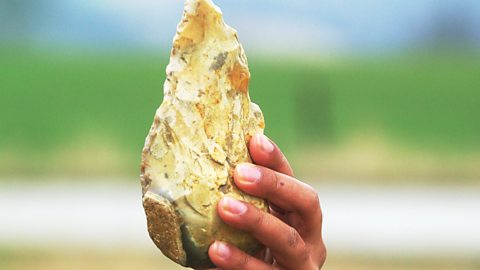
RAKSHA DAVE: A very long time ago in ancient Britain, there were no written words. This was the time before history was recorded. It's prehistory. The only clues to life back then come from the objects, burials, cave paintings, and monuments which speak to us about Britain's ancient past. My name is Raksha Dave. I'm an archaeologist, and I'm in search of Britain's Ancient Voices.
Around 4,500 years ago, some new people arrived in Britain from different parts of Europe. These people brought with them some new ideas, including the way they were buried in special man-made mounds called barrows. When archaeologists excavated these barrows, they found skeletons lying on their sides like this, surrounded by special things known as grave goods. Amongst these goods, they found something extremely interesting. These people were buried with a material that was never found before in Britain - copper. They had discovered how to make metal, and this was something completely new. Copper was the first metal to be made, but it was soon discovered that mixing copper with another metal - tin - would make something even stronger - bronze. And this marked the beginning of a great new age in Britain - the Bronze Age, 4,000 years ago.
To show how long ago that was, I'm going to walk back in time. This is today. If you imagine that every stride I took was equal to 100 years, then to go back to the Bronze Age, I'd have to take 40 steps. One, two, three, four, five, six, seven, eight… After taking 20 steps, I've gone back 2,000 years. This is the first time that history was written down, and now I'm going back into prehistory. I'm now going back 4,000 years. Back there is the Stone Age, and this is the Bronze Age. Making bronze takes lots of skill.
JAMES CLIFT: So, this is the copper ore. We need to crush them down into a fine powder.
RAKSHA: Right, so I need to take some of this, put it in here…
JAMES: Yeah.
RAKSHA: …and then I'm just pounding this down?
JAMES: Just pounding it down.
RAKSHA: The copper and tin ore are ground down to a powder with an antler. The powder is put into a container and heated up to over 1,000 degrees. That's ten times hotter than boiling water.
JAMES: All right, this is it.
RAKSHA: Oh, wow.
It then melts into a red-hot liquid and is poured into an axe mould. That's amazing. The axe head is then plunged into cold water to harden it.
Oh, wow! My first Bronze Age tool. Who would have thought that you could have turned rocks into beautiful metal objects like this?
JAMES: I'm sure that's what the people of the Bronze Age thought. They were magicians.
RAKSHA: The axe head has been fastened to a wooden handle ready to use. Let's see how it compares to the flint axe people previously used before metal was invented. I'm going to try the flint axe first. It's very different from using a modern axe.
RYAN WATTS: Yes, it's a different technique. You don't put all your energy into it in case you break the tool, and it's a case of just taking your time.
RAKSHA: Right. Now, I think I'm going to use the bronze one.
RYAN: OK, so, similar sort of thing, but you can feel already it's much heavier.
RAKSHA: It is a lot heavier.
RYAN: So you use that weight now behind the blows. How different it is…
RAKSHA: Oh, wow, look at that! So much easier. Look at that come away. The bronze axe is far sharper, but more importantly, bronze was a lot tougher, so much better for making tools and weapons. You can really see why these caught on because this is so much easier than the flint tool.
RYAN: Yeah, so, it'd be… You can cut down trees a lot quicker, so you can cut down more of them, clearing the land so that you can actually farm and have the crops growing in your fields.
RAKSHA: The introduction of bronze really helped to transform farming in Britain, with huge areas of forest cleared to create the first proper fields. This axe head in Swansea Museum was actually made in the Bronze Age, and the first swords were made 4,000 years ago thanks to the invention of metal. Turning rocks into metal to create new, stronger, sharper tools and weapons was truly ground-breaking, and it changed the way people lived in Britain forever.
Video summary
Archaeologist Raksha Dave visits Butser Ancient Farm to look at the beginning of the Bronze Age and construct a Bronze Age axe head in exactly the same way Bronze Age man would have done.
Starting with copper and tin, we see how an axe is made by heating the metal to 1,000 degrees centigrade, turning it into a red-hot liquid, before cooling it in water.
To finish the process, the blade is fitted onto a wooden handle.
Flint and bronze axes are then compared to explore the impact that metal making had on people in Britain.
Teacher Notes
Could be used to explore Stone Age technology – what tools did they use and how were they made?
By realising how skilled flint workers were, pupils can be made to appreciate the competence of people at the time and how well-adapted they were to their environment.
This clip will be relevant for teaching History and Social Studies at KS2 in England, Wales and Northern Ireland and 2nd Level in Scotland.
What does Stonehenge Gold tell us about the Bronze Age? video
Raksha explores Maiden Castle – the biggest Iron Age Hill Fort in Britain. We find out how it was built and about the weapons they used to defend the entrance.
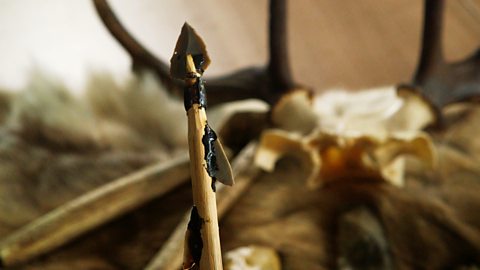
Discovering iron in Iron Age Britain. video
Raksha visits an Iron Age mine in the Forest of Dean and explores iron mining. Iron mining in the Forest of Dean dates back nearly 2,500 years where iron ore was found near the surface.
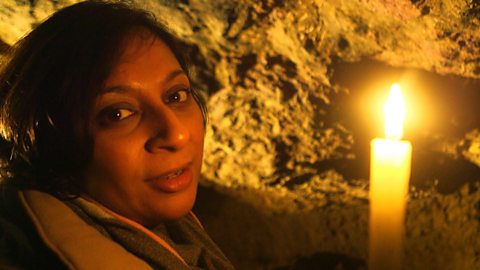
Iron Age daily life video
Archaeologist Raksha Dave explores Maiden Castle, the biggest Iron Age Hill Fort in Britain, to try and piece together what it would have looked like 2,500 years ago.
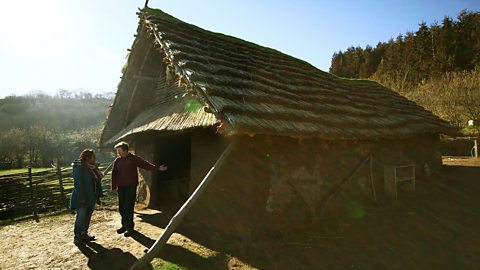
Discovering wool in Bronze Age Britain. video
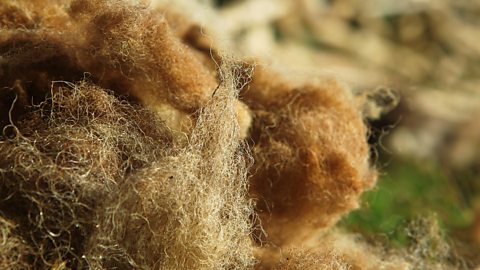
Raksha visits Butser Ancient Farm and learns how woollen cloth was made in the Bronze Age, a re-enactor at the farm shows her how to use a spindle and loom.
Iron Age forts and tribes. video
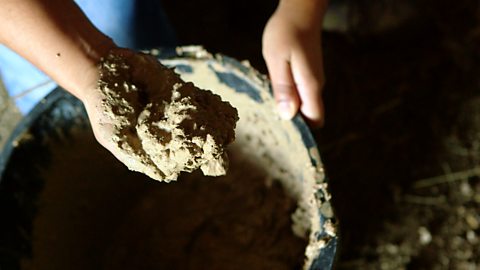
Raksha explores Maiden Castle – the biggest Iron Age Hill Fort in Britain.We find out how it was built and about the weapons they used to defend the entrance.
Stone Age farming and homes. video
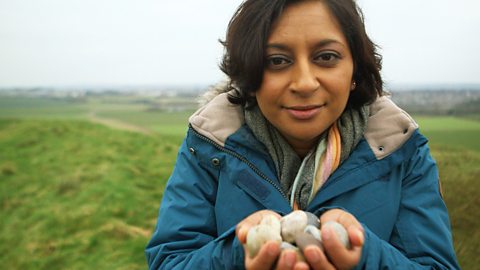
Raksha explores life in Britain during the Stone Age first by looking at hunter-gatherers who lived by hunting animals and collecting fruit and nuts, and then moves on to explore the first farmers
What do ancient bones tell us about the Stone Age? video
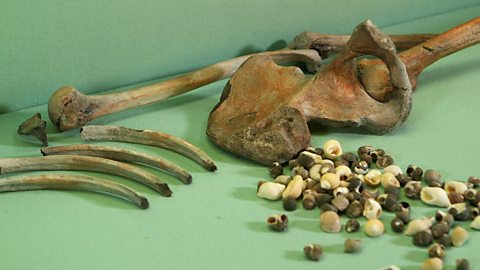
Raksha gives us a real insight into the life and times of higher status hunter-gatherers in the Old Stone Age by looking at The Red Lady of Paviland, one of the oldest skeletons found in Britain.
Discovering Stone Age tools made of flint video
Raksha explores the importance of flint to Stone Age man. A modern day worker makes a replica of a Stone Age arrow, showing us how skilled Stone Age people were in their use of flint.