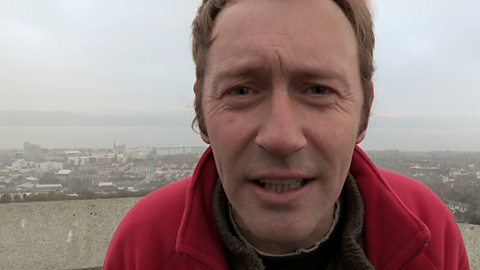
RAB: My favourite word in Scots would be 'braw'.
NARRATOR: Rab Wilson is a man who lives his life in Scots. He writes it, he speaks it, and he makes his living from it.
RAB: You been busy today?
BARTENDER: It's been good, yes.
NARRATOR: Brought up in East Ayrshire, Rab became a writer and poet and he's now a passionate advocate of the Scots language.
RAB: I left school about 16 and I done an engineering apprenticeship for the Coal Board. So I worked down the deep mines for eight years, so I was immersed in this local dialect. But later, when I was post 30 year old, it became apparent that this language had been used by local poets and rhymers for centuries. So I thought to myself, "Well, if I'm going to write, I'll write in that language too." It's a tremendous thing that you can still walk 'doon' virtually 'ony' street in ony village or 'toon' in 'Laland' Scotland and hear this… a 'seuch o' this wonderful lede' still being spoken there. I mean, it's such a 'braw, braw' thing. But if you ask 'thae' folk to write in Scots, they just 'couldnae dae it'. They 'wouldnae be able to dae it'.
There is a wonderful word, 'mawdelit'. M-A-W-D-E-L-I-T. Mawdelit. It's a crazy word really. Only the Scots could have invented such a word as that. It means inventing - no, feigning, feigning an illness in order to avoid going to a court appearance. Now how weird is it that we should have a such a specific word in the Scots language as mawdelit? But yet that word came directly from France because in France, that would be mal de lit, an illness that puts you in your bed. So it's travelled 'ower' the 'watter' here to Scotland where it's been kind of corrupted in its pronunciation into mawdelit.
I remember I got said to me one day to "away and fetch the big Monday, son." I went, "Whit?" "Away and get the Monday hemmer."I said, "Why is there a hemmer called Monday?" I 'didnae' get it, I went and only asked for the hemmer. Now a heavy hammer is like a 'nine-pund mash hammer', but the Monday hammer is a hammer that's about 20 'pund'. It's a great, big, giant floor hammer. If you 'cannae' get something to shift or move with an ordinary hammer, you use this great, big, giant Monday. Go and fetch the Monday. And of course, it 'wasnae' till years after the penny dropped. It's Scots. It means 'maun dae'. This is the thing that will do. You maun dae that. You will do that, you must do that. You know, this is the hammer that must, that will 'dae' the job. You know, when everything else fails, ya bigger 'hemmer'!
Rab Wilson, a Scottish poet, relates his use of Scots to his East Ayrshire upbringing and his time working in coal mines. He notes that if you "ask people to write in Scots, they wouldn’t be able to do it."
He explains the derivation of the words 'mawdelit' and 'maun dae'. 'Mawdelit' is an unusual word as it specifically means feigning an illness in order to not go to a court appearance. 'Maun Dae' relates to an anecdote about a hammer which is equal to the task in hand.
These clips are from the BBC Series, Blethering Scots, first broadcast in 2011.
Teacher Notes
As this clip introduces the topic of “the language used by local poets and rhymers for centuries“, students could research old Scottish poems like those by Sir Patrick Spens and recite interesting verse in Scots.
The parlour game 'Call My Bluff' could be revised and students could play against each other. Using 'Mawdelit' as the example, students could research other unusual Scottish words and create one genuine definition in conjunction with two invented suggestions.
Curriculum Notes
This video clip will be relevant for teaching English at KS3 in England, Wales and Northern Ireland and at third level in Scotland.

More videos on the Scots language:
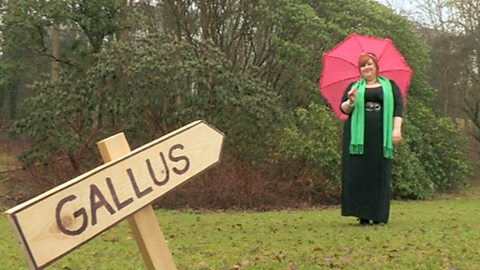
Scots words for weather. video
Presenter and singer Michelle McManus describes the weather in Scots.
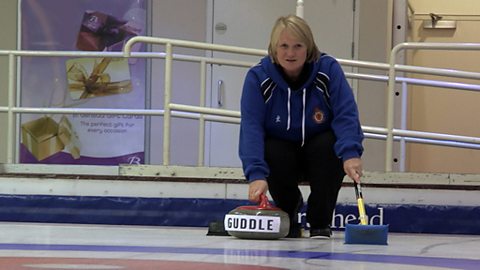
Scots words in the world of curling. video
Rhona Martin, Olympic Gold Medalist and former curler, uses Scots words to describe curling.
The news in Scots. video
Broadcaster Catriona Shearer compares modern official use of English with the 16th Century uses.

The power of Scots words. video
Journalist and TV presenter Kaye Adams describes her experiences of using Scots in her professional life.
Scots words to describe expressive arts. video
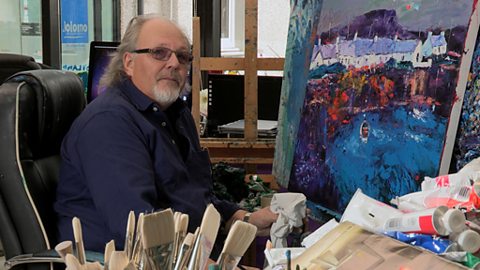
The artist Jolomo explains how Scots words often sums up his thoughts about a landscape.
Retaining Scots words in our everyday lives. video
Poet Mark Thomson comments on the words and sounds of Scots language.