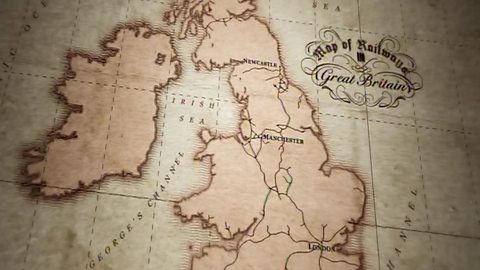
By the early 1800s, Britain was at the centre of a worldwide trading web. The country was in the midst of an industrial revolution, and factories were producing goods on a scale never seen before. Now those goods needed to be moved around the country and the world. This level of industry had changed the face of Britain.
In 1783, a small Lancashire town had just one cotton mill. One generation later, it had 86 mills. Its population of 24,000 was now 150,000. This was the world's first industrial city — Manchester.
Just 36 miles away from Manchester by road was the wealthy port of Liverpool, its gateway to the rest of the world. In 1824, 10,000 ships a year left these docks, bringing back 400,000 bales of cotton from America. Trade between the two cities was already 1,000 tonnes a day.
But the wealthy men who controlled local business and local politics were greedy for more. These men had one thing in common — they could come together in the smoke-filled rooms of downtown Liverpool and agree that the city needed to be better connected to the rest of the country, particularly the rising industrial powerhouse of Manchester, just 30 miles away to the east.
These men shared a dream — that one day, Liverpool and Manchester would be connected by a railway. This would be a huge and very expensive challenge. An engineering project on this scale had never been attempted before.
There was one man who might be able to take it on: a mining engineer from Newcastle called George Stephenson. Self-educated, barely able to read, George had grown up in a working-class mining family. But he was known as an incredibly talented inventor with a growing reputation for building reliable steam engines and reliable tracks. Some even called him a genius.
Stephenson was certainly self-confident. He said, "I will do something in coming time that will astonish all England." It wouldn't be easy. He'd have to do what had never been done before — plan a railway from the heart of one enormous city right into the centre of another. Stephenson would have to reshape Britain. But first he'd have to contend with this… a treacherous piece of natural wilderness known as Chat Moss, feared even by the people who lived near it.
No one, except George Stephenson, believed that it would be possible to build a railway across here. "It's a peat bog, that seems like one vast piece of watery sponge. To see the scale of the problem that confronted George Stephenson, I've enlisted the help of local ecologist Chris Miller."
So the peat is what I'm getting stuck in now. Is that right?
Yeah.
How deep is that peat?
It seems to go down and down. Are we going to drown in this stuff?
Well, yeah, you can get some very, very deep spots.
Whoop, down I go, there we go.
Er, as you can see…
Let's see.
…if you just carefully join me.
Ooh. Ooh, steady.
OK, nice.
(He chuckles)
So you can see, it can get very, very deep. This is more like a lake than dry land.
And was it just as bad as this 200 years ago, when George Stephenson was here?
When George Stephenson… it'd be even worse. It'd have been a lot wetter and boggier, and you'd have had these conditions everywhere.
Boggier than this?
Boggier than this.
Why on earth did he think he could build a railway track through this, then?
Well, he had no choice. I mean, this bog used to be about 35 square kilometres. It was a massive, massive expanse, and it isolated off Manchester from Liverpool, you know. You had a really huge, long journey to go down the bottom of the bog to make it to Liverpool. And so he had to take the railway across the bog.
Fortunately, George had a plan. On the peat bog, he piled on tonnes of rubble to squeeze out the moisture, like water from a sponge. Topping that with a bed of rushes and wood, he was able to float the tracks across acres of wetland.
Stephenson conquered Chat Moss, and he and his men went on to complete the Liverpool and Manchester Railway in four-and-a-half gruelling years. From here you get an incredible view, but you also get a sense of the achievement.
The railway was 35 miles long, had 64 bridges and viaducts, and even the world's first tunnel under a city. Stephenson had succeeded.
And this line now runs like an arrow across the countryside, still being used today. He'd built the railway, but now he needed the trains and the power. The moment had arrived for a final stroke of genius.
Our museums are filled with the foundations of our civilisation. Beautiful works of art, ancient texts and moments of scientific breakthrough. But in here, there's one piece of extraordinary innovation that is second to none.
It was built partly by George, but mostly by his son, Robert Stephenson, who would turn out to be an equally talented engineer. This wasn't Britain's first steam locomotive. There were others, like Stephenson's own Locomotion One, which served on the Stockton and Darlington Railway. But this was different. The others were slower, less reliable, more dangerous.
The Rocket was a watershed. Perhaps most impressive was its sheer speed — 29 miles per hour on a good run. At the time, that level of consistent speed was totally unheard-of. The Rocket could go faster than anything else ever built by humans in the history of the world. No chariot, no sailing ship could possibly keep up with it. It was the start of our enduring obsession with speed.
And the Rocket was so well designed that it would go on to become the blueprint for all steam engines for the next 130 years. That's how good it was.
With all the elements now in place, the scene was set for the opening of the Liverpool and Manchester Railway on September 15th 1830. Tens of thousands lined the streets to see The Rocket and seven other engines speed their way between the two cities. The railway was immediately wildly successful, and changed Britain forever.
It inspired a nationwide thirst for travel that led to a frenzy of rail construction, connecting the whole of Britain for the first time in its history. And it would make George and Robert Stephenson world famous as the men who had not only built the Liverpool and Manchester, but designed The Rocket, too.
George was right — he did do something to "astonish all England", but the railways did more than that. They went on to open up the entire world.
Manchester was the powerhouse of Britain’s Industrial Revolution and its factories produced goods on an unprecedented scale.
But the city’s textile industry was dependant on the cotton arriving from America at the Liverpool docks.
Trade between the two cities was already a thousand tons of cotton per day, but the wealthy industrialists were hungry for more.
Linking Liverpool and Manchester by railway would not be easy; it would take huge amounts of money, a massive labour force, and a brilliant engineer.
The engineer was George Stephenson. Stephenson also won the contest to design the best engine to run on the line – the famous ‘Rocket’.
In 1830 the line opened and a new age of locomotion had begun.
This clip is from the series Locomotion: Dan Snow's History of Railways.
Teacher Notes
Activities for the class could include:
1. Imagine you had invested in the Stockton-Darlington railway in 1825.Would you invest in this line as well?What factors would you have to take into consideration?
2. Write an information board for the Science Museum which helps to explain to visitors how important the Rocket was.You could make it a more interactive presentation if you have access to the technology.
Curriculum Notes
This clip is suitable for teaching History at KS3 and GCSE/KS4 in England, Wales and Northern Ireland and National 4 and in Scotland.
More from Locomotion: Dan Snow's History of Railways
How to build a railway. video
Dan Snow describes how building a railway network that still serves Britain today was an immense achievement.

Life before railways. video
Dan Snow explains the important role played by the railways in the Industrial Revolution in transporting supplies of cheap coal to homes and factories.

The Stockton and Darlington Railway. video
Dan Snow explains why the Stockton and Darlington Railway was a landmark in British history. He explains how the line was efficient, profitable and exciting at the time.
The world that railways made. video
The railways changed our way of living, allowing fresh food to be transported around the country and making holidays a possibility for ordinary people.