| 24 September 2014 |

| |
| BBC Homepage | | |
| |||
| Contact Us | | |
Local HeroesYou are in: Stoke & Staffordshire > History > Local Heroes > Admiral John Jervis - British military hero, from Stone 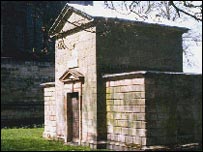 Jervis' mausoleum at St Michael's Church Admiral John Jervis - British military hero, from StoneThe great Earl St.Vincent - John Jervis of Stone- served for 73 years in the Royal Navy, winning many famous victories... an extraordinary record. Neil Stott, from Burton College, went to see his last resting place. 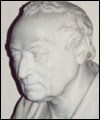 The great Earl St.Vincent - John Jervis of Stone - is interred at St. Michael's Church, Stone in a family mausoleum. Alongside a bust of the great man (photographed right, by Neil Stott) is an impressive memorial to him, where is recorded his long list of achievements. It's copied here for you to read; though do try to visit St Michael's if you can, and see the original. Don't let the eighteenth-century language of the memorial put you off... it's worth reading just to see what his grieving countrymen thought to be a fitting tribute to him. The St Michael's Church Memorial'John Jervis, Earl of St. Vincent, Viscount St. Vincent, Baron Jervis of Meaford in the county of Stafford, Knight Grand Cross of the Order of the Bath, and of the Portuguese Order of the Tower And The Sword, Admiral of the Fleet and General of the Marines. He was the second and youngest son of Swynfen Jervis of Meaford, Esq. by Elizabeth, daughter of George Parker of Park Hall in the county of Stafford, Esq - being born on the 20th of January 1735. At the early age of thirteen he entered the Royal Navy, and remained, during a long and active life, one of the brightest ornaments. In 1759, acting as commander of the Porcupine, he assisted in taking Quebec, and in the conquest of Canada. In April 1782, when captain of the Foudroyant, he, separately from the rest of the fleet, boarded and captured La Pegase, a ship of 74 guns bearing the flag of a French admiral. The modest terms in which his despatch was written, were finely contrasted with the glowing eulogy pronounced on him by Admiral Barrington, his commanding officer, and his merit was stamped by the gracious approbation of his sovereign, who created him Knight of the Bath. Appointed to the command in 1793 of the squadron sent to the West Indies, he affected, in co-operation with General sir Charles Grey, a cordial union of the services, before unexampled, and by their combined efforts the islands of Martinique, Guadeloupe, St. Lucie and Mariegalante were speedily reduced - the gratitude of the nation was expressed by votes of both Houses of Parliament in England and Ireland; and the corporation of Liverpool, peculiarly interested in the prosperity of the west Indies, presented him with their freedom. In 1795 he was appointed commander in chief in the Mediterranean: during this period a spirit of mutiny disorganised our fleets at home, but was crushed in its infancy in the fleet under his command by his unparalleled discipline. On the ever memorable 14th of February 1797, he achieved off Cape St. Vincent with a far inferior force, that conquest over the Spanish fleet which carried his renown to the greatest height, and destroyed the effect of one of the most formidable combinations of the enemy ever directed against the power of Great Britain. Having before this period been, for his former services, raised to the peerage by the title of Baron Jervis - now the joyful acclamations of his countrymen, the expressions of gratitude by numerous corporations which presented him with their freedom, the thanks of each house of the British and Irish legislature, received their triumphant sanction from the act of an approving sovereign, by whom he was promoted to the dignity of Earl and Viscount by the title of the name of the place which formed the scene of his glory. In 1801 he was appointed first Lord of the Admiralty. By this nomination were realised the advantages which were expected from his experience as a naval captain; and the public interests were protected by the reforms which as a patriot statesman he effected in the civil departments of the navy. He instituted the memorable commission of naval enquiry, a measure which drew upon him the hatred and opposition of a host of placemen and pensioners, but which, eminently characteristic of his own purity, integrity, and love of economy, was admirably calculated to detect and prevent fraud, peculation and profusion in the administration of the finances of the country. In 1806 he was appointed to the Channel fleet, and exercised that command till 1807. To the last period of his life fresh honours continued to the flow on him. In 1809, Portugal gave him the grand cross of the order of the Tower And The Sword. Having attained his 89th year he expired on the 13th of march 1823: in the full possession of all his faculties. He married his first cousin, Martha, daughter of the late right honourable Sir Thomas Parker, Knight, Lord Chief Baron of the Exchequer, but left no issue. His mortal remains are deposited in the adjacent family mausoleum.' This is what the people of the time thought of John Jervis, but can you shed any light on what history, and the people of Stone, think about him?If you can, or if you want to say something another other local hero or heroine, check out our message board by clicking on the link below. This is what some people have already had to say about him:THERE IS SO MUCH PEOPLE CLAIMING TO DECEND FROM THE ADMIRAL. IT DESERVES TO BE INVESTIGATED AND NOT TO BE DENIED. I AM A JERVIS ALSO. I LIVE IN HAWAII, WHERE THERE IS ALOT OF JERVIS'S. ALL CLAIM TO DECEND FROM HIM.HOW WE ENDED UP IN HAWAII IS ANOTHER STORY. I READ THE OTHER MESSAGES WITH GREAT INTEREST FROM PEOPLE OF PORTUGAL, THE MADEIRAS, AND THE AZORES. THE ADMIRAL HAD NO CHILDREN WITH HIS WIFE AND THAT IS A FACT. THAT DOES NOT MEAN HE HAD NONE. I AM PROUD OF WHO I AM ON MY OWN MERIT. John Jervis had no children of his own. I am a descendant of his sister (Mary Jervis) who was John Jervis's only sibling to have children. Currently there are about 40 living descendants worldwide of Mary Jervis. There is much information about the living descendants in Burke's Peerage which is online. The best book about John Jervis is Old Oak by William James. There is also much related information in Nelson books due to John Jervis's close professional relationship with Nelson. There are several very good pictures of John Jervis in the City of London, at Greenwich and in the National Portrait Gallery What lessons are there for today? I'm sure the strong Navy established in the late 18th Century has greatly contributed to the spread of British culture throughout the world: English Language, Parliamentary traditions, Accountancy, Law, Sport, Business organisation and clothing. Possible Descendants of Admiral St. Vincent (John Jervis) Jervis Admiral Jervis John Jervis, Earl of St Vincent Admiral Sir John Jervis Jervis Admiral Jervis John Jervis, earl of st vincent last updated: 17/03/2008 at 13:48 You are in: Stoke & Staffordshire > History > Local Heroes > Admiral John Jervis - British military hero, from Stone |
| | About the BBC | Help | Terms of Use | Privacy & Cookies Policy |