I designed Everton's new stadium - now I have an 1878 tattoo
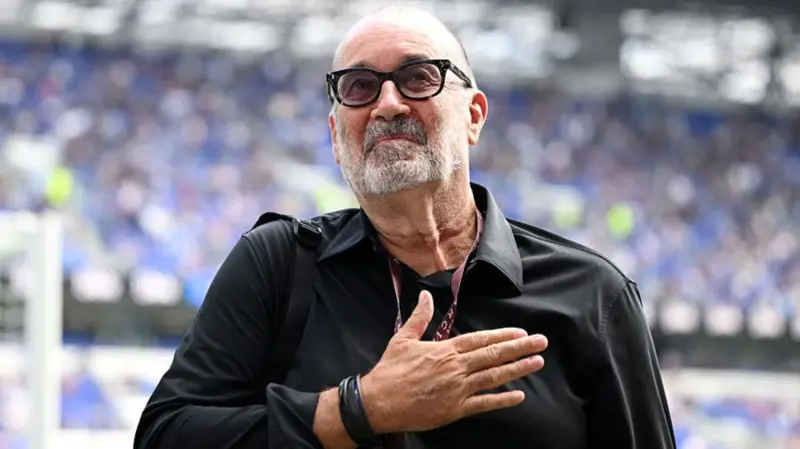
Dan Meis says he has never experienced anything like working with Everton
- Published
Two relegation battles, a change of club ownership, a global pandemic and even discovering unexploded World War Two ordnance on site - just a few things designers and engineers had to contend with before they could deliver the Hill Dickinson Stadium for its opening last August.
"Just about everything that could happen did," said Dan Meis - the Los Angeles-based architect who designed Everton's new ground.
Aside from some of the issues already mentioned, the American had to deal with transposing the Premier League club's fans into a new site - away from Goodison Park, which they had called home for 133 years.
Meis was used to pressure, but nothing prepared him for Everton.
"I live in LA, I did the Staples Center - home of the Lakers," he said.
"That was an important building to people, but it was nothing like Everton.
"I don't think I will ever have another experience quite like that because of who the club are, what the city of Liverpool is and the site where we built."
'The stadium should feel like it grew out of the dock'
- Image source, MEIS Studio


1 of 4
Meis said he was initially sceptical a club like Everton would engage a firm in the US for the project, let alone one based in Los Angeles, but dove into the history of the club and city.
He also engaged closely with fans.
"I learned pretty early through fan engagements how passionate they were about this. It was not always super friendly," added Meis.
One of the big debates was about capacity. Hill Dickinson seats more than 52,000 fans - an increase of more than 12,000 on Goodison, but 9,000 less than Liverpool's Anfield Stadium.
"I can't tell you the number of tweets I got from fans saying, 'it's OK as long as we have one more seat than Anfield'," recalled Meis.
"In the end, fans felt like they were talking to the club. Hearing from them really made me think about these things - making sure they were right on top of the pitch, making sure we weren't sacrificing that football-first energy in any way, while delivering revenue."
After options were explored for different sites, the proposal of a stadium built on Bramley-Moore Dock was mooted.
"The idea really blossomed from all that," he said.
"Bill Kenwright said he wanted something that was both historical and forward looking - that was a bit of a challenge.
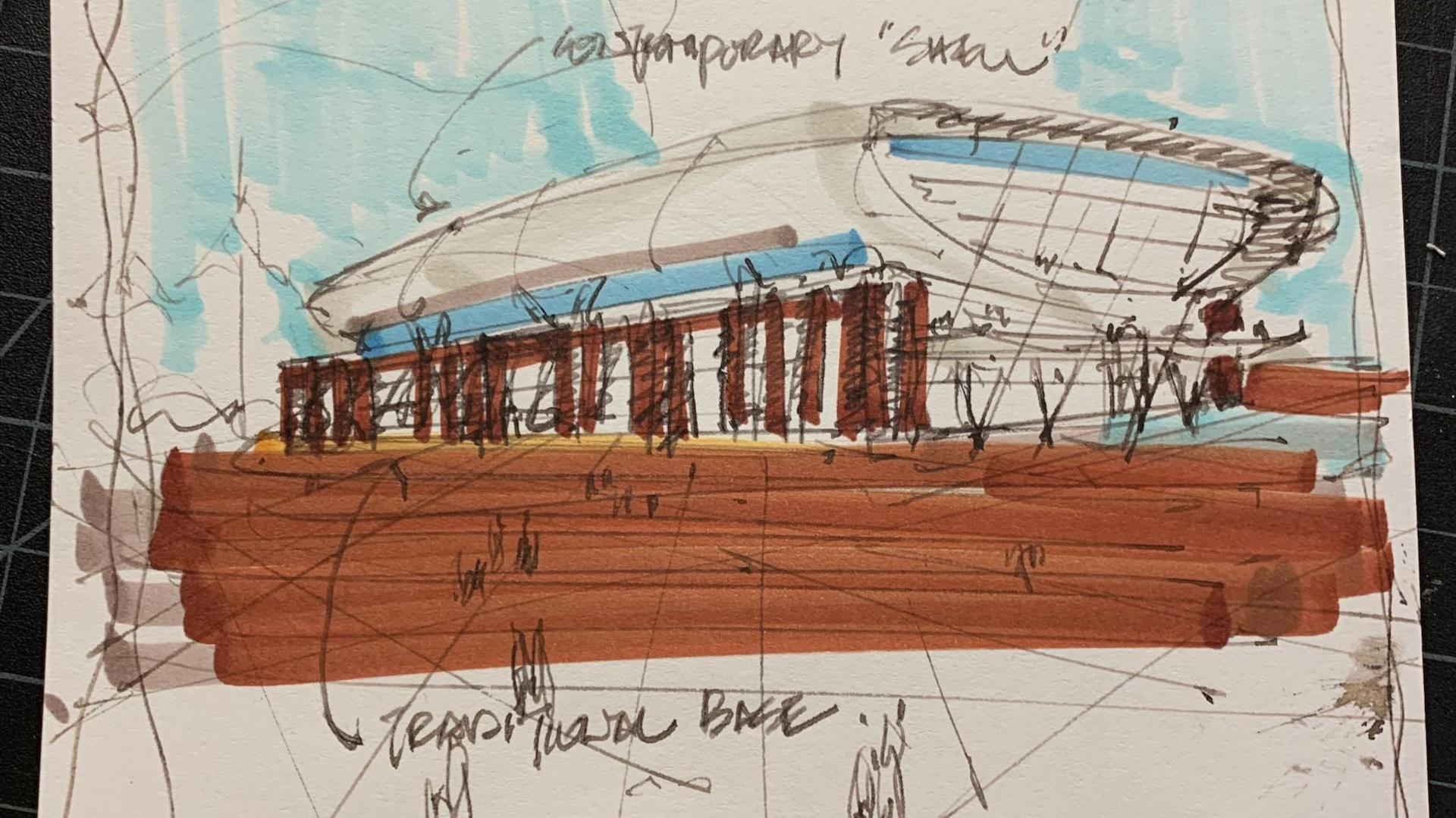
"I really believed in this idea that the stadium should feel like it grew out of the dock. I did one little sketch that was based on the idea of the Mersey washing over the dock. You had this rough scribble of a brick base with a curvy wave over the top of it. If you look at the very early renderings, the final building looks a lot like that."

A rendering of the Hill Dickinson stadium by Dan Meis
'A realisation of tens of thousands of people's hopes'
Construction began in August 2021 and was completed in 2025. However, that shouldn't imply that the project went entirely without a hitch.
"We were on the bubble for relegation more than once. We had a change of ownership and we had a war with Russia and Ukraine that affected the club," said Meis.
The Toffees finished four points above the relegation zone in 2021-22 and just two points clear of the drop zone the following season.
Everton also cut ties with Russian sponsors in 2022 following the invasion of Ukraine and the Friedkin Group took over the club in November 2024.
Nick Tyrer was lead designer for architecture and engineering firm BDP Pattern on the Hill Dickinson Stadium.
"I work on sports stadia around the world," he told BBC Sport.
"The joy, but equally the challenge of them, is that they are such landmark projects that are driven by politics, by the industry, by what's going on in the world."
He explained the design and build contract had been signed by the time Everton were facing potential relegation.
"On social media though, there was a lot of talk about how it would be the best stadium in the Championship," added Tyrer.
"That's a professional concern - you spend six or seven years of your life working on a stadium and it may open in a lower league."
That apprehension will sound familiar to fans of relegation-battling Tottenham Hotspur, who face the prospect of their club playing in the Championship next season in a 62,000-seater stadium that only opened in 2019.
Meis also explained some of the technical challenges involved in building on disused industrial docklands.
"Once the builders got down to the floor of the dock they found unexploded ordnance from WWII," he said. "They found a dolphin at one point and had to shut everything down."
The designer now has a tattoo that reads 1878 - the year Everton was founded.
He attended the first home match against Brighton, which David Moyes' side won 2-0, with Iliman Ndiaye and James Garner on target.
"I still get emotional talking about it. I had grown men with tears in their eyes hugging me, telling me how important this was to them," added Meis.
"One of the most impactful things that happened to me on that first day was that I was walking from one of the club areas to the stadium and one of the female stewards opened the door for me. As I walked through, I heard her say to someone else, 'he really listened to us'. I thought, 'how great is that?'
"I didn't do something for my ego - it was a realisation of tens of thousands of people's hopes."
- Published8 June

- Published28 August