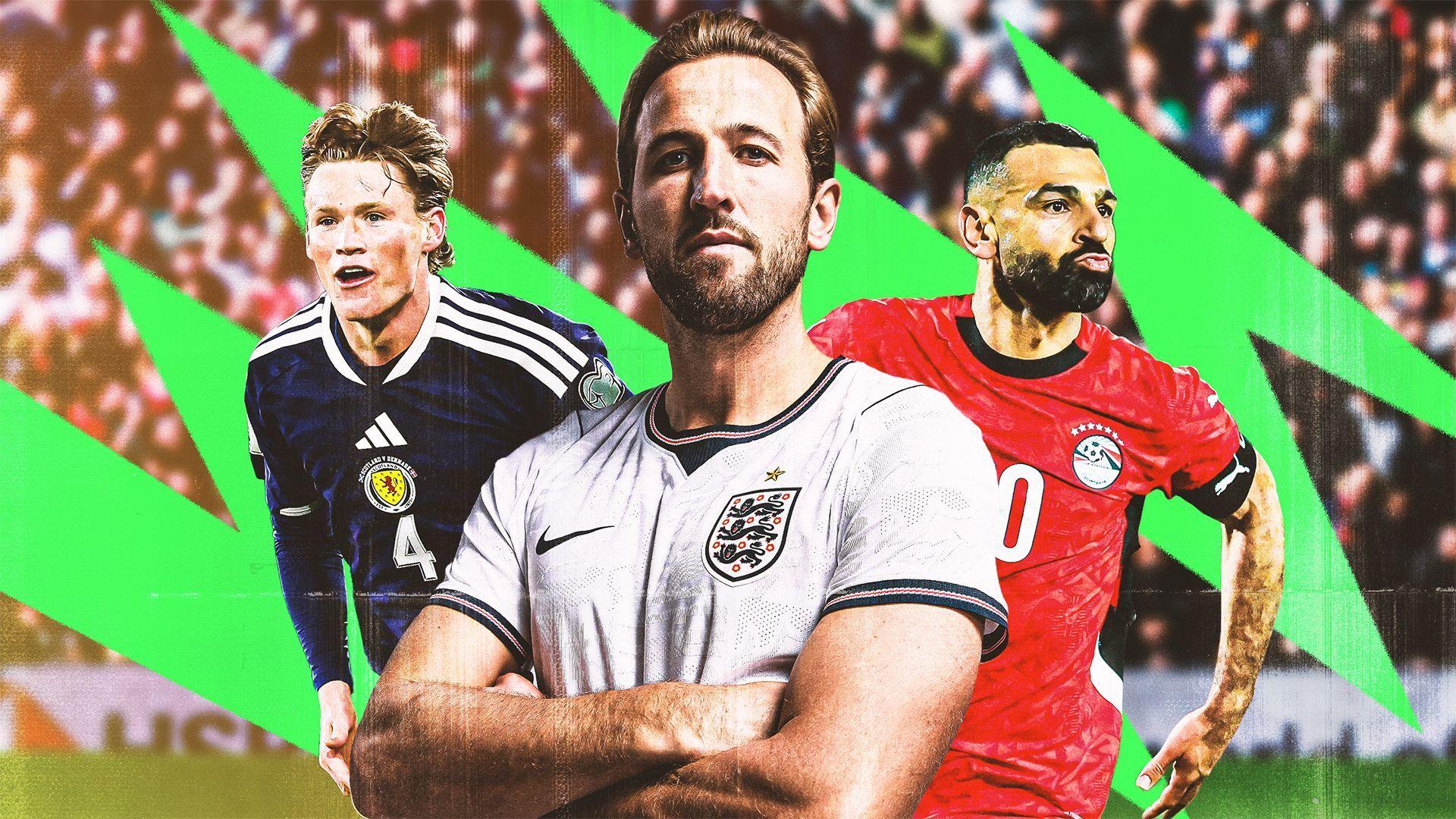
Hydration boos and surprise results - World Cup talking points

Thousand of fans flocked to Argentina's Group J opener against Algeria to catch a glimpse of Lionel Messi
- Published
The first set of matches at the 2026 World Cup is complete.
We have seen all 48 teams in action across three countries over a jam-packed seven days, with 75 goals scored and a smattering of upsets, individual brilliance and controversy.
As the biggest World Cup in history gathers pace, BBC Sport take a look at five talking points from the opening week of the tournament.
Europe and South America won't have it all their own way
World Cup debutants Cape Verde hold on for draw against Spain
Before a ball had been kicked, there were concerns that the expanded tournament - featuring a record 104 matches - would produce a number of boring, one-sided contests.
But it has taken less than a week for those fears to be allayed.
The traditional powerhouses of Europe and South America - the continents that hold 15 of the top 20 slots in the current Fifa rankings - have not had things entirely their own way.
Brazil, Uruguay and Switzerland were all held to draws by so-called 'lesser' nations, while Spain were frustrated by debutants Cape Verde in one of the World Cup's biggest surprises of all time.
The fact that the third-smallest nation ever to qualify for the World Cup was able to hold their own against the reigning European champions helped dispel the myth that this tournament would be riddled with mismatches.
Others have had their moments: Fellow debutants Curacao scored against Germany - despite being drubbed - Jordan pushed Austria for long periods and DR Congo held Portugal.
Asian Football Confederation countries have been particularly impressive, with Australia and South Korea winning, Japan holding the Netherlands and Qatar and Saudi Arabia picking up creditable draws.
The caveat here is its very early days. We are only a third of the way through the group stage, and the bigger teams can perhaps afford an off-day when 32 of the 48 sides will go through to the next phase.
United States' women's manager Emma Hayes told ITV: "There has been a lot of the talk about the expansion, but you can see it is bringing out the best in teams."
Hosts United States have the potential to excite a nation
There's nothing better for the momentum of a World Cup than a successful host country. This summer, we might get three successes.
Canada picked up their first-ever point, after Mexico opened the tournament in style with victory over South Africa - accompanied by two colourful opening ceremonies - but it was the USA who really took the plaudits.
Their impressive 4-1 demolition of Paraguay silenced a few doubters - and home reaction suggested the States is ready to become invested if their team do the business.
The US have demonstrated they have potential to progress in the tournament, with Folarin Balogun and Christian Pulisic showing they are ready to become national heroes.
With the NBA championship now done and dusted, is the USA about to fall in love with soccer? More performances like their thrashing of Paraguay will help.
Hydration breaks disrupting the flow of matches

Hydration breaks have become a frustration for many at the World Cup
A lot of the noise before the tournament was about the prospect of extreme weather causing delays but, with that yet to happen, the annoyance has come from elsewhere.
Hydration breaks have quickly become one of the World Cup's frustrations.
Over the past seven days, supporters have had to get used to referees halting play in the middle of each half to allow players to rehydrate.
The mandatory three-minute breaks - introduced to help players cope with stifling heat - have quickly been exploited by managers.
This has led to the stoppages becoming an annoyance not only for supporters, but also for some managers and players.
'It's changing the game' - pundits debate impact of hydration breaks
United States manager Mauricio Pochettino said he did not like the breaks during his side's 4-1 win against Paraguay, adding they were "unnecessary" when conditions were tolerable.
One of the main issues is that the hydration breaks are not being used primarily for the purpose for which they were introduced - allowing players to take on water in difficult conditions.
Instead, managers are using the stoppages to pass on tactical instructions, with fresh ideas and plans often changing the momentum of matches almost immediately.
That was the case during Brazil's 1-1 draw with Morocco last week. The five-time champions were trailing when the hydration break arrived, allowing manager Carlo Ancelotti to pass on new instructions to his players.
Less than 20 minutes later, Brazil had levelled through Vinicius Jr, with Ancelotti later acknowledging the break had helped his side assert control.
Netherlands captain Virgil van Dijk said the interruptions were frustrating for supporters watching at home.
But, for the millions of fans around the world, hydration breaks appear to be here to stay.
World Cup hydration breaks - who are the winners and losers?
- Published15 June
Strong attendances ease early concerns over empty seats
Scotland's national anthem is sang at the World Cup for the first time in 28 years
One of the biggest talking points heading into the tournament was Fifa's ticketing policy and pricing.
Not only were ticket prices set astronomically high, with Fifa introducing a controversial dynamic pricing model, but only a limited number of tickets were made available to fans of each participating nation.
It initially appeared as though the pricing and distribution strategy might leave Fifa red-faced, as there seemed to be thousands of empty seats during the match between South Korea and the Czech Republic on the tournament's second day.
Fifa later claimed that the empty seats visible at the Estadio Akron in Mexico last week were due to fans remaining on the concourse rather than taking their seats.
According to figures released by football's governing body, stadiums have been more than 99% full.
Whether those numbers are entirely accurate is difficult to know but one thing we can be sure of is there is no evidence of the swathes of empty seats seen at certain games in previous tournaments.
It seems as though World Cup fever has taken hold in the United States, Mexico and Canada - despite the hefty prices.
The superstars are bringing their games
Messi opens the scoring against Algeria
Just a glance at the top scorers table is proof enough that the world's best mean business.
Lionel Messi: 3. Erling Haaland: 2. Kylian Mbappe: 2. Harry Kane: 2
The first three names on that list lit up the World Cup on Tuesday, before Kane joined the party a day later.
Germany's Kai Havertz is also on two goals, along with a number of lower-profile players who have also shone - Balogun, New Zealand's Eliah Just and Sweden's Yasin Ayari.
But do not be surprised to see the established order steal the show again when it really matters.
Related topics
- Published18 July
- Published6 June
- Published1 April