Japan benefit from new World Cup substitution rule
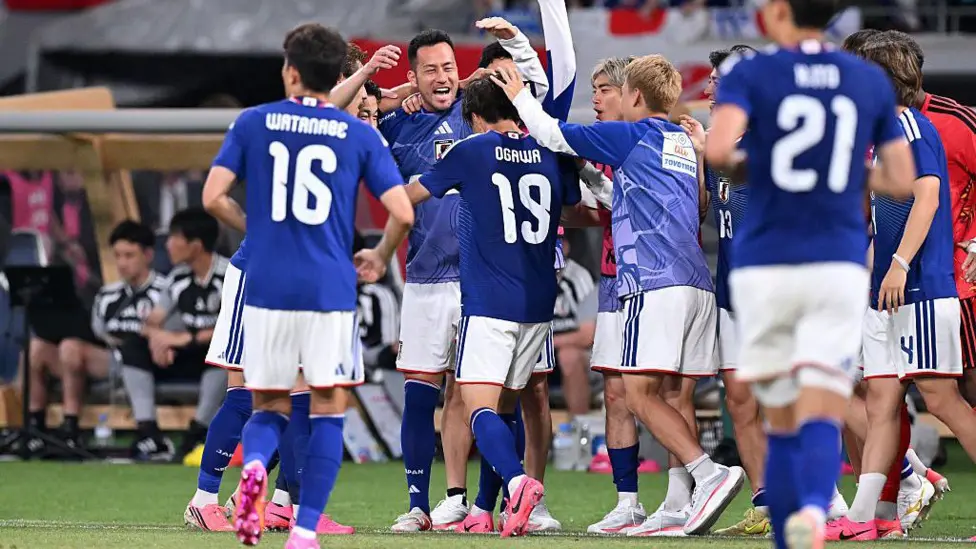
Japan will look to reach the quarter-finals of a men's World Cup for the first time
- Published
Japan became one of the first beneficiaries of the new time-limited substitution rule on Sunday when they scored while opponents Iceland had just 10 players on the pitch.
Under several new rules introduced by the International Football Association Board (Ifab) in time for the World Cup, players have 10 seconds to leave the field at the nearest point when being substituted.
If they fail to do so, the substitute cannot enter the field for at least one minute until the next stoppage in play, meaning their team must continue with 10 players.
During a friendly between Japan and Iceland on Sunday, Iceland fell foul of the new rule and winger Isak Thorvaldsson was unable to come on.
While Iceland were down a player, Koki Ogawa scored an 87th-minute header to earn Japan a 1-0 win.
Japan's goal came one minute and 54 seconds after Thorvaldsson was prevented from entering the pitch.
Speaking after the match, Japan manager Hajime Moriyasu warned his players about making the same mistake as Iceland.
"I thought the players handled the new rule adjustments today with almost no issues," Moriyasu said.
"Under the new rules, players won't necessarily be able to get back on the pitch as quickly as before. That's something we need to be mindful of. Whether it's during substitutions or in other moments, we need to avoid creating openings that give the opponent a chance."
Moriyasu also spoke about the importance of delivering clear and concise tactical instructions during three-minute hydration breaks, another new introduction.
"In those three minutes, we have to organise the key points we need to get across and communicate them clearly to the players," the 57-year-old said.
"I felt that how well we use those three minutes could have a major impact on the outcome of matches, so we want to prepare thoroughly."
Japan begin their World Cup campaign against the Netherlands on Sunday, 14 June (21:00 BST), before facing Tunisia and Sweden.
Other law changes for the World Cup
This summer's World Cup will see a high number of law changes, primarily around eradicating tactics to slow the tempo of play and waste time.
Fifa referees' chief Pierluigi Collina hopes these changes will mean stoppage time is not as long as at the 2022 World Cup. But there is guaranteed to be three minutes in each half for the hydration breaks.
Throw-in countdown (five seconds): If a player deliberately delays the restart of play, the throw can be given to the opposition.
Goal-kick countdown (five seconds): Also applies to deliberate attempts to run down the clock and can result in a corner being awarded.
Off-field treatment (one minute): Players who are treated by the physio must stay off the field for 60 seconds. There are some exceptions, including for goalkeepers, injuries and if the opponent is booked or sent off.
Players covering their mouths: Any player covering their mouth in a confrontational situation with an opponent may be sanctioned with a red card.
As well as Collina's request for the change to the protocol on corners, there are also a couple of other tweaks to VAR.
Corners can be checked: If VAR can make sure that a corner has been correctly awarded, but this must be done quickly and before the restart. Does not apply to wrongly awarded goal-kicks.
Second yellows can be reviewed: Players sent off for two cautions can have the second booking checked - but there will be no reviews for potential second yellows.
Related topics
- Published10 December 2025

- Published1 April