DMF & MXL: from sharing media to orchestrating software based live production
The Media eXchange Layer project and a new joint task force are helping the EBU Dynamic Media Facility become reality.


Last September we introduced the European Broadcasting Union’s (EBU) Dynamic Media Facility (DMF) project. DMF is about moving live production from rigid, hardware-dependent workflows to flexible, software-first environments. The core idea is to combine “media functions” running on generic IT infrastructure in ways that can adapt and scale to meet changing needs as the broadcast landscape rapidly evolves.
But interoperability is also important so broadcasters avoid going down potential wrong paths with proprietary solutions. A first step has been the creation of the Media eXchange Layer (MXL) project, for fast sharing of video, audio and data between media functions.
Rapid progress with MXL
The last six months have seen significant momentum, with the public release of MXL 1.0 SDK on Christmas Day, leading to a growing ecosystem of tools and implementations, including new Rust implementation and integrations with frameworks like GStreamer. At the NAB show, over a dozen companies were showing MXL in some form, with most providing containerised media functions for an interoperability demonstration running across multiple hosts.
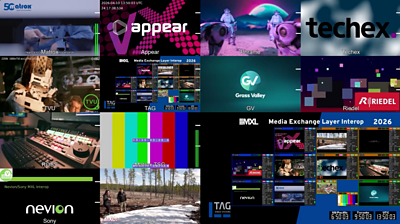
Now the MXL community is turning its attention towards finalising the APIs for sharing media between different types of compute, which will unlock high-performance graphics and AI functions, as well as remote shared access using high-speed networking within a cluster. In BBC R&D we’ve done some early testing using RDMA on our OpenStack environments in Salford and London, and the results look promising.
Beyond exchange: a musical analogy
While MXL focuses on sharing between media functions, DMF as a whole is about how media functions work together. It’s like writing for a group of talented musicians: each plays their part, but the real value comes from coordination and harmony. In other words, we need good orchestration.
This is an often-used term in the world of IT and software, and in the EBU DMF team we have spent some time carefully identifying areas of orchestration and requirements as part of the second release of its Reference Architecture. For example, media functions will typically run in software containers managed by a container orchestration technology such as Kubernetes. Whereas at a higher level, workflow orchestration will determine when and how media functions are invoked and interact. The DMF’s goal here is not to prescribe a single model, but to clarify the roles and interfaces so that different orchestration approaches can coexist and interoperate.
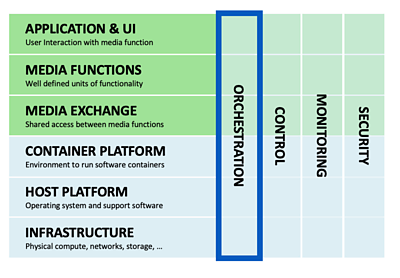
EBU and the Advanced Media Workflow Association (AMWA) have created a Joint Taskforce on DMF (JT-DMF) to work on the practical next steps for orchestration. Rather than attempt to tackle everything at once, we’ve identified some of the most pressing priorities:
- Flow connection management: how connecting DMF media functions using MXL differs from connecting using streaming protocols and what this means for control frameworks such as NMOS.
- Compute resource management: how to request CPU, GPU, network, and storage for DMF media functions, so an orchestration system can reserve resources.
- End-to-end synchronisation: how incoming streams of video, audio, and data can correctly recombine when they travel through DMF media functions and MXL sharing.
(In our musical analogy, these three areas would be: making the melody move smoothly between the instruments, ensuring they don’t overpower each other, and keeping everyone in time.)
We’re taking an agile approach, demonstrating ideas early, reviewing progress quickly, and we expect to see running code very soon.
Talking business: what does this mean for broadcasters and the industry?
DMF and MXL are as much about the journey as the destination. We are engaging with teams at the BBC and other broadcasters about their roadmaps for moving to software-based operations - including their immediate and future facility needs, how those facilities will be operated, and the skills needed to run them. We are also giving teams hands-on experience with our test environments to help evaluate technologies and how best to use them. Meanwhile, a new JT-DMF business group is looking at future commercial and licensing models where software applications and media functions replace hardware boxes.
Find out more
The video above is our introduction to DMF and MXL, and we’ll be talking about the work at the Media Production Technology Show in London on 13-14 May:
- At 13.35 on day 1: Peter Brightwell and Willem Vermost (EBU) will present at the SMPTE Media Technology Conference Europe.
- At 12.35 on day 2: Shyamalie (Sha) Thilakawardana will be on a panel on the Broadcast Technology Theatre.
For more in-depth information about the DMF and MXL projects, head to the EBU’s site and find our code in the MXL GitHub repository.
Search by Tag:
- Tagged with IP Production and BroadcastIP Production and Broadcast
- Tagged with FeaturesFeatures
