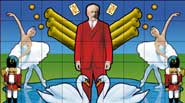
Diaghilev
Without Sergei Pavlovich Diaghilev (1872-1929), 20th-century art would have been much the poorer. Passionate about music, painting, opera and ballet, he had neither enough talent to become an artist himself, nor enough money to become a patron to others. He found his great role in acting as an impresario, a facilitator and middleman who to a great extent shaped European cultural life during the first quarter of the century.
He began by publishing a journal "The World of Art" and organizing exhibitions of Russian painting in Paris. After the first successes, he switched to music and in 1907 he brought Rimsky-Korsakov, Glazunov, Scriabin and Rachmaninov to France for an ambitious series of concerts.
The following year, he staged Musorgsky's opera Boris Godunov at the Paris Grand Opera - a historic production which made both the opera itself and the bass Fyodor Shaliapin internationally famous. On the basis of this success, he would probably have continued mounting operatic productions, but his financial constraints made this a risky prospect. Instead, he decided to bring the best dancers of the Mariinsky Theatre to Paris - this offered the twin advantages of much lower expenses and the absence of any language barrier. An expedient this might have been, but Diaghilev applied all his genius to it, and the celebrated Ballets Russes were born.
What, for example, would Stravinsky have been without Diaghilev? When Diaghilev was looking for a composer for his first newly-commissioned ballet, The Firebird, Stravinsky was little more than a young epigone of Rimsky-Korsakov and Glazunov. He was Diaghilev's fourth choice and only got the job after Cherepnin, Lyadov and Glazunov turned it down. But the excitement surrounding the project, and the brilliance of his artistic collaborators, Alexander Benois (sets) and Mikhail Fokine (choreography) inspired Stravinsky to new heights, and he supplied a clever concoction of Russian music idioms from the past century, packaged in sparkling orchestration. Paris thought the Firebird was a miracle, and Diaghilev decided that Stravinsky was worth further investment.
Next year came Petrushka, once again a collaboration between Benois, Fokine and Stravinsky. This time, Stravinsky went a step further and created a new type of descriptive music that illustrated every single detail of the action, down to the broken valve on the organ-grinder's instrument. The themes moved cinematically, from the background to the foreground and back again, they collided and dispersed in the air, representing the real-life cacophony of the fairground.
The next project, which Stravinsky conceived together with the painter and archaeologist Nikolai Roerich, was at first even kept secret from Diaghilev. This was The Rite of Spring, a score of a truly explosive force, which, combined with the iconoclastic choreography of Nijinsky, set the scene for one of the most famous artistic scandals. The premiere ended in a riot, and Diaghilev, ostensibly horrified by this reception, reckoned that all publicity is good publicity.
The calamity of the First World War temporarily brought Diaghilev's Paris seasons to an end, and Stravinsky's future began to look bleak. Diaghilev almost dropped his young protégé when he decided that Eric Satie offered something even more cutting-edge, and in 1917 he staged the outrageous Dadaist Parade, a collaboration between Satie, Cocteau and Picasso. But Stravinsky soon made his comeback with Les Noces, based on a Russian wedding ritual - arguably his greatest masterpiece.
Always a trendsetter, it was Diaghilev who pushed Stravinsky towards neoclassicism. Enchanted by some 18th-century Italian scores, he asked Stravinsky to make a set of pleasing orchestral arrangements. But Stravinsky's response went much further than Diaghilev could have imagined: beyond the task of orchestration, Stravinsky added new counterpoints and ostinati and created his characteristic new harmonic palette of diatonic dissonance. Diaghilev, on receiving the completed Pulcinella, was unhappy, "offended on behalf of the 18th century", as he put it. But he quickly realized the commercial potential of neoclassicism, and the new trend took off. Stravinsky became a god for the young French composers, Les Six, who followed in his footsteps - and in turn they were able to make their reputations through their own Diaghilev productions.
It could be said that when Stravinsky lost his mentor - Diaghilev died suddenly in 1929 - he also lost his way. He persisted with neoclassicism, and while this resulted in some important works, he found himself out of fashion by the 1940s, until his association with Robert Craft made him re-think his style once again and turn to serialism.
As for Diaghilev's legacy, it continues, of course, in modern dance, but also, much more widely in the many "isms" that emerged from the Diaghilev camp. It would be hard, for example, to imagine Schnittke's polystylistic manner, or Michael Nyman's film scores if Diaghilev had never existed. Stravinsky left clear instructions that on his death he was to be buried near Diaghilev's tomb, and so, from 1971 onwards, they have both lain in the same Venetian cemetery.
© Dr Marina Frolova-Walker/BBC

 Back to the A-Z index