Back to books: Sweden’s digital backlash
Why tech-savvy Sweden is ditching screens for books and pens in its schools.
Sweden, once a global poster child for digital education, is changing course. The Nordic nation previously championed a screen-first approach; laptops and tablets have been the norm in classrooms since the 2010s. Now, the country is pivoting back to basics, reintroducing physical textbooks, limiting screen time, and investing heavily in school libraries.
Stockholm-based reporter Maddy Savage explores why one of the world’s most tech-savvy countries is embracing analogue learning once again. Driving the shift are falling international test scores and growing anxiety over the potential impact of heavy screen use on pupils' concentration, and how children process information.
While the move broadly has political support and backing from the OECD, it has sparked a debate over future-proofing the next generation. In an era of rapid AI integration, critics worry that reducing classroom technology could dent digital literacy and widen the inequality gap. The concern is that children with parents who lack the digital skills to support them will be left behind.
We hear from the teachers, parents, pupils and researchers at the heart of this transition.
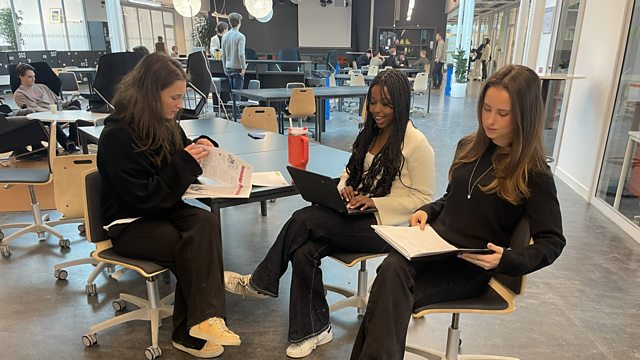
(Photo: Swedish high school students opening their books. Credit: Maddy Savage)
Last on

More episodes
Previous
Broadcasts
 Thu 16 Apr 202601:32GMTBBC World Service
- Thu 16 Apr 202608:32GMTBBC World Service
- Thu 16 Apr 202619:06GMTBBC World Service except East and Southern Africa & West and Central Africa
- Sat 18 Apr 202623:32GMTBBC World Service except Americas and the Caribbean, East and Southern Africa & West and Central Africa
- Sun 19 Apr 202604:32GMTBBC World Service except East and Southern Africa & Live News
- Sun 19 Apr 202612:30GMTBBC Radio 4
- Sun 19 Apr 202613:06GMTBBC World Service News Internet
- Sun 19 Apr 202622:32GMTBBC World Service East and Southern Africa & West and Central Africa only
- Mon 20 Apr 202615:00GMTBBC Radio 4
