Peter Singer’s Drowning Child thought experiment
In 1972, the philosopher Peter Singer published his Drowning Child thought experiment, one of the most influential ideas in modern philosophy.
In 1971, the region that is now Bangladesh fought for independence from Pakistan. At the time, Peter Singer was a philosophy lecturer at the University of Oxford.
Horrified by the suffering in Bangladesh, Singer wrote an essay in which he put forward his Drowning Child thought experiment, one of the most influential ideas in modern philosophy.
The thought experiment, published in 1972, inspired the Effective Altruism movement, which has led donors to commit billions of dollars to charities. Peter Singer speaks to Ben Henderson.
This programme contains views on disability that some people may find offensive.
Eye-witness accounts brought to life by archive. Witness History is for those fascinated by and curious about the past. We take you to the events that have shaped our world through the eyes of the people who were there.
For nine minutes every day, we take you back in time and all over the world, to examine wars, coups, scientific discoveries, cultural moments and much more.
Recent episodes explore everything from how the Excel spreadsheet was developed, the creation of cartoon rabbit Miffy and how the sound barrier was broken.
We look at the lives of some of the most famous leaders, artists, scientists and personalities in history, including: the moment Reagan and Gorbachev met in Geneva, Haitian singer Emerante de Pradines’ life and Omar Sharif’s legendary movie entrance in Lawrence of Arabia.
You can learn all about fascinating and surprising stories, like the invention of a stent which has saved lives around the world; the birth of the G7; and the meeting of Maldives’ ministers underwater. We cover everything from World War Two and Cold War stories to Black History Month and our journeys into space.
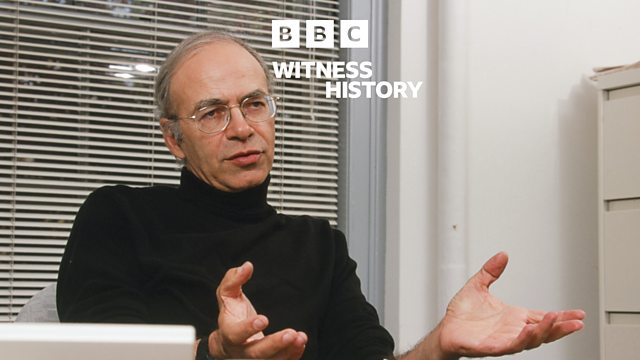
(Photo: Peter Singer in 2001. Credit: Najlah Feanny/Getty Images)
Last on

More episodes
Broadcasts
- Wed 29 Apr 202607:50GMTBBC World Service
- Wed 29 Apr 202611:50GMTBBC World Service
- Wed 29 Apr 202617:50GMTBBC World Service except East and Southern Africa, News Internet & West and Central Africa
- Wed 29 Apr 202621:50GMTBBC World Service East and Southern Africa & West and Central Africa only
- Thu 30 Apr 202602:50GMTBBC World Service except East and Southern Africa, East Asia, South Asia & West and Central Africa
Podcast
![]()
Witness History
The story of our times, told by the people who were there