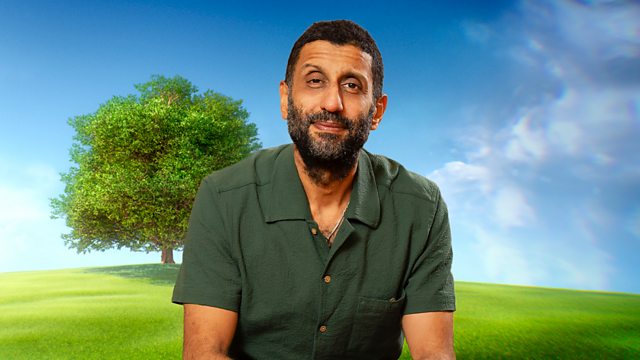
Adeel Akhtar
Adeel Akhtar wants to know how his ancestors came from India to Kenya and makes a surprising discovery that his roots in the country run deeper than he ever imagined.
Multi award-winning actor Adeel Akhtar wants to find out about his Indian Kenyan roots on his mum’s side. In his words, “how did a load of Indian people end up in East Africa?”
Adeel visits his mum who tells him how she left Kenya for London when she was just 17 and knows little about the family, other than her mum came from a family called Suleman Verjee. Originally from Gujarat, they became one of the wealthiest families in Nairobi. She suggests Adeel goes to visit his cousin Shelley in Nairobi to find out more.
In Nairobi, Shelley tells him that Suleman Verjee is not only the family name but the name of the first relative who settled in Kenya from India. The story is that he came on a boat, called a dhow, from Gujarat to Mombasa and this is where Adeel should go to discover more.
In Mombasa, Adeel meets Kalandar Kamalkhan who reveals Suleman Verjee is Adeel’s three-times great grandfather and that he travelled to Mombasa in 1885 with his son, Adeel’s great great grandfather Kassam. An account of the voyage details how Kassam, aged only 15, helped his fellow passengers during a storm. In Mombasa’s old town, Adeel learns how Suleman set up shops there before sending for the rest of the family, including Kassam’s brothers Hussein and Madatally. Now Adeel wants to know how the family moved from Mombasa to Nairobi.
Adeel’s next stop is Mombasa’s railway station where he meets historian Dr Moindi Kennedy. In 1896 the British started construction on the Kenya-Uganda railway and for families like Adeel’s it led to opportunities. The Suleman Verjees set up stalls along the railway track, and when the railway reached the newly established settlement of Nairobi, they were amongst the very first to open shops in what became the Indian Bazaar.
Following in the footsteps of his ancestors, Adeel returns to Nairobi, where he meets Professor Kenneth Ombongi who tells him how, despite their thriving business, the Verjees were operating in a difficult environment. The crowded conditions and poor sewerage systems in the bazaar led to recurring epidemics of plague. When the colonial government commissioned an investigation into sanitation in the bazaar Adeel’s great great grandfather Kassam gave evidence. Kassam argued that it was the poor infrastructure that led to the spread of disease. The commission disagreed and a year later a British Government report proposed segregating Nairobi based on race. Adeel is shocked and saddened to hear how this struggle is emblematic of a system based on discrimination.
In the end the plan for a fully segregated Nairobi wasn’t implemented but Adeel’s family still faced racial prejudice. Adeel meets historian Zahid Rajan to see if he can tell him how the family navigated this. By 1919, Adeel’s three-times great uncle Hussein was president of the East African Indian National Congress which advocated for Indian rights in British East Africa. Adeel reads Hussein’s speech, which talks movingly about the sacrifice Indian soldiers made during the war and the lack of recognition and rights they received afterwards. Adeel reflects on how far they have come to better their lives and are still treated like this.
The research team have managed to track down two of Adeel’s distant relatives, Inayat and Basharat Suleman Verjee. Their great grandfather was Madatally, the younger brother of Adeel’s great great grandfather Kassam. They tell Adeel the family were Ismaili, a denomination of Islam whose leader is the Aga Khan, and that the family donated money to build a Jamatkhana centre for the Ismaili community in Nairobi. Adeel then learns that his great great grandfather Kassam also made a bequest to establish a girls’ school in the Jamatkhana. He sees a list of the first pupils and spots his grandmother Kulsum’s name, which he finds very touching. The brothers have one more surprise for Adeel when they present him with a family tree that shows that Kassam’s first marriage was to a woman called Ziada, and she was from the Giriama people. Adeel is surprised and delighted to discover he has African Kenyan ancestry as well as Indian Kenyan.
Adeel meets Samuel Nyanchoga, an expert on Giriama culture. Samuel explains that while he doesn’t have specific information about Ziada, marriages like hers to Kassam were not that unusual. He thinks they would have met through trade. Ziada is an Arabic name so he thinks she may have converted on marrying Kassam. Adeel reflects on how their legacy lives on in subsequent generations.
Adeel is amazed by the vastness of the story he has uncovered, the journeys his ancestors took from Gujarat to Kenya to England and his newly discovered African Kenyan roots. Now he feels an even greater connection to the country in which his mother was born and cannot wait to take his wife and children back there.
Last on

More episodes
Clips
![]()
Adeel goes to Nairobi in search of family connections
Duration: 01:21
![]()
“He saw that inequality and wanted to redress it in some way”
Duration: 01:14
![]()
"I'm fascinated to know the Indo-Kenyan side of my family"
Duration: 00:42



Credits
| Role | Contributor |
|---|---|
| Presenter | Adeel Akhtar |
| Narrator | Angela Griffin |
| Series Producer | Lucy Swingler |
| Executive Producer | Colette Flight |
| Production Manager | Demi McGarrell |
| Director | Ali Naushahi |
| Producer | Phoebe Mills |
| Production Company | Wall to Wall Media |

Featured in...
![]()
Who Do You Think You Are?
Lost connections and unfamiliar histories are revealed.