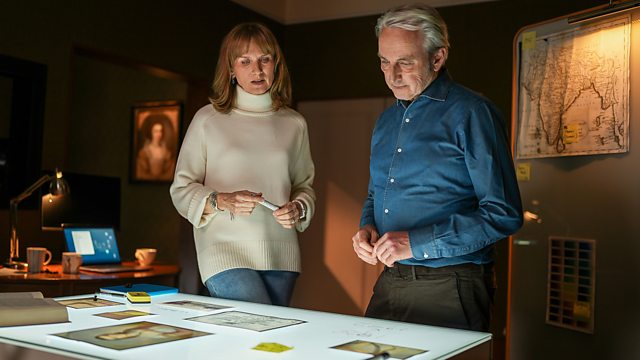
A Passage to India
Two women lost in time: an enigmatic Indian woman and an 18th-century Scottish artist. Will this quest uncover a double attribution leading to a six-figure price tag?
Two women lost in time: an enigmatic Indian woman and an 18th-century Scottish artist, both of whom, only now, are being rediscovered.
Fiona Bruce and Philip Mould embark on a high-stakes quest to authenticate a portrait and to find out who the glamorous and mysterious female Indian subject could be. But will a double attribution lead to a six-figure price tag?
Twenty years ago, retired accountant Mary-Lou Wedderburn was left a painting in her uncle Sandie’s will. It features an Indian woman in a formal pose, wearing a sheer dress, a string of pearls, a large emerald pendant, a mystery black necklace, bangles and a nose ring. Mary-Lou, together with her late husband, loved this portrait and were keen to find out its origins and who the woman was.
She believes the painting to be work of a distant relative, 18th-century Scottish artist Katherine Read, well known in her time as a portraitist who specialised in depicting women and children in both paint and pastel. But experts on Read have challenged this attribution. Mary-Lou loves the family connection and hugely admires Read’s character, so finding out the truth matters to her, not least because she feels the painting deserves more of an audience and should ideally be loaned to a Scottish gallery.
But, if the attribution is true, then how did a Scottish female artist like Read come to paint an Indian woman, and if so, where did she paint the portrait?
Unlikely subject matter aside, there is the problem of finding comparative paintings for Read. The artist studied in Europe, moved professionally in elite circles and was so successful that she was paid more handsomely than well-known figures such as Gainsborough at the time. But like many other women artists, she has subsequently languished forgotten because of changing fashions and due to many of her portraits having been re-attributed to male artists. Until recent scholarship started to unearth more of her work, it was hard to identify her as the creator of other paintings. Fiona and Philip have their work cut out.
From Dundee to Chennai, our art detectives hunt down the story of this artist and this painting.
Along the way, experts like Professor Catriona Seth, Ashvin Rajagopalan and artist and presenter Lachlan Goudie reveal Read’s intrepid, bold and eccentric character – one that takes her across Europe and to India to seek new commissions and find a husband for her most-loved teenage niece, Helena, her ward following her sister’s death.
We follow Read on a journey of huge professional highs and personal lows, finally ending in a betrayal by her niece, who was also known as Nelly. It's a betrayal that breaks Read’s heart badly. The next stage in her life is no happier, she becomes unwell and reaches an unhappy end, dying on board a ship back from Chennai, known at the time as Madras.
Fiona and Philip have a mammoth task ahead trying to find authentic Read works to compare to ours. Trawling through dense, centuries-old Dundee family archives, picking out letters and wills that could shed light on Read’s life in India and speaking to experts, they slowly piece together not just the story of Katherine Read but of the people she may have painted – the Nawabs of Arcot, the local Mughal rulers of what is now Chennai. Is the lady in the picture a court dancer, highly prized for their cultural knowledge and skills? Or is she one of the wives kept in the secluded zenanas of a palace, possibly Chepauk Palace in Chennai, that Read might have accessed in a way that perhaps only a woman artist could do?
If the team discover that Read did in fact paint a wife of a nawab, this would be a hugely significant historic and artistic find. Additionally, if other paintings of the nawabs still out in Chennai are subsequently discovered to be by Read, then we could even reveal a potential canon of other works by Read out in India.
But with a worryingly unclear line of provenance of over more than 200 years, can scientific breakthroughs and historical detective work prove the painting’s worth in an Indian art market that is currently booming? Or will it reveal the painting to have been created by someone else entirely?
Last on

More episodes
Clips
![]()
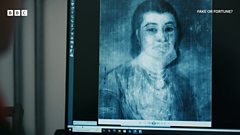
X-Ray reveals a hidden painting!
Duration: 02:15
![]()
Fiona Bruce discovers the best jewellery she's ever worn!
Duration: 02:28

Credits
| Role | Contributor |
|---|---|
| Presenter | Fiona Bruce |
| Presenter | Philip Mould |
| Producer | Philip Broadhurst |
| Series Producer | Rocio Cano |
| Series Editor | Robert Murphy |

How to contact us
Get in touch if you think you have a lost masterpiece.
