Tuned for Praise
A service from the Chapel of St John's College, Cambridge, to celebrate the new Willis/Harrison organ, which is central to the building's music and worship.
A service from the Chapel of St John's College, Cambridge, to celebrate the new Willis/Harrison organ, which is central to the building's music and worship. The service includes music and readings which reflect the theme that Christians are called to be instruments of praise, people who are made for song, and who embody the love of God in their lives. The College choir leads the congregation in the hymns 'Good Christians, all, rejoice and sing' and 'When in our music God is glorified'.
Introit: Upon your heart (Eleanor Daley)
O filii et filiae (Martin Baker)
Reading: Isaiah 35 vv1-10
Hymn: Good Christians, all, rejoice and sing (Vulpius)
Reading: Romans 8 vv31-39
Sermon
Hymn: When in our music God is glorified (Engelberg)
Psalm 150 (Wayne Marshall)
Organ Voluntary: Fantasia in G (Parry)
The Revd Canon Dr Victoria Johnson (Dean)
The Revd Graham Dunn (Chaplain)
Christopher Gray (Director of Music)
Tingshuo Yang and Pascal Bachmann (Organ Scholars)
Producer: Ben Collingwood
Last on

Programme Script
RADIO 4 OPENING ANNOUNCEMENT:
At ten past eight here on Radio 4 and BBC Sounds it’s time now for Sunday Worship. This morning’s service was recorded in the Chapel of St John’s College in Cambridge, and opens with an introit by Eleanor Daley: ‘Upon your heart’.
CHOIR:Upon your heart (Daley)
VICKY:
Good morning, I’m Victoria Johnson, the Dean of St John’s College Cambridge, and with the Chaplain, Graham Dunn, the Director of Music, Christopher Gray, and the College Choir, we welcome you to our worship on this Third Sunday after Trinity.
Today we consider our calling to be people whose deepest vocation is to love God with everything that we are, with all our heart, and soul, and mind and strength. We are called to be instruments of praise, people who are made for song, and who embody the love of God in our lives. We give thanks for all that gives voice to our prayers and praises, instruments of music, choirs and musicians, and our own voices created to sing of this love, made known to us in Jesus Christ.
GRAHAM:
We also give thanks for a newly restored musical instrument which is woven into the fabric of praise that we offer here in this chapel day by day. Within the context of our worship this morning, we call this pipe organ back into life as it fully finds its voice and lives into its vocation to proclaim the good news, to lift our praises, and to sing of God’s love.
Awake, O sacred instrument! Sing the praise of God, our Creator.
ORGAN:Improvisation
VICKY:
Awake, O sacred instrument! Sing of Jesus, our Lord, dead and risen for us.
ORGAN:Improvisation
GRAHAM:
Awake, O sacred instrument! Sing of the Holy Spirit that animates our lives with the breath of God.
ORGAN:Improvisation
VICKY:
Awake, O sacred instrument! Bring the congregation of the faithful together in songs of thanksgiving and praise.
ORGAN:Improvisation
GRAHAM:
Eternal God, source of all beauty and harmony we praise you for the gift of music: for the inspiration given to those who compose it; for the skill and devotion of those who perform it; for the faculties and powers which enable us who enjoy it. And we pray that you will sanctify and accept the music to be rendered in this chapel today, and make it an offering of praise to the glory of your holy name, through Jesus Christ our Lord. Amen.
VICKY:
O Lord God Almighty, whose glory cherubim and seraphim and all the hosts of heaven with ceaseless voice proclaim: Hear and accept, the praises of your Church below; and pour down upon your servants such a spirit of reverence and joy as shall lift up to you both our hymns and our lives through Jesus Christ our Lord. Amen.
GRAHAM:
The choir sings O filii et filiae, by Martin Baker. These fifteenth Century words take us back to that first Easter morning, and this music expresses the joy of the resurrection through the Hebrew word ‘Alleluia’, which means ‘Praise the Lord’.
CHOIR/ORGAN: O filii et filiae (Martin Baker)
GRAHAM:
Our first reading is taken from the Book of the Prophet Isaiah, who gives us a vision of the whole of creation giving praise to the God who makes all things new.
READER 1: Edie Carter
The wilderness and the dry land shall be glad, the desert shall rejoice and blossom; like the crocus it shall blossom abundantly, and rejoice with joy and singing. The glory of Lebanon shall be given to it, the majesty of Carmel and Sharon. They shall see the glory of the Lord, the majesty of our God. Strengthen the weak hands, and make firm the feeble knees. Say to those who are of a fearful heart, ‘Be strong, do not fear! Here is your God. He will come with vengeance, with terrible recompense. He will come and save you.’
Then the eyes of the blind shall be opened, and the ears of the deaf unstopped; then the lame shall leap like a deer, and the tongue of the speechless sing for joy. For waters shall break forth in the wilderness, and streams in the desert; the burning sand shall become a pool, and the thirsty ground springs of water; the haunt of jackals shall become a swamp, the grass shall become reeds and rushes.
A highway shall be there, and it shall be called the Holy Way; the unclean shall not travel on it, but it shall be for God’s people; no traveller, not even fools, shall go astray. No lion shall be there, nor shall any ravenous beast come up on it; they shall not be found there, but the redeemed shall walk there. And the ransomed of the Lord shall return, and come to Zion with singing; everlasting joy shall be upon their heads; they shall obtain joy and gladness, and sorrow and sighing shall flee away.
VICKY:
Our first hymn this morning calls all people everywhere to rejoice and sing of the love and life found in Jesus Christ.
CHOIR/ORGAN/CONGREGATION: Good Christians all, rejoice and sing (Vulpius)
GRAHAM:
The second reading is from the Letter of St Paul to the Romans and reminds us that nothing can separate us from the love of God.
READER 2: Heather Hancock (The Master)
What then are we to say about these things? If God is for us, who is against us? He who did not withhold his own Son, but gave him up for all of us, will he not with him also give us everything else? Who will bring any charge against God’s elect? It is God who justifies. Who is to condemn? It is Christ Jesus, who died, yes, who was raised, who is at the right hand of God, who indeed intercedes for us. Who will separate us from the love of Christ? Will hardship, or distress, or persecution, or famine, or nakedness, or peril, or sword? As it is written,
‘For your sake we are being killed all day long; we are accounted as sheep to be slaughtered.’
No, in all these things we are more than conquerors through him who loved us. For I am convinced that neither death, nor life, nor angels, nor rulers, nor things present, nor things to come, nor powers, nor height, nor depth, nor anything else in all creation, will be able to separate us from the love of God in Christ Jesus our Lord.
VICKY:
May I speak in the name of the Father, and of the Son, and of the Holy Spirit. Amen.
The new organ here in our Chapel at St John’s, has over three and a half thousand individual pipes. It’s an incredible instrument, and each of these pipes has its own distinctive voice. There are flutes and strings, diapasons and reeds. Two of the most famous sounds are the Trompeta Real…
ORGAN:Demonstration (Trompeta Real)
VICKY:
…and the Zimbelstern…
ORGAN:Demonstration (Zimbelstern)
VICKY:
…both loved by choristers over many generations. Each pipe, each voice, is pitched and tuned so that all these different voices can ‘sing’ together in one vibrant chord, rather like a choir, or an orchestra at your fingertips.
In western classical music, most instruments are tuned to a particular note- and from that note great symphonies can begin. Imagine an orchestra tuning up before a concert. The perfect ‘A’ sounded out by the oboe, then becomes the note to which all others are tuned. To make great music, instruments and voices need to be tuned in to each other otherwise they are literally out of tune, noisy and discordant.
If we are a kind of musical instrument, what note are we tuned to? What song do we sing? What is our sounding as human beings? Today we remember that love is the perfect note that sings throughout God’s universe- and we pray that our song is love, our sound is love, and love might be the perfect note to which we strive to tune our lives. If I do not have love, says St Paul in his letter to the Corinthians, I am a noisy gong or a clanging cymbal, in effect I am an instrument without a song, a soul without a tune, a life without the potential for harmony.
Two thousand years ago God showed us the most perfect kind of love. God sent his son into the world to give us an example of what love is. Not everyone liked the tune he played, some were threatened by the song he sang, and he was nailed to a cross.
But nothing could separate us from his love, not hardship, distress, peril or sword. When Jesus rose from the dead, there was a new frequency of love in the world, a new song was sung and where once there was sadness, here was joy; where once there was death, here was life in all of its fullness.
The love of God that we experience in the risen Christ, is the tune from which all other tunes come, the note from which all other notes emanate, the sound of all sounds, the music of all music. How do we tune our hearts to this note, to the sound of this love? How are we incorporated into his beautiful music day by day? This music sings through the whole of creation, the dry land will rejoice and blossom and burst into song, and even in the depths of despair, when weeping at the grave, we are still called to make our song, Alleluia, with the promise that love is stronger than death.
In one of her devotional poems, Christina Rossetti prays that that our hearts, and souls and voices may be tuned to the sound of love given to us in Jesus Christ, we are like a sacred instrument. Tune me O Lord, she says, into one harmony with Thee, one full responsive vibrant chord; Unto Thy praise all love and melody, Tune me, O Lord. We are called to sing and offer praise with every breath that we have, with our lips and hearts and minds and voices, to the glory of God alone. Tune us, O Lord, to sing of your love in the name of the Father, the Son and the Holy Spirit. Amen.
GRAHAM:
We sing the hymn, When in our music God is glorified, giving thanks for the gift of music and for our own vocation to offer praise.
CHOIR/ORGAN/CONGREGATION: When in our music God is glorified (Engelberg)
GRAHAM:
Let us pray.
God of all creation, for whom the church, in liturgy and song, has borne faithful witness through the centuries; let us be your instruments of praise, that in us may be found that new dimension of sound which tunes our souls and bodies
to the infinite beauty of your truth and the profound glory of your eternal light.
For you reign, Trinity in unison, God in harmony, now and forever. Amen.
We pray for those in our world who sing a song of lament, whose voices are silenced, through oppression, conflict, poverty, or grief. We pray for those of a fearful heart, who have put down their instruments, who have lost confidence in their own voice. Where there is discord, we pray for harmony and peace and we long for the time when all peoples will come together in praise to sing of God’s glory.
Bring us, O Lord God, at our last awakening into the house and gate of Heaven, to enter into that gate and dwell in that house, where there shall be no darkness nor dazzling, but one equal light; no noise nor silence, but one equal music; no fears or hopes, but one equal possession; no ends or beginnings, but one equal eternity, in the habitations of thy glory and dominion, world without end. Amen.
We gather our prayers together in the words Jesus taught us:
ALL:
Our Father, who art in heaven,
Hallowed be thy name.
Thy kingdom come.
Thy will be done, on earth as it is in heaven.
Give us this day our daily bread.
And forgive us our trespasses, as we forgive those who trespass against us.
And lead us not into temptation,
But deliver us from evil.
For thine is the kingdom, the power, and the glory, forever. Amen.
GRAHAM:
The Book of Psalms concludes with Psalm one-hundred and fifty, a paean of praise and thanksgiving. All instruments are called to offer themselves to the glory of God, lutes and harps, cymbals and pipes, the psalmist reminds us that ultimately we are an instrument of praise along with the whole of creation, we are made for song: ‘Let everything that has breath, praise the Lord’. This setting of Psalm 150 is by Wayne Marshall and expresses the joy that we are called to make our own as we being each new day.
CHOIR/ORGAN: Psalm 150 (Wayne Marshall)
VICKY:
Bless, O Lord, the work of this College, which is called by the name of thy beloved disciple; and grant that love of the brethren and all sound learning may ever grow and prosper here, to thy honour and glory, and to the good of thy people, who, with the Father and the Holy Spirit, livest and reignest, one God, world without end. Amen.
May the songs of the angels sustain you, may the praises of the saints inspire you, may the silent music of the Unseen Trinity be in your heart, and the blessing of God almighty, the Father, the Son and the Holy Spirit, be among you and remain with you always. Amen.
ORGAN: Fantastia in G (Parry)
RADIO 4 CLOSING ANNOUNCEMENT:
An organ Fantasia in G by Parry, bringing to a close this week’s Sunday Worship which came from the Chapel of St John’s College, Cambridge. It was led by the Dean of Chapel, The Reverend Canon Dr Victoria Johnson, and by the Chaplain, The Reverend Graham Dunn. The Director of Music was Christopher Gray, the organists Tingshuo Yang and Pascal Bachmann, and the producer was Ben Collingwood. The programme is available now on BBC Sounds from where you can also click through to a copy of the script. Next week’s Sunday Worship comes from St Matthew the Apostle in Burnley, and explores social cohesion as part of Radio 4's Common Ground season.
Broadcast
- Sun 21 Jun 202608:10BBC Radio 4
Lent Talks

Six people reflect on the story of Jesus' ministry and Passion from their own perspectives
No fanfare marked Accession Day...
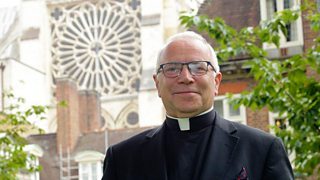
In the Queen, sovereignty is a reality in a life, says the Dean of Westminster.
The Tokyo Olympics – Stretching Every Sinew

Athletes' reflections on faith and competing in the Olympics.
"We do not lose heart."
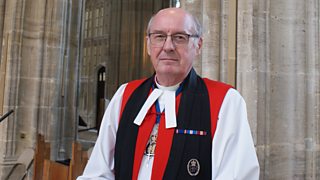
Marking the centenary of HRH Prince Philip's birth, a reflection from St George's Chapel.
St David's Big Life Hack
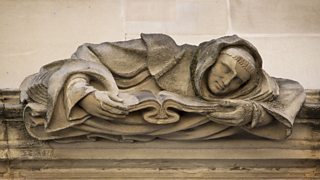
What do we know about St David, who told his monks to sweat the small stuff?
Two girls on a train

How a bystander's intervention helped stop a young woman from being trafficked.
Sunday Worship: Dr Rowan Williams
How our nation can rise to the huge challenges it faces, post-Covid-19.
