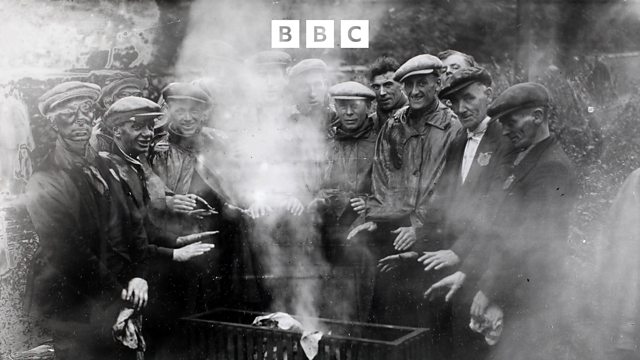
Voices of the General Strike
Accompanied by the recorded memories of those who took part, historian David Runciman explores the General Strike of 1926: nine days that shook the nation.
Accompanied by the recorded memories of those who took part, historian David Runciman explores the General Strike of 1926: nine days that shook the nation.
On the 4th of May 1926, millions of workers downed tools and went on strike. They did so in sympathy with coal miners who'd been locked out of work by mine owners demanding longer working days for lower pay. In places, life almost ground to a halt — public transport stopped, docks were blockaded, gas and electricity threatened, food supplies halted, newspapers ceased publication.
For coal miners the strike was an attempt to halt the worsening of their already desperately poor pay and conditions. For the millions of workers who, trusting their union leaders, took the extraordinary step of sacrificing their own pay in support of others, it was a radical hope that collective action might improve a system that seemed weighted against them.
For Labour leader Ramsay Macdonald the strike was a misguided tactic on the road to socialism. For Conservative Prime Minister Stanley Baldwin it was a constitutional threat. He said so on the airwaves, in a speech partly rewritten for him by the BBC's General Manager John Reith, who felt that the national schism of the strike threatened the future of the BBC and that a closeness to government was the only way to ensure its survival. With newspapers mostly out of action, the BBC — soon to transform from a private company to a public corporation — gained a new primacy as a source of news.
Meanwhile Winston Churchill commandeered paper supplies to produce a daily propaganda newspaper, called the British Gazette. The TUC countered with their own more modest and often more level-headed publication, the British Worker.
The government instituted emergency measures and across the country volunteers were recruited to break the strike and maintain essential services.
In the background loomed the spectre of the Soviet Union and a fear — grounded in reality or not — of revolution.
Until, on the 12th of May 1926, the TUC called off the strike, having secured no concessions for the miners, who remained locked out of the pits until they agreed to the conditions of the mine owners six months later.
Before, during and after — and almost forgotten amid the drama and febrile politics — is the predicament of the coal miners.
Featuring:
David Hendy, cultural historian, author of The BBC: A People's History
Neil Kinnock, former leader of the Labour Party who grew up in a mining family with memories of the Strike
Florence Sutcliffe-Braithwaite, historian, co-author of Women and the Miners' Strike 1984-1985
David Torrance, historian, author of The Edge of Revolution: the General Strike that Shook Britain
Last on

Broadcast
- Sat 2 May 202620:00BBC Radio 4
