The Pearl of Great Value
The Bishop of Dorking the Rt Rev Dr Jo Bailey Wells preaches in the second of Radio 4's special services for Lent, from St Mary's Church in the heart of Guildford.
'What we measure controls us' is the theme the Bishop of Dorking, the Rt Revd Dr Jo Bailey Wells, takes as she preaches for the second of Radio 4's special services for Lent, from St Mary's Church in Guildford. The service is led by the Rector, the Revd Canon Robert Cotton. The choir is directed by Martin Holford and Alexandra Stevenson and the organist is Anthony Gritten. Producer Andrew Earis.
A link to resources for individuals and small groups based on the Archbishop of Canterbury's Lent Book is available on the Sunday Worship web pages.
Last on

More episodes
Previous
Script
BBC Radio 4. The Bishop of Dorking the Right Reverend Doctor Jo Bailey-Wells is the preacher for Sunday Worship this second week of Lent. The service comes from St Mary's Church in Guildford and is introduced by the Rector the Revd Canon Robert Cotton.
RobertGood morning and welcome to Guildford. At each end of our picturesque cobbled High Street there is one of the two churches of this parish. At the upper end stands Holy Trinity Church: a grand place of ceremony and celebration. From its front door, you can see businesses and banks, an alms-house, a school and the Guildhall.
At the other end of town lies St Mary’s church, where we are today. This has been a place of prayer since before 1066. Here, in stillness, God can re-order hearts and minds
Lent is as much a season for cleansing and healing as it is for daring and doing. We give up things so that we can have focussed time with God. We take on things so that we can actively spend time for God. This Lent we are challenged by the Archbishop of Canterbury to these two tasks: first, to have our priorities well ordered, rearranged by God’s healing grace; and, second, to engage daringly in the world so that what we treasure matches what we do, and what we do brings into being what we hope for.
Let us pray.
O God,You are our beginning and our end.You provide a resting place and fill us with dreams.Nourish us now,Strengthen our spiritsAnd use us for the furthering of your kingdom.In Jesus’ name we pray. Amen.
Our prayer continues that God will be our all in all: “Fill thou my life, O Lord my God, in every part with praise, that my whole being may proclaim thy being and thy ways”.
Music: Fill thou my life (t. Richmond)
RobertThe theme the Archbishop takes this second week of Lent is ‘What we measure controls us.’ It’s an assertion that Bishop Jo will address later and you may be interested to know that there are resources on the Sunday Worship web pages for individual or group use, including this recording of The Archbishop of Canterbury reflecting on what is needed to enthrone God in the centre of our lives:
Archbishop Justin (pre-recorded)The degree to which money - Mammon - is enthroned in each of our lives is uncomfortably revealed by the degree to which we often disproportionally value the things we can readily measure. This can lead to a demeaning of people who do things without economic reward. Mammon brushes past them, spurning them as unimportant, little people. The parent or family member who stays at home or refuses a promotion to be with a child with disabilities is not considered to contribute. Yet the sacrifice and care they demonstrate is extraordinary. A spouse who supports their partner at the cost of their own career is seen as second-rate, or lacking ambition. So how do we dethrone Mammon in our own lives, and in the lives of our communities and nations? The answer must come through what we measure, what we see and what we hear. Everything is to be assessed through the eyes of Jesus.
ANTHEM: Lord, for thy tender mercies sake - Farrant
Robert“Lord, for thy tender mercies sake”, with music by Richard Farrant, asks God to bring the fragments of our lives together, to forgive and make us whole once again. If we are to become fully the people that God would have us be, then we need to be released from the burdens and troubles that naturally accumulate along our daily journey.
Our first reading this morning is taken from the Gospel of Luke, chapter 19, after which the suffragan bishop of this diocese, Bishop Jo Bailey Wells, gives the first of three short reflections.
Reading: Luke 19:1-10Jesus entered Jericho and was passing through it. A man was there named Zacchaeus; he was a chief tax-collector and was rich. He was trying to see who Jesus was, but on account of the crowd he could not, because he was short in stature. So he ran ahead and climbed a sycomore tree to see him, because he was going to pass that way. When Jesus came to the place, he looked up and said to him, ‘Zacchaeus, hurry and come down; for I must stay at your house today.’ So he hurried down and was happy to welcome him.
All who saw it began to grumble and said, ‘He has gone to be the guest of one who is a sinner.’ Zacchaeus stood there and said to the Lord, ‘Look, half of my possessions, Lord, I will give to the poor; and if I have defrauded anyone of anything, I will pay back four times as much.’ Then Jesus said to him, ‘Today salvation has come to this house, because he too is a son of Abraham. For the Son of Man came to seek out and to save the lost.’
Bishop JoZacchaeus is someone whose whole life depended on controlling what he could count. He measures people up according to their wealth, charges them tax, then counts his gains. He has the authority to exercise control – to determine what a person owes, and to ensure that they pay it. His life is all about measurement - charging, collecting, counting. It brings him lots of money but not a single friend. Here we meet a person impoverished by his prosperity and warped by complete immersion in a counting culture.
He knows all about how what we measure brings control, precisely because he does a lot of measuring and exerts plenty of control. The problem is that the means of measuring by which he controls others ends up controlling him. He’s like the addict who thinks she’s controlling the bottle when in truth the bottle is controlling her. He is lonely, he is trapped: his life is reduced to counting money. Surrounded by riches, he’s poor.
When Jesus offers the opportunity of release from this hamster wheel of despair, he does not hold back. The signs of transformation are dramatic and unprompted: suddenly he’s eager to give half of everything he owns away and to pay back anyone he has diddled four times the sum. A man who chased pennies is tossing away pounds – reckless in his new-found freedom.
We’re naïve if we don’t think the counting culture controls us. So much of life gets reduced to measurable bottom lines: to a number on a league table, to my score on a video game, to my rating on a UCAS form, to the likes on my facebook page, to the points in a research rating, to the votes in a talent show. What might begin as healthy incentive and rewarding competition ends with crude reduction and insidious comparison – where lives are defined by a series of numbers, a score-card, and quantity seems to triumph over quality.
I remember someone in an interview trying to impress with the 2000 hours she’d spent in voluntary service. Afterwards the interviewer asked: ‘If it really was voluntary, would you need to count?’ The danger is that we find ourselves playing a game we detest, obliged to measure ourselves against a scale we don’t believe in. Trapped. Just like Zacchaeus – who thought he controlled what he could count, yet found he lost control… and didn’t count.
Psalm 63 (Responsorial)RobertPsalm 63, the song of one who is thirsty, desperately thirsty, longing to be released, waiting achingly for the day when lament is turned into praise.We now hear more words from Chapter 19 of Luke’s Gospel, another story of the mixing of the temple and mammon.
Reading: Luke 19.45-48Then Jesus entered the temple and began to drive out those who were selling things there; and he said, ‘It is written,“My house shall be a house of prayer”; but you have made it a den of robbers.’ Every day he was teaching in the temple. The chief priests, the scribes, and the leaders of the people kept looking for a way to kill him; but they did not find anything they could do, for all the people were spellbound by what they heard.
Bishop JoWhen life is reduced to how we measure up in quantitative terms, it’s not just that our lives are cheapened. We also lose the capacity to judge well, to value what we can’t count. We lose sight of how to value the things that really matter.
Jesus’ frustration at the traders in the temple wasn’t so much with the idea of trade in a place meant for prayer, but with the fact that these folks had turned what lay beyond all material evaluation into a financial transaction. The whole point of worship is that it’s divine, not human. They’re touting as a cash deal something that on the one hand is free and on the other hand is priceless.
The temple was the sign of God’s presence with the people: it was the place that embodied the very possibility of reconciliation. These guys are charging that which is not theirs for what they cannot control. They’re kidding themselves and deceiving others, pretending to have control not only over people but even over God. It’s a lost cause.
When we try translating things of real depth into our culture of measurement and control, we find ourselves just as confused, just as lost. It’s about as ridiculous as chasing the wind or catching a cloud. ‘How do I love thee?’ asks Elizabeth Barrett Browning, ‘let me count the ways!’. But she can’t count and she doesn’t count; her poetry paints pictures designed to stretch the soul to new depth and breadth and height.
That which we count and contain and control diminishes us. God’s love and life does just the opposite: it raises our horizons and expands our possibilities. God’s gift of reconciliation cannot be counted or contained or controlled. It is young and wild and free, growing the windows of our soul to new depth and breadth and height. Who would settle for less?
Robert
Music: From ashes to the living font
Robert“From ashes to the living font, your Church must journey, Lord”, a hymn speaking of that journey into a greater reality of spiritual life: once we hear God’s voice speaking deep within, we can grow in confidence to use the tools and talents we have been given.
Clare Brunet is head teacher of the parish’s church school. We hear from her in a few moments time, but first we hear from two pupils at the school, Toby and Megan.
Toby
Megan
Clare
RobertToby and Megan now read from the letter to the Colossians chapter 3, beginning at verse 12.
[Toby] As God’s chosen ones, holy and beloved, clothe yourselves with compassion, kindness, humility, meekness, and patience. [Megan] Bear with one another and, if anyone has a complaint against another, forgive each other; just as the Lord has forgiven you, so you also must forgive. [Toby] Above all, clothe yourselves with love, which binds everything together in perfect harmony. [Megan] And let the peace of Christ rule in your hearts, to which indeed you were called in the one body. [Toby] And be thankful.
Bishop JoHow do we live in a culture that evaluates by numbers without turning into a Zacchaeus or a temple money-changer?
Paul urges us ‘as God’s dearly-loved people, to put on the virtues’. That is to say, to inhabit the values of Jesus Christ, in just the way we put on our shirt and socks each morning. Resisting the culture of measurement is a daily intentional practice of shaping our lives around a different set of values. It’s as simple as getting dressed, and just as routine.
I sat down the other day and tried to write down my values. I wish I’d thought of the list that Paul offers here: compassion, kindness, humility, gentleness, patience, forgiveness and love. And if we can live them with others – as at the local school here in Guildford, or perhaps in your place of work, or your church – we start to shape the culture of a community, and together reach above and beyond those necessary-yet-insidious bottom lines.
Without a determined attention to live our values, to pursue the virtues, we’re liable to be swallowed up by numbers. But when our habits take root, they become our second nature, as automatic as tying shoelaces and brushing teeth. They’ll change the way we live and the choices we make – bringing us to love the things that are beyond measure: taking value in things for their own sake, not for how we might gain from them. Cherishing the simplest things we do, the profoundest.
You are God’s chosen, holy and dearly loved, says Paul. Which is to say, God values each one of us for our own sake – not for our effectiveness, not for our scores and successes, not for our usefulness – simply because we are. God is not interested in counting us or assessing us – each of us is the pearl of great value, the one for which he gives everything. Each of us is the one – as if there are no others. Jesus would have died on the cross just for you, just for me. God does not score the effectiveness of Jesus’ ministry by counting how many people like Zacchaeus are transformed.
Thank God it’s not about what we measure. But how we’re transformed.
Anthem Come my way, my truth, my life – Richard Lloyd
Robert“Come my way, my truth, my life”, words by George Herbert set to music by Richard Lloyd. The first line could be heard as a mild request. Perhaps today, we can hear it as a robust demand – we are determined, and we know that we need God’s grace to live fully.
Trusting in the mercy of God, let us pray.
Reader 1Gentle GodHeal our eyes so that we are not deceived by false glamour,Heal our hearts so we are not distracted by what does not satisfy;Fix us in your heart,And our hearts in your life.
Music Through our lives and by our prayers, your kingdom come.
Reader 2Fearless GodPurge from our world all that drowns out human dignity;Shake our indifference,Correct our ways,Overturn our complacencyThat we may more fully love our neighbours, wherever they come from:
Music Through our lives and by our prayers, your kingdom come.
ReaderBeautiful GodSurprise us with joy,Astound us with wonderInfect us with delight;And, with these blessings, may we bless all we meet day by day
Music Through our lives and by our prayers, your kingdom come.
Anthem: Litany to the Holy Spirit – Peter Hurford
RobertAs Jesus taught us, so we prayOur Father in heaven,hallowed be your name,your kingdom come,your will be done,on earth as in heaven.Give us today our daily bread.Forgive us our sinsas we forgive those who sin against us.Lead us not into temptationbut deliver us from evil.For the kingdom, the power,and the glory are yoursnow and for ever. Amen.
RobertBishop Jo now leads us in a Blessing
Blessing – Bishop Jo
Robert“Never despair of the mercy of God”: so says the Rule of Saint Benedict. The journey towards recognising fully the powers we have been given, and then to use them wisely, will not be complete this side of eternity. But, in the words of our closing hymn, ‘the love of God is broader than the measure of our minds’. “There’s a wideness in God’s mercy”.
Hymn: There’s a wideness in God’s mercy
Organ voluntary
Broadcast
- Sun 12 Mar 201708:10BBC Radio 4
Lent Talks

Six people reflect on the story of Jesus' ministry and Passion from their own perspectives
No fanfare marked Accession Day...
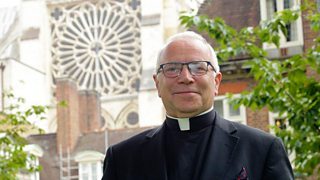
In the Queen, sovereignty is a reality in a life, says the Dean of Westminster.
The Tokyo Olympics – Stretching Every Sinew

Athletes' reflections on faith and competing in the Olympics.
"We do not lose heart."
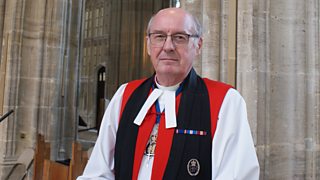
Marking the centenary of HRH Prince Philip's birth, a reflection from St George's Chapel.
St David's Big Life Hack
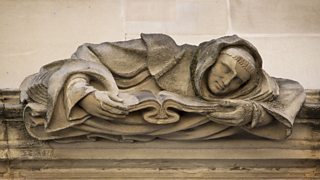
What do we know about St David, who told his monks to sweat the small stuff?
Two girls on a train
How a bystander's intervention helped stop a young woman from being trafficked.
Sunday Worship: Dr Rowan Williams
How our nation can rise to the huge challenges it faces, post-Covid-19.
