The amazing technology that helps us survive disasters
It can feel as if developments in technology are simply about allowing us to live our lives faster and solving “first world problems”. However, technology is making startling inroads into disaster relief. Here’s how cutting-edge technology can relieve the pressure after a natural disaster and provide lifesaving information to those on the ground.
Flying drones

Drones with the facility to film or deliver vital equipment can be a game changer, post-earthquake. Satellite images are often blocked because of the level of dust which is thrown up, but drones can get under the dust cloud and can provide almost roof-level imagery of what has happened where. They can also provide vital medicines to people whose access has been blocked.
Exoskeletons
“Lifesuits” are in development – mechanically-enhanced suits which will allow rescue responders to clear rubble and recover survivors in toxic or dangerous surroundings. The suit is currently being tested by firefighters in Seattle.
Landslide detectors
Researchers at the University of the Philippines are developing a landslide sensor and warning system. Tubes of around a metre long are stuffed with an accelerometer which detects movement in the earth. A moisture sensor gives feedback on any changes in the soil. These tubes are buried in boreholes on slopes which are seen as likely suspects for landslips. They can be powered through solar panels on the site if electricity is not available. Warnings are sent out to the relevant authorities, using mobile networks.

Floating internet connections
Google is working on Project Loon, in which internet connection devices are delivered to inaccessible places through a network of high altitude balloons.
Mesh networking
The brainchild of Australian computer systems researcher Dr Paul Gardner-Stephen, mesh networking allows mobile phones to communicate directly with each other even where there is no network coverage, or when mobile masts have been knocked out of action. Users can send text messages, make calls and send files to other users nearby, creating a mobile network through a web of users.
TERA
Tera stands for the Trilogy Emergency Relief Application (Tera), a mass text-messaging programme now being rolled out by the Red Cross in 40 countries around the world. Aid workers can send a mass text at the click of a button to all the mobiles in an area. It was invaluable following the Haiti earthquake, where information about clean water and medical supplies was delivered right across the country.
Portable telecoms tower
Open-source telecom towers have been developed which can be carried in the luggage compartment of an aircraft. It takes seven minutes to be set up wherever it’s needed, and parts for it can be created on a 3D printer in the field.
Crowd sourcing
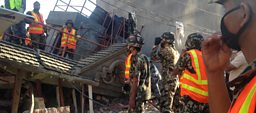
Volunteers with experience in social media, translation of local dialects and mapping are being trained by humanitarian organisations and kept on standby to lead mini-networks of information providers for when disasters occur. Social media, particularly Twitter, has an enormous reach when transmitting vital information, and that information can be disseminated swiftly and simply via trusted sources.
Technology means that aid is not just about dropping food parcels and leaving – it empowers citizens on the ground to make the best decisions possible based on information they would not be able to glean from anywhere else. So next time you’re frustrated with your satnav or irritated by social media, just remember that somewhere, this technology could be saving a life.
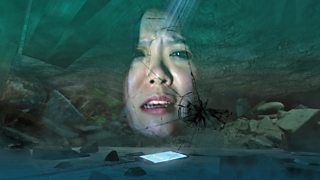
Listen to or watch Quake, a thrilling drama set during an earthquake and inspired by the remarkable but little-known world-wide revolution of digital humanitarianism.
Quake from BBC Radio 4
![]()
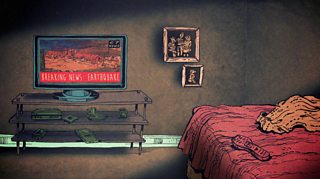
Quake: Trapped Man 2D
Experience the first part in a graphic-novel style animation.
![]()
Quake: Trapped Man 3D
An immersive, 360-degree, 3D film of the first part of the series.
![]()
Find out more about Quake
A drama inspired by the digital revolution in humanitarianism.
![]()
Download the podcast
12 interweaving short-form audio dramas to download.