'My Bed is like 'a crime scene' - 5 things we learnt about Dame Tracey Emin
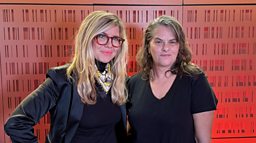
On podcast Ready to Talk, Emma Barnett digs deep into the lives of people she finds fascinating - and was genuinely thrilled to speak with artist Dame Tracey Emin.
“[Dame Tracey] has never shied away from making the unseen seen through her art,” says Emma, recalling her feelings of being moved by Emin’s works on pain – both physical and psychological.
In their powerful conversation on BBC Sounds, Dame Tracey speaks about art, life and the “hardcore” repercussions of her extensive cancer treatment. Here are some of the things we learned from that interview.
1. Installing ‘My Bed’ is a forensic operation
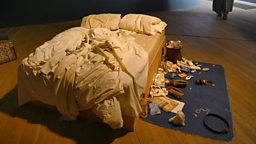
Emma was fascinated to know how Dame Tracey’s most famous work, ‘My Bed’ – and the “detritus” associated with it, was stored and installed in galleries.
“It’s like a crime scene – it is phenomenal"Dame Tracey Emin
Now almost 30 years old, the controversial piece is quite literally Emin’s bed – mattress, sheets and all - littered with discarded items on the floor, such as cigarette packets, condom packets and a pregnancy test.
“It’s like a crime scene – it is phenomenal,” Dame Tracey says, describing the boxes and “little bags with everything in it”.
“Two safety pins, an apple core… the bed travels and the sheets, everything – it’s all airtight!”
“The bed can only be shown about every five years and only for a certain amount of time, because of the fragility of everything… you don’t want the sheets going all bleached out.”
Bizarrely, Emin says she must wear a hazmat suit – usually used when handling toxic substances - to handle the artwork, even though it was her own creation.
“It’s protected and insured [by the Tate Modern], so even though it’s my bed, I don’t own the stuff. I own the idea, but it’s not literally my possession anymore.” she says.
Emma was surprised to learn that whilst the preserved apple core is the original, one unexpected item was swapped on “health and safety” grounds.
Dame Tracey explains: “The only thing that got changed over about 20 years ago was the Nurofen and headache pills because they were worried that they might be taken”.
2. My Bed changes character over time

For Dame Tracey, the bed has “its own life” and “character”, bringing a different feeling depending on when and where it is shown.
“Is any part of me left still remaining in that bed?"Dame Tracey Emin
Unveiled in 1998, the chaotic work freezes in time a particularly harrowing time in her life: when she was suicidal and had not eaten or drunk anything but alcohol for four days.
Emin says the bed took on an “angry” character in the Tate Liverpool, but for the Turner Gallery in Margate “it was rumpy-pumpy, it was sexy… a bed that lived.”
But with the latest Tate London installation, Emin - now 62 and having survived extensive and life changing cancer surgeries – felt “really sad” recreating the scene, heavy with memories.
“Last time I’d installed it, I was well, I was fit,” she says. “I hadn’t gone through all of what I’ve gone through. Emotionally, it would’ve pulled something through me.”
With the bed now instead representing a place “where someone nearly died”, it promoted her to begin questioning: “Who is this person?”
“Is any part of me left still remaining in that bed?” she asks. “My spirit, my soul? Where is the energy from the person who created it, the person who survived this bed, have they gone?”
“Maybe I felt remorseful as well,” she muses, “About the indulgence of how I lived, but… alcoholics don’t want to be alcoholics.”
3. Losing the pleasure of food was one of the hardest parts of cancer aftermath

“Not being able to eat the food I wanted… I felt like I was being really punished”Dame Tracey Emin
Emin was diagnosed with an aggressive form of bladder cancer in 2020, requiring extensive surgery with life-altering implications.
In a gruelling seven-and-a half hour operation, the artist’s bladder was removed, as was her urethra, uterus, lymph nodes, half of her vagina and part of her bowel to stop the spread of the disease.
Thankfully the surgery worked, and she is cancer-free, but adapting to life with a urostomy bag, which collects the urine, has been difficult.
“Someone said to me, ‘Oh, but you’re lucky that it was your bladder and you don’t need it. And I felt like, I said, ‘The next person who says that, I’m going to stick my hands inside their f****** stomach, pull their bladder out and slap it around their ears.”
“Not being able to urinate and to have a bag of piss attached to you for the rest of your life is hardcore,” she says.
“I don’t know why they design it like this, but the bag goes on your knee… so every time you walk or bend your knee, you can feel it, liquid… and it’s a horrible feeling.”
Emin also suffers from incontinence, due to the partial bowel removal and surgical scar tissue. To avoid needing an additional colostomy bag, she has had to change her relationship with food – a consequence which has been the hardest-hitting.
“I’m on a strict diet now and basically a lot of it is baby food and low fibre diet food that is easily digested and breaks down easily.”
“With the cancer, I just cried once – one tear went down my face, that was it. But with the not being able to eat the food I wanted to eat, that was really bad. That made me cry because I felt like I was being really punished."
“I don’t drink anymore, I’ve never taken drugs, hardly ever have sex... the one last thing we’ve got - food - it felt like I was being punished when the food was taken away.”
4. Her doctor told her ‘not to get a dog’ - because her cancer prognosis was so bad

Before surgery, Dame Tracey’s cancer outlook was so severe, at one point she was told she would be dead in a matter of months.
She decided to ask one of the surgeons an unusual question to determine the outlook of her situation.
“I said, ‘I want to get a King Charles Cavalier spaniel puppy, can I get one?’ And he went, ‘No, it’s not a good idea’.”
“And I said, ‘What about a rescue dog? A really old rescue dog?’ and he said, ‘No, no dog. You can’t get a dog.”
Emin asked again, “’Maybe just a dog that lasts for only a year or something?’ And it was like, no, the answer was no.”
“Basically the guy's going, you're not going to be around... So I knew the chance of me surviving by asking those questions was really slim.”
Luckily, the surgery saved her life. Whether Dame Emin has since adopted a four-legged friend was not revealed in the interview.
5. She believes galleries are feel-good places for everyone, not just art lovers

Earlier in Dame Tracey's life, although she was unreligious, she often went into churches to be moved by the feeling of being in a “hallowed space”.
“[Art] takes you somewhere. It’s like walking through nature, it’s like watching a river flow”Dame Tracey Emin
“It’s exactly the same with an art gallery,” she says. “You don’t have to know about art.”
“When you go into the… art gallery, you go in and you will feel very different when you come out. Something will just catch you, something will make you feel different.”
She continues: “You’ll be transfixed for ten seconds staring at something, getting lost in it – and it takes you somewhere. It’s like walking through nature, it’s like watching a river flow.”
“Art is one of the purely, purely amazing, good things that humankind makes and does and creates for no reason at all but for art itself, for its own sake. And if you can pick up on a tiny bit of that, it makes you feel really, really good.”
Emin adds that people should not feel the need to “read the panels” with lots of text, which is why her art has little written accompaniment.
“My show at the Tate [London], there’s very few panels,” she says. “There’s just the titles of the work… there’s no big explanations… you can just take what you want from it.”
“You don’t have to be bombarded with what other people have said or what other people think, you can make your own mind up looking at it. It’s yours to take, visually, emotionally, mentally.”
In the full discussion, Dame Tracey Emin talks about womanhood, growing up in poverty, her decision to have an abortion and why she believes she would have been treated as “a witch”, hundreds of years ago.
More from Ready to Talk with Emma Barnett
![]()
‘I was lucky I was hated in high school!’ - 5 Things We Learned About Katherine Ryan
Katherine opens up about the power of being disliked, making money, and her relationships with men.
![]()
‘I turned down Strictly’ – 5 things we learned from Chris McCausland’s interview with Emma Barnett
The Strictly champion talks about his career, fatherhood and dancing – and why letting go of perfectionism has been a “game changer”.
![]()
Subscribe now! Ready to Talk with Emma Barnett
Experiences that have reshaped lives. Bold questions, unexpected truths, lots of tea... Emma Barnett invites you into her world for deeply human conversations.