I fell 900ft to the ground - and survived
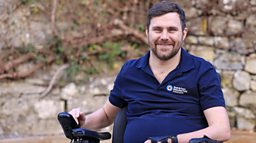
When parachute instructor Rob Bugden stepped towards the aircraft edge for a routine training jump, he had no idea that it would be the last time he ever walked.
A terrifying mid-air collision above the California desert sent him hurtling 900ft to the ground. Miraculously, he survived, but with life-changing injuries.
Speaking with Dr Sian Williams on BBC Radio 4's Life Changing, Rob explains how he is adapting to a new normal, inch by inch.
A parachute instructor 'terrified of heights'
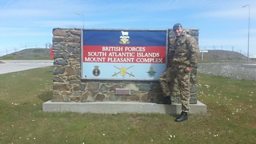
Growing up in a military family, it was no surprise when Rob Bugden decided to join the RAF.
“I think when you're scared of something, you should confront it"Rob Bugden
With three grandparents, his father and his brother all having served in various roles, he notes, "I guess it's the family business - it's just what we do".
Rob joined the RAF in 2008 and specialised as a parachute instructor – despite being terrified of heights.
“I think when you're scared of something, you should confront it,” he says.
“I wanted to work with the best and the best in my mind are the UK Special Forces… And because you're teaching them to jump out of planes, you also have to do it.”
“It is an incredible experience,” he adds. “At the end of the day, it was my job and I loved it.”
A horror mid-air collision
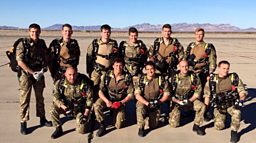
In early 2016, Rob completed his high-altitude parachuters course in California, learning how to jump out of an aircraft at 25,000 feet, falling at 175 miles an hour.
"I don't know this is going to be the last time that I'm going to walk"Rob Bugden
Whilst covering some basic skydiving high above the desert, the 30-year-old was about to take the last jump of the last day.
"As I walked down the aircraft at about 12,000 ft," he says, "I don't know this is going to be the last time that I'm going to walk.”
Rob linked together with the other parachutists and they leapt from the plane.
After uncoupling, the group came together in a stack - a formation which allows the team to land together.
He can recall the stunning bright blue Californian vista and the breeze on his face - feeling happy as the parachute opened successfully.
Then, at around 1,000 ft, Rob and his friend Brook Stebbins collided - knocking Rob unconscious.
"I think that's what breaks my neck,” says Rob. “Our canopies collapse and we fall about 900 ft, with not a lot above our head.”
Life-saving treatment
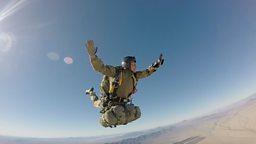
On the ground UK Special Forces, a Royal Navy doctor and several paramedics rushed to help the injured pair.
“I'm told if it had been 50ft one way, we would have landed on the runway"Rob Bugden
“They were there to stabilise us and give that initial life-saving treatment,” says Rob.
“The incredible training and incredible instincts kicked in, and if they hadn't have rushed over to us would I be alive? I don't know.”
“It sounds a weird thing to say, but there is a lot of good fortune about this day,” says Rob. “First, we land on sand.”
“I'm told if it had been 50 ft one way, we would have landed on the runway.”
Stebbins remained conscious and was able to push out a landing, but suffered broken bones and tore his kidneys.
“He remembers everything, whereas I don't,” says Rob. "I definitely think I've come off slightly better in that regard.”
'I couldn't move at all'
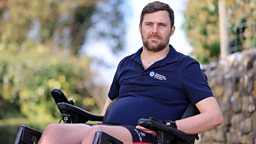
Rob woke up under a haze of painkillers in the hospital and noticed he "couldn't move at all."
"I know how my body works now, but it still surprises me"Rob Bugden
Upon realising that his divorced parents were in the room together - he knew it was serious.
“My injuries were quite substantial", he says. "Because of my spinal injury, I'm rendered tetraplegic - my legs don't work at all.”
Rob bruised his heart, which was beating dangerously low, requiring a pacemaker to bring it back up.
He had plastic surgery to repair a broken eye socket, and the spinal damage meant he had trouble regulating his body temperature, as well as other serious neurological impacts.
"[I have] the big three for anyone with a spinal injury: bladder, bowel and unfortunately sexual function," he says, "So, my ability to have children is compromised.”
Rob recalls his disbelief, "bursting into tears" as doctors, nurses and physios explained the ramifications of his injuries; the things he would never manage to do again.
“It's an ever-evolving thing, I'm still piecing it together," he says, "I know how my body works now, but it still surprises me.”
Trying to stay 'positive'
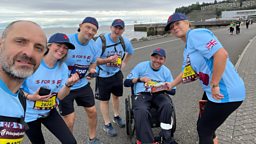
“I’ve tried to be positive. A lot of that is who I'm surrounded by – I have the most incredible group of family and friends. If ever I'm in trouble, I can phone them.”
"[My friends] were still going to take the mickey out of me, and that’s what I wanted"Rob Bugden
In hospital, his colleagues visited him every day.
“You know what the beauty of it was?" the veteran recalls: "Not once did they start talking about my injury or anything like that. It was exactly treating me as I've always been.”
“They were still going to take the mickey out of me, and that’s what I wanted.”
After four years of intensive rehabilitation, Rob left the RAF. It "still hurts," he admits, but he knew "it was coming".
“I love the Air Force. I loved my time in it. And anybody that listens, I will tell them all the good things.”
“Family's the best word for it. That's what it is. You're in it for life.”
A new normal
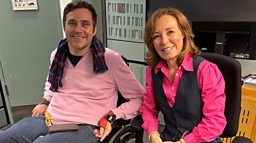
Over the decade since the accident, Rob has been adapting to a new normal, but still requires a lot of very personal care.
“I think I am still quite resistant to it,” he admits. “I don't like using the word accept… If you accept something, you stop wanting to strive to improve. And I still want to strive to improve.”
“Combing my hair, washing my face, brushing my teeth. All those little things that aid your independence. It comes back to being stubborn.”
The embarrassment caused by a sudden bladder or bowel accident will never go away, he admits.
He relishes feeding himself or taking a swig from a bottle. “Every time I go to the pub and have a beer with my mates, I try not to take it for granted and just enjoy the moment.”
He recently went to watch the rugby in Cardiff with his family.
“Most importantly of all, I'm still doing the things I always used to do; still doing the things I've always loved doing. That's a huge thing.”
Ten years on - a letter to my younger self
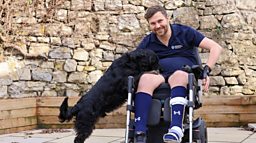
To mark ten years since the accident, the RAF Benevolent Fund (who Rob is an ambassador for) asked Rob if he would write a letter addressed to his younger self, as he lay in hospital in Arizona, unable to move, unable even to breathe for himself.
“Life's worth living... it doesn't matter in what capacity you're living it in"Rob Bugden
With his dog and “best friend” Denzel by his side, the words poured out of him:
“There are so many reasons for getting up every morning. Even the days when you still don't want to and you don't think you can go on.
I know I keep going on about them, but your family and friends get you through. And I'm so thankful for everything they do for you.
Then, of course, is your four-legged friend, Denzel, who doesn't care you're in a wheelchair or they need someone to hoist you to bed every night.
He just loves you for being you and because you take him to the beach. I'll leave by saying life's just a game of inches. So stay in the fight. And remember, you're never alone."
“Life's worth living," says Rob. "It doesn't matter in what capacity you're living it in. You're living it. And the way I live it is different to the way everybody else lives it. It's not wrong.”
You can listen to the full interview with Rob and other stories like it on Life Changing with Dr Sian Williams. Listen now on BBC Sounds.
More from Life Changing
![]()
I shook hands with the man who nearly killed me
Paul's amazing true story of restorative justice.
![]()
50 years after he died at sea, I finally knew my father
The true story of Angie, who found a transformative way to remember her father.
![]()
Smell of meat triggers my 'life-threatening' panics
Veteran Geoff was plagued by c-PTSD, but a unique partnership restored his independence.
![]()
‘I ran off with a biker at 49 – and it changed my life’
A split-second decision changed the course of backpacker Jacqui Furneaux's life.