Manchester airport at 80: History in five photos
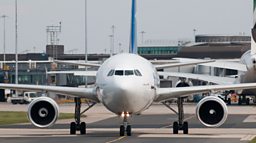
80 years ago Mancunians ushered in a new age of air travel with a purpose-built airport to the south of the city at Ringway.
Situated to the south of the city, 8,000 passengers took to the skies in its first year of operation.
Today the airport, still known to locals as Ringway, handles five times that number in a single day.
Here is a history of those first 80 years - in five photos.
1. The first passengers prepare for take-off
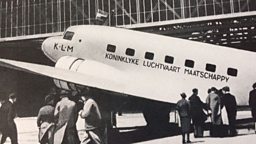
The first civil passenger flight, a KLM service to Amsterdam took off from Manchester on 27 June 1938.
Adorned with the airline’s full name, Royal Dutch Airlines - or Koninklijke Luchtvaart Maatschappij (oddly misspelled in this photo of the day) - the 14-seat plane was a twin-engined Douglas DC-2.
The Amsterdam service, with an optional request-stop in Doncaster, was the airport’s only scheduled international route in the 15 months till war broke out, in September 1939.
Despite being the first official flight, the DC-2 wasn’t the first plane to land at Ringway. That honour went to a de Havilland Hornet Moth, flown by Duncan Menzies, who became lost in fog on his way to Barton Aerodrome and touched down at the then incomplete airfield on 17 May 1937, nine miles off course.
2. "Arrive at least 15 minutes before"
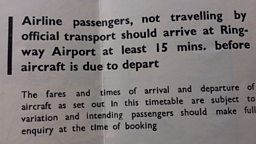
With security never tighter at UK airports it’s hard to remember that air travel was a far more relaxed affair when Manchester Airport, or Ringway as it was known, first opened its doors to civil aviation in 1938.
To mark the occasion, Manchester City Council prepared this snappily titled pamphlet, Particulars of regular Air Transport Services operating to and from Ringway Airport.
Among the sage advice for travellers was the instruction that passengers should arrive at the airport at least 15 minutes before their flight’s departure.
The airport still gives departure advice on its website. Currently it suggests passengers be checked in and ready to go through security at least two hours before their flight.
3. "Home again" for George Best
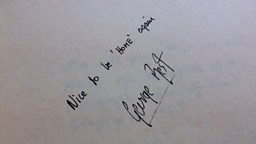
It may be George Best Belfast City airport which bears his name but, as this memento shows, it was Manchester Airport that became 'home' for the United legend.
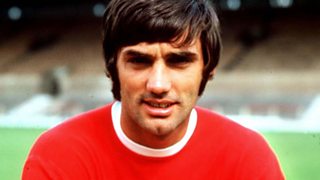
In 1966, 2,000 United fans departed the airport on 16 specially chartered planes after Best’s performance in the previous round set up a European Cup Semi-Final with Real Madrid.
In the days before budget airlines it was the biggest single exodus Ringway had ever dealt with. Victory eluded the team that season but Best had well and truly announced his arrival on the world stage.
Six years and a 1968 European Cup medal later, another departure marked the beginning of the end for Best at Old Trafford. Disappearing mid-season, he headed to the airport and took the first flight he fancied - to Marbella.
He was coaxed back from the beach but his days as a United player were numbered.
Best’s connection to the airport was complete following his death in 2005 when Flybe named a plane after the player for its Belfast to Manchester route.
4. When tickets were hand-written
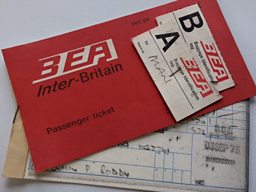
Before BA there was BEA (British European Airways), which ran domestic flights from Manchester.
This hand-written ticket is from last full year of operation before it merged with BOAC to create BA in 1974.
The company was also involved in one of Manchester's worst tragedies in March 1957, when BEA flight 411 crashed on approach to the airport after a flight from Amsterdam.
The plane smashed into a house in nearby Wythenshawe, killing 15 passengers and five crew members on board, as well as two people who lived in the house.
Tragically, they were the wife and baby son of a man who had campaigned about the dangers of low-flying aircraft.
5. Two very different Royal visits
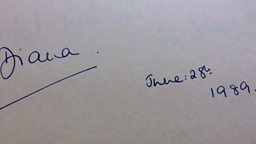
Princess Diana visited twice in the 1980s under very different circumstances.
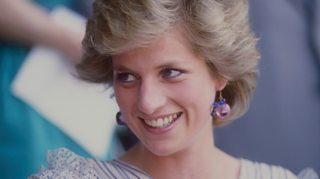
In 1985 she met the firefighters who had tackled a blaze on board British Airtours flight 737 as it was about to take off for Corfu.
Fifty-five people died, most from smoke inhalation.
One of those on board, John Beardmore, later described to the BBC how a "curtain of black toxic fumes" swept through the fuselage.
He and his family were among the 82 people who escaped the fire.
As a result of the disaster, many aspects of aviation fire evacuation procedures have changed.
Diana returned to Manchester for happier reasons in 1989 when she opened Terminal A, which is now part of Terminal 3.