Who were the Vikings really? Here are 8 facts you might not know
Say the word “Viking” today and it conjures images from countless films, TV shows, video games and comic books. One of pillage and savagery, a cliched world of horned helmets and blood eagles; of hirsute heathens enthralled to gods and monsters; the Hell's Angels of the high seas.
But this only tells part of a bigger story - of a people who were so much more than the fur-clad thugs of popular imagination. In fact, the Vikings hailed from a sophisticated and developed civilisation.
In Real Vikings - the new weekly podcast from Noiser, hosted by Iain Glen (Game of Thrones, Resident Evil, Downton Abbey) - you can dive deep into the Viking age on BBC Sounds... boarding longboats bound for new lands, following might warlords like Eric Bloodaxe and Olga of Kyiv and uncovering the real figures behind the legends of the sagas.
The Vikings terrified the medieval world, yet they beguile us today. Who were they really? Here are 8 things we learned from episode one of Real Vikings.
1. The first recorded Anglo Saxon to battle with Vikings was called Beaduheard.
The year is 789 AD. It's market day in the town of Dorchester, as it's known today, in England's southwest. When the local reeve, Beaduheard, overhears a group of men talking about some foreigners trading furs over the side of their boats, he rides to the Isle of Portland, down on the coast, about 30 miles to the south. He is met by a group of formidable strangers.

“You can't trade that here,” Beaduheard shouts, explaining that they will have to pass through a king's port in order to pay the correct taxes. The foreigners are unmoved by his words, if they even understand them. One of them reaches for a long-handled battle axe, and Beaduheard and his men are murdered in cold blood.
2. Not all Scandinavians in the Viking age were ‘Vikings’.
In one form, the word “Viking” comes from Old Norse and is contemporary with the Viking age itself. As historian Eleanor Barraclough puts it: “There's a version of the word Viking, ‘vikingr’, which is essentially a raider or a pirate. There's also a related form of that word, which is essentially ‘to go on a Viking’, ‘to go on a raid’.” Another suggestion is that it's related to the Old Norse word for a bay, “vik”: so a Viking is someone who comes from a bay. There's also a region in Norway called “Viken” - so perhaps the original Vikings came from there. Whatever the origin, its meaning soon broadens out.
“Not all Scandinavians of the Viking Age would have been, or considered themselves to have been, Vikings,” says Davide Zori, Associate Professor of History and Archaeology at Baylor University. “Only once you get on a boat and try to pirate stuff would you become a Viking.”
In the beginning, “going a-Viking” is something you do to supplement your regular income, an 8th century side hustle. “And that's how it started,” says Davide. “With people going seasonally abroad to opportunistically engage in some kind of wealth production that could be trade or it could be raiding.”
3. Vikings didn’t just raid foreigners - they fought each other, too.
As the 8th century drew to a close, the modern nations of Denmark, Sweden and Norway, were yet to come into being. Power was concentrated in the hands of chieftains and warlords and based on close bonds of allegiance. It was a shifting, unstable political picture.
Dominance came through wealth - silver - which was used to buy the loyalty of supporters. As Davide says: “The drive of the sort of alpha-type chieftain to control and to sustain power is one of the motors, the engines of the Viking age that pushed them beyond their own shores as they tried to accumulate more wealth to reinvest in the political economy and generate bonds of loyalty with their supporters.”
4. Religion was another strong motive for the Vikings’ adventures.
Religion played a key role in convincing men to follow charismatic leaders on long voyages to unknown lands. Unlike much of Europe, Scandinavia was still pagan. As Historian Stefan Brink says: “The pre-Christian religion in Scandinavia was polytheistic, with many gods and goddesses, minor deities living with the people, in the barn, in hills, in a landscape charged with sacrality and with a mythology we today find fascinating.”
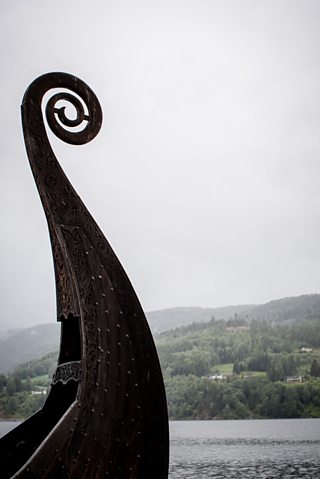
For a Viking warrior, death was something to be welcomed, not feared. To die with your sword in your hand ensured immortality, allowing you to enjoy a glorious afterlife in Valhalla, the Hall of the Fallen.
“That belief gives rise to a culture of warfare, a sense of fearlessness, of invincibility even, underpinned by a code of valor,” says Stefan. “I think that it's important to consider the ideological motivation. I think that the fatalism and the push towards honor generating stories about your accomplishments was a high motivator.”
5. The Vikings were polygamists.
Alongside religion and mythology, there may be more practical considerations at play in pushing the Vikings out from Scandinavia.
“It's also been suggested that there might be something of a gender imbalance,” says Eleanor Barraclough. “So essentially there are fewer women for the men to marry and settle down with and kind of build up a farmstead and raise a family.”
The Vikings' practice of polygamy didn’t help, with the most powerful men taking multiple wives. It provided an incentive for lesser males to venture abroad in search of foreign brides, or come back home with wealth they can use to compete for the hand of a local girl.
6. The Vikings specialised in one particularly lucrative form of commerce.
“In the 9th century, the slave trade with the Muslim world exploded on the continent,” says Pragya Vora, a lecturer in medieval history at the University of York. “Slavery became very important for the Scandinavians in the Viking age. Slaves became the major trading commodity for the Scandinavians. And slavery, I believe, in a way came to characterise the Viking period at that time.”
In fact, so rife was slavery that it formed part of a three-tiered Viking society. At the top there was the chieftain, or jarl, from which we get our word earl. Below him came the freemen, or carls, and right at the bottom sit the slaves, or thralls - the origin of another English expression, to be enthrall to someone.
7. Compared to other civilisations, the Vikings were illiterate.
It is partly their notoriety as slavers that accounts for the Vikings' enduring reputation for violence. But it also has a lot to do with the sources we're using. Historian Elizabeth Rowe explains: “Nearly all of the contemporary accounts that we have for the Scandinavians in Western Europe are from the point of view of the victims of Viking raids and attacks. A byproduct of the Vikings' paganism is that when held up against Christendom, they are comparatively illiterate. No Bible, no libraries, no monastic scholars to record events.”
The closest thing the Vikings had to a written language was carved in a crude, stick-like alphabet we know as runes, with each of its 24 characters corresponding to a vocal sound. It was a functional means of notification, rather than a means of archive or record. As a result, the history of the Vikings in this early period is that their story is told by their victims.
8. When exactly the Viking age began is disputed.
The Anglo Saxon Chronicle pinpoints the 8th century as the time when Viking raids kick off. This is the traditional narrative: that the Viking Age begins in the late 700s. But we know that there were Northmen trading in England for at least a century before this.
Recently analysed DNA evidence suggests that people with Scandinavian heritage may have been present in Britain even earlier than that. Nordic remains found in the city of York have been dated to as far back as between the 2nd and 4th centuries AD, well before the wide-scale Anglo-Saxon settlement.
To find out more, listen to Real Vikings on BBC Sounds.
More on BBC Sounds
![]()
Titanic: Ship of Dreams
Explore life and death on the most infamous ship in history.
![]()
Real Narcos
Follow the real DEA agents who brought down history's most notorious criminal masterminds.
![]()
Sherlock Holmes Short Stories
Listen to Sherlock Holmes Short Stories, narrated by Hugh Bonneville.
![]()
Short History Of...
Witness history's most incredible moments and remarkable people.